Advanced Data Analytics and Financial Fraud Prevention
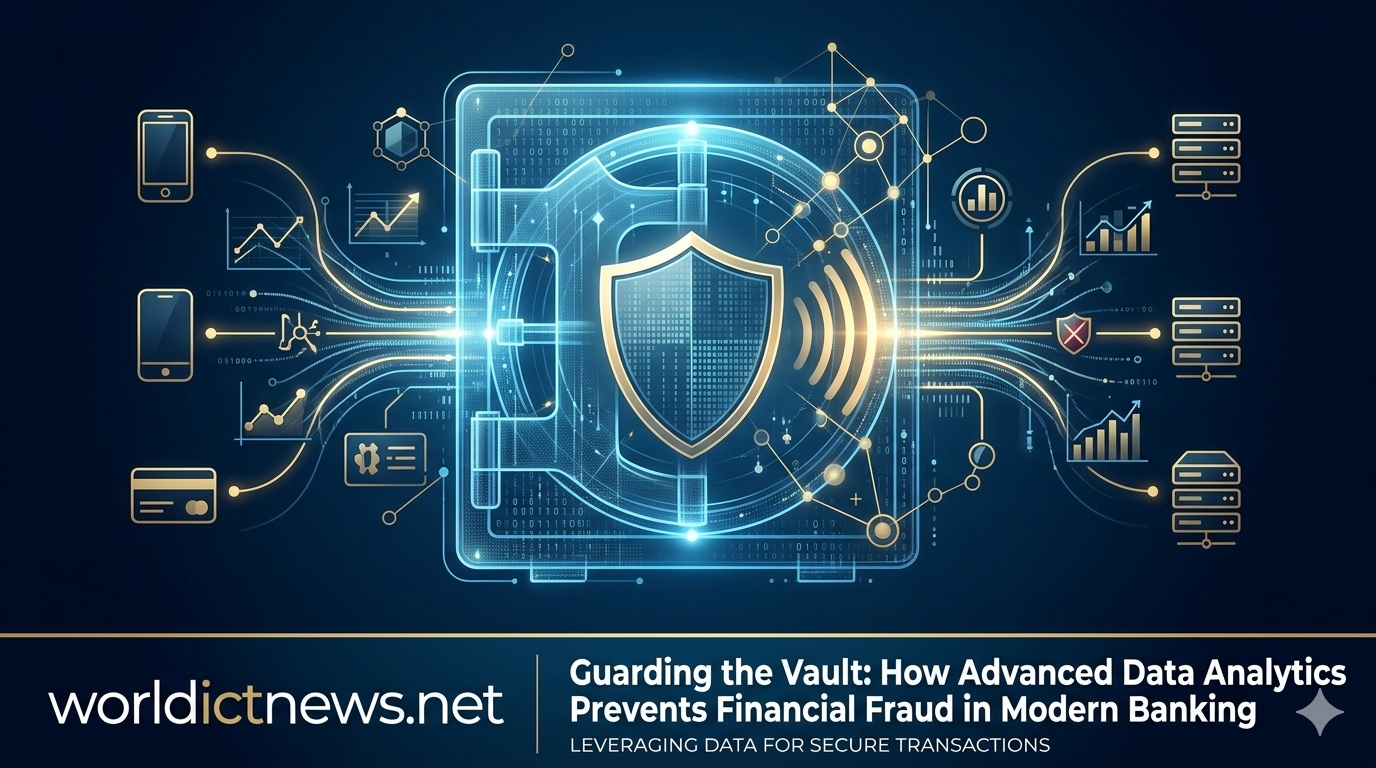
How Advanced Data Analytics Prevents Financial Fraud in Modern Banking.
The global banking ecosystem is undergoing an unprecedented digital transformation. As institutions shift from legacy physical branches to cloud-native mobile applications, instant payment rails, and decentralized financial architectures, the speed of commerce has accelerated exponentially. Today, billions of dollars cross international borders in milliseconds. However, this friction-less digital experience has introduced an equally sophisticated, hyper-connected threat matrix: automated, distributed financial fraud.
Traditional, rules-based fraud detection systems—built on static, "if-then" logic structures—are no longer capable of keeping pace with modern criminal syndicates. These legacy tools are inherently reactive, flagging anomalies only after a vulnerability has been exploited. To shield institutional capital and maintain consumer trust, the financial sector must pivot toward proactive, predictive intelligence.
Data analytics, driven by machine learning pipelines, real-time streaming architectures, and behavioral telemetry, has emerged as the foundational pillar of modern banking defense. By processing petabytes of transactional, behavioral, and contextual data simultaneously, financial institutions can identify, isolate, and neutralize fraudulent activities in mid-air before a single cent leaves the network.
1. The Anatomy of Modern Financial Fraud
To appreciate the disruptive impact of data analytics, one must first analyze the highly technical nature of modern banking fraud. Cybercriminals leverage automated infrastructure, residential proxy networks, and generative artificial intelligence to mimic legitimate consumer profiles.
Synthetic Identity Theft
Synthetic identity fraud is one of the fastest-growing financial crimes globally. Instead of stealing a real person's complete identity, malicious actors harvest fragments of real credit data (such as stolen Social Security Numbers or national identity tokens) and combine them with completely fabricated personal details (false names, synthetic addresses, and newly registered burner phone numbers). Over several months, these synthetic profiles apply for minor lines of credit, build positive repayment histories, and suddenly "spin out"—maxing out major institutional loans and vanishing without a trace.
Account Takeover (ATO) Attacks
Account Takeovers occur when unauthorized entities gain complete administrative control of a legitimate customer’s banking profile. These breaches are rarely executed via simple manual password guessing. Instead, malicious actors deploy automated credential-stuffing botnets across cloud infrastructure, testing millions of leaked username and password combinations across banking login portals within minutes. Once inside, they rapidly alter contact phone numbers, disable multi-factor authentication (MFA) parameters, and drain liquid assets via untraceable peer-to-peer wire transfers.
Authorized Push Payment (APP) Scams
Unlike direct hacks, APP scams exploit human psychology. Attackers use sophisticated social engineering, business email compromise (BEC) frameworks, or deepfake audio to convince legitimate users, business accountants, or corporate treasurers to willingly authorize high-value wire transfers to shell corporate accounts. Because the actual transaction is initiated by an authorized user using their correct security tokens, legacy fraud systems see the payment as entirely legitimate.
2. The Core Analytics Framework: Transitioning from Rules to Prediction
Legacy banking applications protect accounts using static rulesets, such as: "If a transaction exceeds $10,000 and occurs outside the home country, flag for manual review."
While straightforward, this approach exhibits two catastrophic flaws:
Massive False Positive Rates: Legitimate travelers making normal purchases are locked out of their accounts, destroying the user experience.
Susceptibility to Reverse Engineering: Professional fraudsters rapidly test transaction amounts (e.g., executing charges of $9,995 instead of $10,000) to map out and bypass a bank's defensive limits.
Advanced data analytics solves this by replacing binary rules with multi-dimensional, continuous risk scoring.
[ Incoming Transaction ]
│
├──> Behavioral Telemetry Analytics ───┐
├──> Graph Theory Network Mapping ──────┼─> [ Machine Learning Engine ] ─> [ Continuous Risk Score ]
└──> Device Fingerprint Analytics ─────┘ │
├──> Score < 30 : Approve Automatically
├──> Score 30-70 : Trigger Adaptive MFA
└──> Score > 70 : Instant Freeze & Decline
3. Key Analytic Techniques Driving Fraud Prevention
To build a comprehensive, multi-layered fraud prevention stack, banks run three primary data analytics workflows simultaneously across their core processing engines.
1. Behavioral Biometrics and User Telemetry
Every human interacts with digital devices in a highly distinct, idiosyncratic manner. Behavioral analytics models ingest unstructured telemetry data directly from mobile apps and web frontends to build an invisible, continuous biometric profile for each client.
Keystroke Dynamics: Analyzing the exact millisecond dwell time (how long a key is held down) and flight time (the gap between keys) during a login attempt.
Touchscreen Pressures & Angles: Measuring how firmly a user presses their smartphone screen and the precise angle at which they hold the device.
Mouse Trajectory Vectoring: Track real-time cursor paths. Real humans move mice in erratic, curved vectors with natural micro-pauses; automated botnets move in perfect, computationally optimal straight lines.
If an account logs in with the correct password and passes MFA, but the typing speed and finger pressure vectors match a known botnet signature or a distinct profile, the system instantly triggers an out-of-band identity verification step.
2. Graph Database Analytics and Network Topology
Fraudsters rarely operate in complete isolation; they rely on interconnected webs of mule accounts, shell companies, and shared digital infrastructure to launder stolen funds. Traditional relational databases (SQL) struggle to track these relationships because mapping deep links across billions of columns requires complex, computationally expensive table joins.
Graph analytics utilizes specialized graph databases (such as Neo4j or Amazon Neptune) to treat data as nodes (entities like accounts, names, or devices) and edges (the relationships between them).
[ Stolen Device ID ] ──(Shared Link)──> [ Fraudulent Account A ]
│
(Rapid Transfer)
▼
[ Mule Account B ]
│
(Rapid Transfer)
▼
[ Shell Company C ]
By visualizing the banking network as an interconnected topology, graph analytics can detect Fraud Rings instantly. If the system observes ten separate bank accounts opened by completely different individuals, but notes that all ten profiles share a single, hidden variable—such as a matching hardware MAC address or an identical employer tax ID—the graph network flags the entire cluster as a synthetic identity setup before a single credit line can be drawn.
3. Real-Time Streaming Analytics and Event Processing
Fraud occurs at machine speed; therefore, remediation must occur at machine speed. Modern banking architectures utilize streaming data platforms like Apache Kafka or Amazon Kinesis to intercept transaction payloads in transit.
As a payment request is initiated, the streaming engine matches the event against historical baseline data within a tight 200-millisecond window. The model runs predictive algorithms evaluating historical location drift, spending velocities, merchant categorization codes, and device health. If the transaction deviates significantly from the user's localized spatial-temporal habits, the pipeline changes the transaction state to "Pending Verification," freezing the assets safely before the outbound wire clears the clearinghouse.
4. The Engineering Blueprint: Implementing AI/ML Fraud Pipelines
Building an enterprise-grade analytics engine requires an integrated data engineering pipeline that can handle both massive batch training and ultra-fast real-time scoring.
Architecture Tier | Technological Tooling | Primary Operational Role |
|---|---|---|
Data Ingestion | Apache Kafka, AWS Kinesis | Captures clickstream logs, device telemetry, and raw financial transactions concurrently. |
Storage & Feature Store | Snowflake, Databricks, Feast | Houses historical raw logs and processes calculated features (e.g., 24-hour rolling transfer velocity). |
Model Processing Engine | Apache Spark, PyTorch, XGBoost | Executes complex machine learning inferences and predictive classification modeling within milliseconds. |
Orchestration Layer | Apache Airflow, Kubeflow | Automates the continuous retraining, validation, and deployment of updated ML models. |
Feature Engineering: The Secret to High Accuracy
The predictive accuracy of any AI model rests entirely on the quality of its features. In a financial context, feature engineering takes raw transaction points and translates them into meaningful metrics. For example, instead of passing a raw transaction amount ($500) to an algorithm, data scientists engineer dynamic variables such as:
ratio_ of _current_ amount_ to_ historical_ average _30d
velocity _of_ transactions_ in_ last _60_ minutes
distance_ between_ physical_ merchant_ and_ last_ atm_ withdrawal
By providing the machine learning model with highly descriptive, contextual variables, the algorithm can accurately separate an unusual but completely legitimate holiday shopping spree from an actual, active account draining operation.
5. Overcoming Ethical and Operational Obstacles
While data analytics offers immense power, banking institutions must navigate critical regulatory, privacy, and infrastructure challenges when deploying these systems at scale.
Managing False Positives
Locking an active card or freezing a business payroll account due to an incorrect fraud algorithm causes immense customer frustration and reputational damage. Banks must implement Explainable AI (XAI) frameworks. If a model flags a transaction as fraudulent, it cannot simply output a black-box answer. It must provide clear, auditable reasons (e.g., "Flagged due to a 400% deviation in typical transaction value combined with an unverified browser footprint"). This allows customer support teams to resolve issues transparently and efficiently.
Regulatory Compliance and Data Privacy
Financial analytics operates under strict global compliance mandates, including the General Data Protection Regulation (GDPR), Payment Card Industry Data Security Standard (PCI-DSS), and Know Your Customer (KYC) mandates. Banks cannot blindly store unencrypted consumer data in public cloud environments for analytics modeling. Data engineering teams must implement advanced anonymization, tokenization, and differential privacy methodologies, ensuring that models learn transactional patterns without ever exposing the sensitive, personally identifiable information (PII) of individual consumers.
Conclusion: The Future of Autonomous Financial Defense
Data analytics has completely shifted the power dynamics of global risk management. Financial fraud is no longer an unavoidable operational cost of doing business online; it is an engineered problem that can be actively managed, contained, and neutralized through continuous data intelligence.
As cybercriminals continue to integrate sophisticated artificial intelligence into their offensive arsenals, the banking sector's defensive architectures must evolve in parallel. The institutions that thrive in this digital-first era will be those that view data analytics not merely as an IT support tool, but as a core, strategic shield—an autonomous, self-learning ecosystem capable of protecting global capital, preserving system integrity, and maintaining human trust at machine speed.
Did you find this ICT insight helpful?