Sustainable ICT (Green Tech) in Nigeria in 2026
Sustainable ICT (Green Tech) in Nigeria in 2026.
In 2026, Sustainable ICT (Green Tech) in Nigeria is defined by a massive shift toward solar-hybrid energy for telecommunications and the emergence of a formal circular economy for e-waste. As the nation grapples with high energy costs and the environmental impact of its rapid digital expansion, the "Green Tech" movement has transitioned from a niche environmental concern to a core economic strategy for resilience and cost-saving.
1. The Energy Pivot: From Diesel to Sunlight
For decades, the biggest hurdle for Nigerian ICT was the "diesel tax." In 2024, it was estimated that telcos spent billions of Naira monthly on fuel to power over 50,000 base stations. By 2026, the narrative has changed.
Solar-Hybrid Base Stations
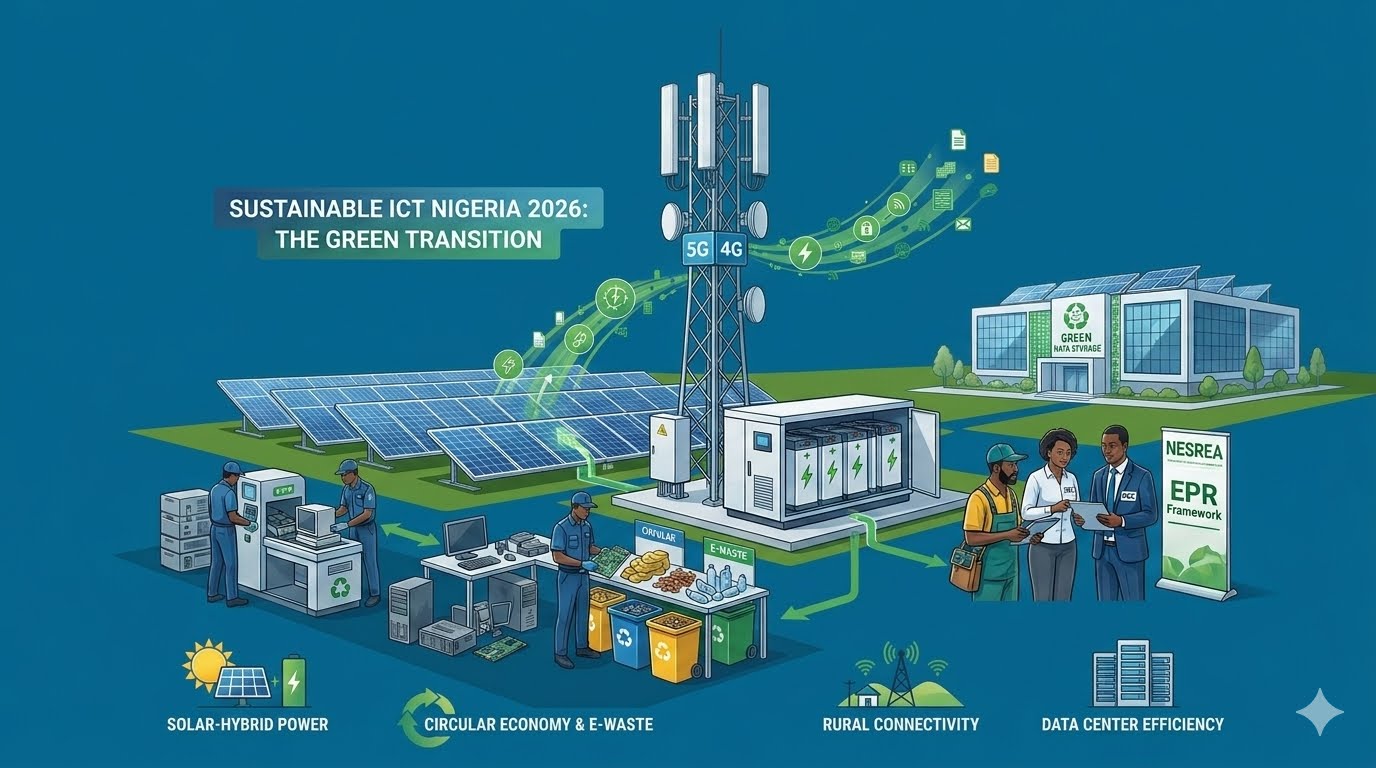
Nigeria has become a global leader in Solar-Hybrid Site Management. Most new 5G and 4G towers across the country now feature integrated lithium-ion storage and high-efficiency solar arrays. These sites use AI-driven power management systems that prioritize solar during the day, store excess in batteries, and only trigger backup generators during prolonged cloudy periods.
Impact: This has reduced the operational carbon footprint of major telcos like MTN and Airtel by over 40%.
Economic Win: By decoupling from volatile fuel prices, these companies have managed to stabilize data costs for consumers despite inflation.
Green Data Centers
Nigeria is now a West African hub for data residency, but tropical heat makes cooling data centers energy-intensive. In 2026, new facilities in Lagos and Abuja are utilizing Free Air Cooling and Liquid Cooling technologies specifically designed for high-ambient temperatures. These centers are often powered by dedicated "Renewable Energy Independent Power Producers" (RE-IPPs), ensuring that the growth of Nigeria’s "Sovereign Cloud" doesn't break the national grid.
2. The E-waste Goldmine: Circular Economy in Lagos
Nigeria was once a dumping ground for the world's electronic waste. In 2026, the country has flipped the script, turning E-waste Management into a multi-million dollar recycling industry.
Formalized Recycling Hubs
The informal recycling sector in areas like Alaba International Market has been integrated into a formalized "Circular Economy" framework. Backed by the National Environmental Standards and Regulations Enforcement Agency (NESREA), new high-tech processing plants in Ogun and Lagos states now extract precious metals—gold, copper, and palladium—from old smartphones and laptops.
Urban Mining: Nigeria is now exporting high-purity recycled metals back to global manufacturers, proving that "Urban Mining" is more sustainable and profitable than traditional mining in some regions.
Second-Life Batteries: Old EV and laptop batteries are being refurbished into "Second-Life" power banks for small businesses, providing affordable backup power for vendors across the country.
3. Policy and the "Green Naira"
The Nigerian government’s Energy Transition Plan (ETP) has placed ICT at its center. In 2026, "Green ICT" incentives are driving the market:
"The goal is simple: Every byte of data processed in Nigeria by 2030 should be powered by at least 70% renewable energy." — Federal Ministry of Communications, Innovation & Digital Economy, 2026 Outlook.
Carbon Credits for Tech
Nigerian tech startups are now participating in the Global Carbon Credit Market. By demonstrating a reduction in carbon emissions through remote work software, smart building IoT, or green hosting, these startups earn credits that can be sold to international corporations, providing a new stream of "Green Foreign Investment."
4. The Role of Smart Agriculture (Agri-Tech)
Sustainable ICT isn't just about the hardware; it’s about using technology to make other sectors green. In Nigeria, AI-driven Precision Agriculture is the standout success.
Low-power LoRaWAN sensors (Long Range Wide Area Network) are being deployed in the Middle Belt to monitor soil moisture and nutrient levels. This allows farmers to use 30% less water and 50% less fertilizer, reducing the chemical runoff that damages Nigerian waterways. This "Tech-enabled Sustainability" is ensuring food security while protecting the land.
5. Challenges on the Horizon
Despite the progress, 2026 faces significant "Green Gaps":
Initial Capital Expenditure (CAPEX): While solar saves money in the long run, the upfront cost remains high for Small and Medium Enterprises (SMEs).
Skills Gap: There is a shortage of certified "Green ICT" engineers capable of maintaining advanced cooling systems and lithium-storage arrays.
Battery Disposal: While lithium-ion is "cleaner" than lead-acid, the long-term environmental impact of battery disposal is a looming challenge that Nigeria is only beginning to address.
6. The Digital-Green Synergy
In 2026, the Nigerian tech ecosystem has realized that Digitalization and Decarbonization are two sides of the same coin. The "Green Tech" movement is no longer viewed as an expensive Western import but as a local necessity.
The rise of Sustainable ICT has made Nigeria’s digital economy more resilient. When the global fuel supply chain falters, Nigeria’s solar-powered internet stays on. When the price of raw materials rises, Nigeria’s recycled e-waste provides a local supply.
Conclusion
Nigeria's ICT sector in 2026 is a testament to the power of "Leapfrogging." By skipping the era of heavy fossil-fuel-dependent infrastructure and moving straight to solar-hybrid and circular models, Nigeria is setting the blueprint for how a developing nation can grow its digital economy without sacrificing its environment. The "Green Naira" is here to stay, and it is powering the most connected version of Nigeria yet.
Did you find this ICT insight helpful?