Wi-Fi 7 vs. 5G: The Future of Industrial Connectivity
Wi-Fi 7 vs. 5G: The Future of Industrial Connectivity.
The industrial world is at a connectivity crossroads. As "Industry 4.0" matures into its next phase, the debate is no longer about whether to go wireless, but which wireless standard will form the backbone of the "Smart Factory" of 2026. In one corner, we have Wi-Fi 7 (802.11be), the latest evolution of the world’s most ubiquitous local area network. In the other, 5G (specifically Private 5G), the cellular powerhouse designed for mission-critical mobility.
For the first time, these two technologies are overlapping in their capabilities. Wi-Fi 7 has gained the low-latency features it previously lacked, while 5G has become more accessible through localized private deployments. Choosing between them is no longer a matter of "good vs. bad," but a strategic decision based on the specific operational requirements of the industrial floor.
Wi-Fi 7: The "Extreme High Throughput" Powerhouse
Wi-Fi 7, dubbed Extremely High Throughput (EHT), represents a quantum leap for indoor industrial networking. Unlike its predecessors, which were often plagued by interference and jitter, Wi-Fi 7 was built with the factory floor in mind.
Key Industrial Advantages of Wi-Fi 7
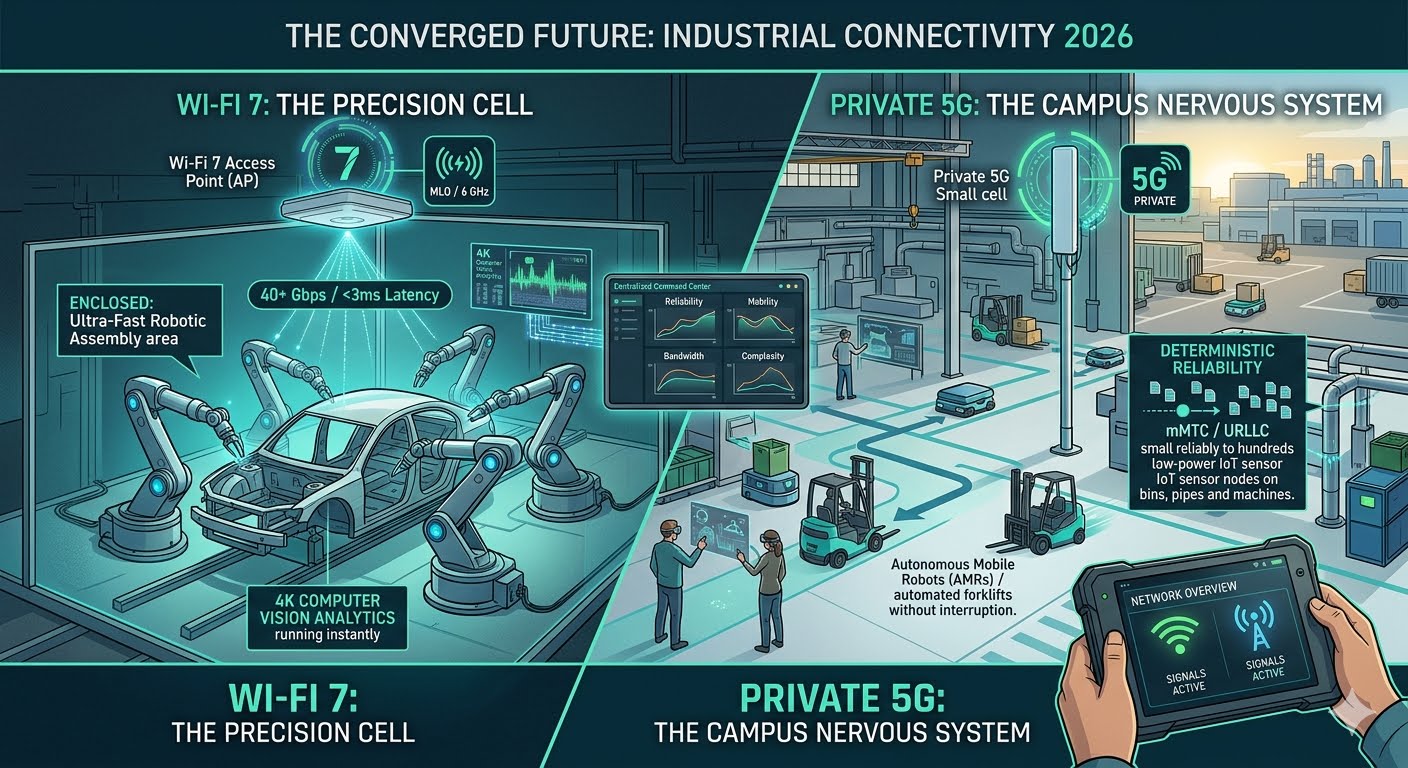
Massive Bandwidth (320 MHz Channels): Wi-Fi 7 doubles the channel width of Wi-Fi 6, enabling peak speeds of over 40 Gbps. This is critical for high-definition computer vision systems used in quality control and real-time 4K digital twins.
Multi-Link Operation (MLO): This is the "game changer." Traditionally, Wi-Fi connected over a single band (2.4, 5, or 6 GHz). MLO allows a device to send and receive data across multiple bands simultaneously. If one band suffers from interference (common in environments with heavy machinery), the data instantly shifts to another without dropping a packet. This brings Wi-Fi's reliability closer to a wired connection than ever before.
Ultra-Low Latency: By utilizing the interference-free 6 GHz spectrum and advanced scheduling, Wi-Fi 7 can achieve sub-5 millisecond latency, making it viable for high-speed robotics and motion control.
5G: The King of Mobility and Mission-Critical Scale
While Wi-Fi 7 dominates the high-speed local "bubble," Private 5G is the undisputed champion of the wide-area industrial campus. 5G was designed from the ground up for massive machine-type communication (mMTC) and ultra-reliable low-latency communication (URLLC).
Key Industrial Advantages of 5G
Deterministic Reliability: 5G operates on licensed or semi-licensed spectrum, meaning there is zero chance of interference from a neighboring office's Wi-Fi. In 5G, the network controls exactly when each device speaks, ensuring that a critical emergency stop signal is never delayed by a "collision" with a non-critical data packet.
Seamless Mobility (Handover): 5G excels at handling devices moving at high speeds across vast distances. For Autonomous Mobile Robots (AMRs) or automated forklifts navigating a million-square-foot warehouse, 5G provides perfect handovers between base stations. Wi-Fi, even with modern roaming standards, often experiences "micro-drops" during these transitions.
Device Density: A single 5G cell can support up to 1 million devices per square kilometer. This makes it the only choice for "Massive IoT" deployments where every bin, sensor, and tool in a factory is connected.
The Comparison: Head-to-Head in 2026
Feature | Wi-Fi 7 (802.11be) | Private 5G (Rel. 16/17) |
|---|---|---|
Peak Speed | Higher (up to 46 Gbps) | Lower (up to 20 Gbps) |
Indoor/Outdoor | Optimized for Indoor | Indoor and Vast Outdoor |
Deployment Cost | Lower (standard IT gear) | Higher (specialized Core/RAN) |
Complexity | Simple (plug-and-play) | High (requires cellular expertise) |
Battery Life | Improved (TWT) | Superior for small IoT sensors |
Interference | Potential (unlicensed spectrum) | Zero (licensed/private spectrum) |
The Rise of the "Converged" Industrial Network
In 2026, the most successful industrial leaders are realizing that Wi-Fi 7 vs. 5G is a false dichotomy. The future is not one or the other, but a coordinated coexistence.
The Wi-Fi 7 Use Case: The "Precision Cell"
Imagine a robotic assembly cell where six arms work in perfect synchronization on a chassis. The arms require massive data throughput for 3D vision and ultra-low latency for coordination. This cell is a perfect fit for Wi-Fi 7. It’s cheap to deploy locally, offers incredible speed, and handles the static high-data load perfectly.
The 5G Use Case: The "Nervous System"
Now imagine the AGVs that bring parts to that cell and the thousands of environmental sensors monitoring temperature, humidity, and vibration across the whole plant. These devices are mobile or low-power and spread over a vast area. This is the Private 5G domain. It provides the "always-on" connectivity that keeps the entire ecosystem breathing.
Challenges for the Road Ahead
Both technologies face hurdles. For Wi-Fi 7, the challenge is the availability of the 6 GHz spectrum globally. While many countries have opened it up, some still restrict its use, which cripples Wi-Fi 7’s potential.
For 5G, the challenge is accessibility. Until recently, only massive telcos could run 5G. While "Private 5G-in-a-box" solutions are appearing, they still require a level of cellular networking knowledge that the average IT department doesn't possess.
Conclusion: Choosing Your Future
If your industrial goal is to achieve the highest possible speed for a localized set of machines with a simple, cost-effective setup, Wi-Fi 7 is your winner. It is the evolution of the network you already know, pushed to its absolute limits.
However, if your goal is to build a hyper-reliable, "future-proof" campus where thousands of devices move seamlessly and interference is a non-option, Private 5G is the necessary investment.
In the end, the winner of the industrial connectivity war won't be a single technology, but the software layer that can seamlessly bridge the two, allowing a robot to walk out of a Wi-Fi 7 cell and instantly pick up a 5G signal without missing a single heartbeat of data.
Did you find this ICT insight helpful?