Modern JavaScript: Frameworks and Ecosystem
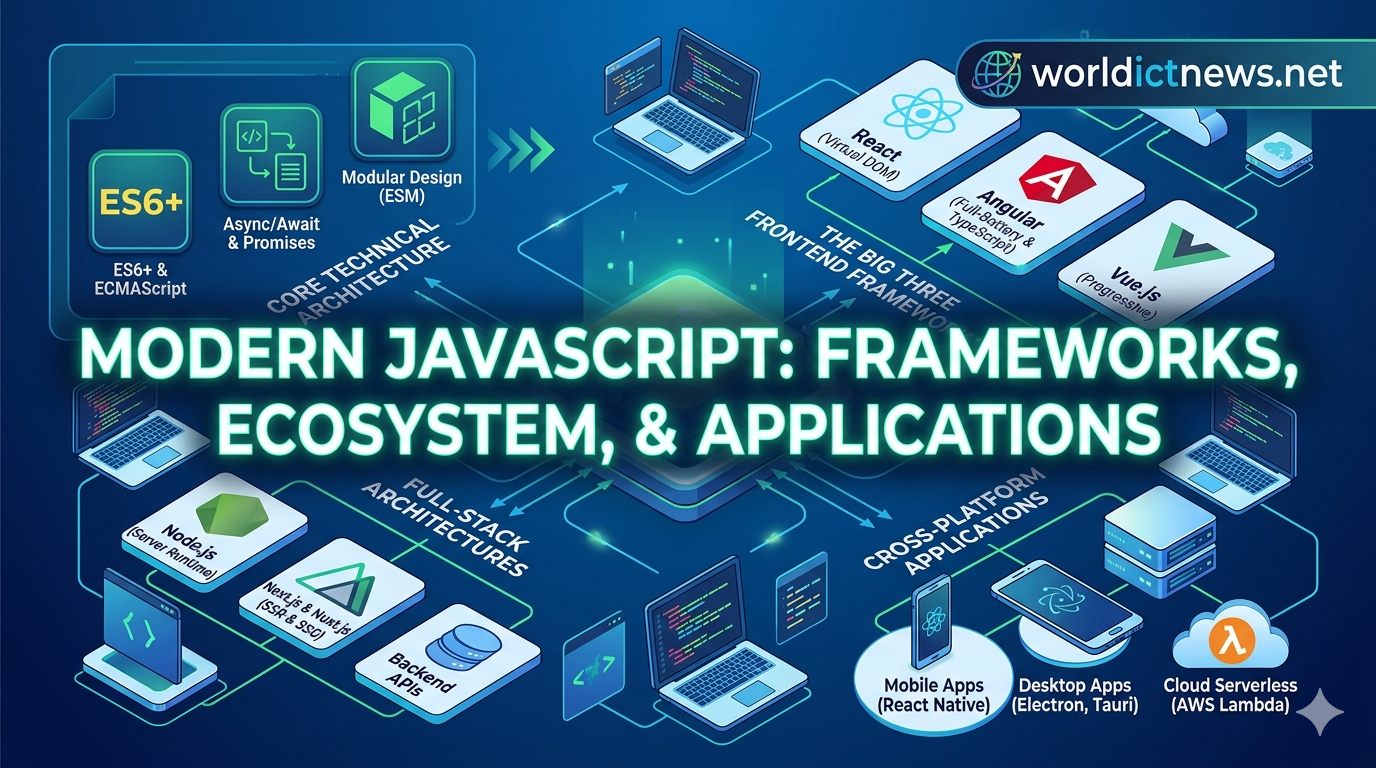
Modern JavaScript: Frameworks, Ecosystem, and Applications in Software Development.
The evolution of JavaScript is one of the most remarkable stories in software engineering. What began in 1995 as a lightweight client-side scripting language designed to add basic animations to web browsers has transformed into an engineering powerhouse. Today, Modern JavaScript is an omnipresent runtime engine that powers complex enterprise web platforms, mobile applications, cloud services, and desktop software frameworks.
This shift was accelerated by two major architectural milestones: the standardization of Modern ECMAScript (ES6+) specification rules and the creation of Node.js, which unlocked JavaScript execution outside the web browser environment. This comprehensive guide explores the core technical features of Modern JavaScript, analyzes the dominant development frameworks, and maps out its versatile applications across modern enterprise software development.
1. Core Technical Architecture of Modern JavaScript (ES6+)
Before diving into frontend libraries and server runtimes, it is essential to understand the modern language features that distinguish old JavaScript (ES5) from Modern JavaScript (ES6 and beyond). Modern development relies on clean, declarative syntax structures that improve code maintainability and minimize runtime logical bugs.
Asynchronous Execution: Promises and Async/Await
JavaScript is fundamentally a single-threaded language, meaning it executes one line of code at a time. However, web applications must handle slow operations—such as retrieving database records or querying third-party APIs—without freezing the user interface. Modern JavaScript handles this natively via asynchronous structures.
javascript
// Modern Asynchronous API Fetch Example using Async/Await
async function fetchSystemMetrics(endpoint) {
try {
const response = await fetch(endpoint);
if (!response.ok) throw new Error("Network latency anomaly detected.");
const data = await response.json();
return data;
} catch (error) {
console.error("System Log Error:", error.message);
}
}
Use code with caution.
Modules and Scoping Controls
Modern frameworks use modular design principles, isolating software parts into separate script files. This prevents scope conflicts using built-in encapsulation keywords:
javascript
// Exporting a specialized utility class: mathUtils.js
export const calculateDataDrift = (metricA, metricB) => Math.abs(metricA - metricB);
// Importing the component into your application entrypoint: app.js
import { calculateDataDrift } from './mathUtils.js';
Use code with caution.
2. The Big Three Frontend Frameworks
Building large, scalable user interfaces using raw, native DOM manipulation code quickly leads to unmanageable code architectures. To solve this problem, software engineers rely on component-driven frontend frameworks. While many specialized libraries exist, three open-source ecosystems dominate enterprise software development.
┌── MODERN JS FRAMEWORKS ──┐
│ │
▼ ▼ ▼
┌──────┐ ┌──────┐ ┌──────┐
│ REACT │ │ ANGULAR │ │ VUE.JS │
│ Component │ │ Full-Battery │ │ Progressively│
│ Ecosystem │ │ Framework │ │ Adaptable │
└──────┘ └──────┘ └──────┘
React (Maintained by Meta)
React is technically a UI library rather than a full-battery framework, but it commands the largest developer market share globally. React introduced the concept of the Virtual DOM, an in-memory representation of webpage elements that calculates minimal, optimized updates before rendering changes to the actual browser window.
Core Architecture: Component-Based, using JSX syntax (a declarative blend of JavaScript logic and structural HTML markup).
Best Use Case: Single-Page Applications (SPAs), complex dashboards, and rapidly scaling tech platforms.
Angular (Maintained by Google)
Angular is a robust, strictly structured, full-battery web application framework. Unlike React, Angular ships with built-in modules for routing, form validation, and server communication out of the box.
Core Architecture: Model-View-Controller (MVC) built entirely on TypeScript (a statically typed superset of JavaScript that catches code errors during development rather than at runtime).
Best Use Case: Enterprise banking software, corporate internal tooling, and large-scale applications managed by decentralized engineering teams.
Vue.js (Community-Driven Project)
Vue.js is a progressive frontend framework designed to combine the clean component architecture of React with the approachable, template-driven syntax of traditional HTML.
Core Architecture: Single-File Components (SFCs), where HTML structure, CSS layout styling, and JavaScript programmatic logic exist inside a unified
.vuefile wrapper.Best Use Case: Rapid prototype creation, content-driven websites, and teams transitioning from traditional server-side rendering architectures.
3. Full-Stack Architectures and Meta-Frameworks
While frontend frameworks handle client-side rendering, modern enterprise development requires robust search engine optimization (SEO), fast initial load speeds, and secure backend routing. This need has catalyzed the rise of Meta-Frameworks that bridge client logic with server computing.
Next.js (Built on React) and Nuxt.js (Built on Vue)
These meta-frameworks abstract complex server pipelines away from developers, providing native access to advanced server architectures:
Server-Side Rendering (SSR): The server pre-renders the full structural HTML page with complete data before transmitting it to the user's browser, providing optimized indexation for search engine crawlers.
Static Site Generation (SSG): Pages are compiled into static files during the build pipeline, allowing them to be cached on global Content Delivery Networks (CDNs) for near-instantaneous load times.
4. Cross-Platform Applications: Beyond the Web Browser
Modern JavaScript is no longer limited to browser windows. A single engineering team can leverage JavaScript skills to deploy software applications across entirely distinct computing hardware targets.
┌─── MODERN JAVASCRIPT ───┐
│ │
┌────┴───┐ ┌───┴──┐ ┌──┴──┐
▼ ▼ ▼ ▼ ▼ ▼
[ MOBILE APPS ] [ DESKTOP APPS ] [ CLOUD SERVERLESS ] [ BACKEND APIS ]
React Native, NativeScript Electron, Tauri AWS Lambda, Cloudflare Node.js, Bun runtimes
Mobile Application Development: React Native
Using React Native, developers can write application code in JavaScript and compile it directly into native iOS and Android user interface components. Unlike web-view wrapper apps, React Native applications communicate directly with the mobile operating system's native graphics engines, achieving high performance and fluid animations.
Desktop App Deployments: Electron and Tauri
Enterprise desktop platforms like Slack, Visual Studio Code, and Discord are built using JavaScript ecosystems. Electron packs a Chromium browser window alongside a Node.js runtime process into a native app container. For more resource-constrained environments, modern alternatives like Tauri replace heavy internal browser dependencies with thin system web views to build highly optimized desktop apps.
Cloud Serverless Computing: AWS Lambda and Cloudflare Workers
Because modern JavaScript runtimes like V8 feature near-instant start times, the cloud computing architecture uses JavaScript heavily for Serverless Functions. When an event triggers an API endpoint, serverless nodes run short code loops instantly, enabling organizations to process backend events without paying for idle server space.
5. Implementation Roadmap for Choosing Your Software Stack
When structuring a new enterprise digital platform, matching the correct JavaScript runtime environment and framework to your business goals is critical. Use this technical checklist to configure your project stack:
Evaluate SEO Requirements: If your platform depends on organic web search discoverability, skip basic client-side React/Vue architectures. Choose a meta-framework like Next.js or Nuxt.js configured for Server-Side Rendering (SSR).
Enforce Type Safety: For systems processing complex data contracts or financial records, require TypeScript over standard JavaScript to prevent object property runtime failures.
Select Runtimes Judiciously: For standard corporate web APIs, utilize Node.js. For microservices prioritizing maximum request throughput and low cold-start latency, evaluate modern high-performance runtimes like Bun.
Consolidate Codebases: If your roadmaps require both iOS and Android variants, utilize React Native to share business logic across both platforms, reducing total development resource overhead.
Conclusion
Modern JavaScript has evolved into a highly versatile and robust software development ecosystem. Through structural language features like async/await, powerful frontend components from React, Angular, or Vue, and cross-platform runtimes like Node.js and React Native, JavaScript enables developers to build complex, full-stack applications with efficiency and scale. By understanding these modern paradigms and choosing the right framework combinations, engineering teams can build resilient digital architectures suited for the modern landscape.
Frequently Asked Questions (FAQ)
1. What is the fundamental difference between Node.js and browser-based JavaScript?
Browser-based JavaScript executes inside a sandboxed environment controlled by the browser, giving it direct access to user interface elements (the DOM) while restricting direct file system operations. Node.js is a standalone runtime environment built on Chrome's V8 engine that runs directly on server hardware, giving it full access to filesystem operations, operating system networks, and databases.
2. Why should a project switch from standard JavaScript to TypeScript?
TypeScript adds static type definitions on top of standard JavaScript syntax. By declaring strict datatypes for variables and functions, errors are discovered during code compilation inside the development editor, rather than triggering unpredictable runtime crashes for active users.
3. What is the primary benefit of utilizing a Virtual DOM over standard DOM manipulations?
Directly updating webpage elements (the DOM) is computationally expensive and causes rendering lags when performed frequently. A Virtual DOM acts as a lightweight blueprint copy inside memory. When data changes, the framework calculates the most efficient structural changes first, batch-updating the visible webpage elements all at once to maintain performance.
4. How does Server-Side Rendering (SSR) improve page performance over Client-Side Rendering (CSR)?
In CSR, the server sends a blank HTML shell along with heavy JavaScript file streams; the user's browser must download and run those scripts before any text appears. In SSR, the server runs the initial scripts on the backend and transmits a complete, text-filled HTML page to the user, leading to faster initial load times and reliable indexing by search engine web crawlers.
5. Can JavaScript be used for high-performance backend data processing?
Yes, but with architectural constraints. Because JavaScript runs on a single event-driven loop, it handles high volumes of concurrent I/O connections (like receiving web traffic requests or fetching data) exceptionally well. However, for continuous CPU-heavy calculations (like advanced video processing or complex scientific model analysis), multi-threaded environments like Rust, C++, or Go are generally preferred.
Did you find this ICT insight helpful?