Re-branding Artificial Intelligence as "Super Intelligence" (SI)
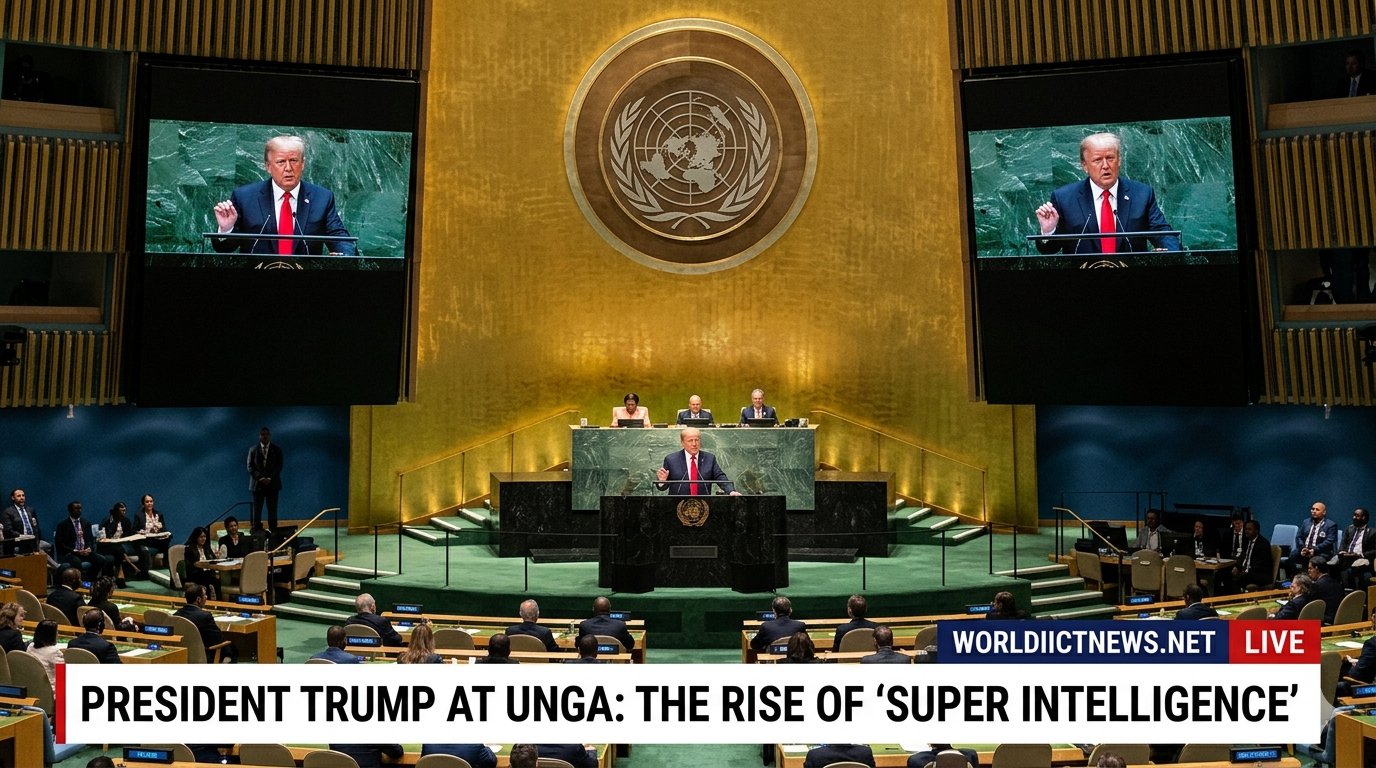
On September 22, 2026, U.S. President Donald Trump addressed the 81st United Nations General Assembly (UNGA) in New York, sparking global debate by re-branding Artificial Intelligence as "Super Intelligence" (SI). This rhetorical shift marks a definitive moment in technological geopolitics, directly challenging the United Nations’ efforts to build international regulatory frameworks.
Redefining the Future: President Trump’s "Super Intelligence" Doctrine at the UNGA
The Rhetorical Shift: Why "Artificial" Fails, and "Super" Wins
During his address to the United Nations General Assembly, President Trump explicitly took aim at the standard terminology used by global tech firms, researchers, and policymakers: "Artificial Intelligence". To a crowded assembly room of global leaders, he argued that the word "artificial" heavily undersells the capabilities and massive socio-economic scale of the technology.
Trump argued that "artificial" makes intelligence sound fake, declaring that official documents would transition to the term Super Intelligence (SI). This rebranding treats the technology as a dominant expansion of cognitive power rather than a synthetic imitation. Following public name-testing that discarded alternatives like "Supreme Intelligence," SI was adopted as the formal U.S. government standard.
Direct Rejection of Global AI Frameworks and Economic Growth
Trump used the UNGA podium to explicitly reject coordinated global regulatory schemes or limits on high-level models, maintaining that U.S. agencies can manage domestic issues without foreign oversight. Dismissing existential safety concerns as an innovation-stifling "hoax", the administration prioritized economic maximalism, with Trump asserting that SI will be "bigger than the Industrial Revolution" and drive breakthroughs across finance, automation, and infrastructure.
Geopolitical Stance and Global Fallout
Driven by a zero-sum race against China where America currently leads by a wide margin, the administration's stance avoids bureaucratic slowdowns that could erode U.S. tech supremacy. This unilateral pivot has introduced diplomatic friction with European allies favoring strict governance, created a fractured compliance landscape for multinational tech firms, and fundamentally altered the global terminology and terms of engagement surrounding technological primacy.
Did you find this ICT insight helpful?