A Comprehensive Guide to Digital Forensics in Cybersecurity
The Digital Fingerprint: A Comprehensive Guide to Digital Forensics in Cybersecurity.
When a cyberattack breaches an enterprise network, security teams cannot rely on guesswork. They must determine exactly how the threat actor entered, what files were accessed, and what data left the perimeter.
This is the domain of Digital Forensics and Incident Response (DFIR). Digital forensics bridges the gap between raw computer science and data-driven investigation. It applies rigorous, scientifically sound methods to collect, preserve, analyze, and present digital evidence in ways that are legally admissible in court.
As corporate networks grow more complex, digital forensics has transformed from a post-event investigation tool into a core pillar of modern cybersecurity defenses.
The Intersection of Cybersecurity and Digital Forensics
While standard cybersecurity focuses on defense, monitoring, and mitigating active attacks, digital forensics focuses on historical reconstruction.
Cybersecurity (The Shield): Deploys firewalls, configures Endpoint Detection and Response (EDR) agents, and manages active system configurations to block incoming threats.
Digital Forensics (The Detective): Intervenes during or after a security failure to reverse-engineer the attacker's timeline and secure evidence without altering underlying system states.
[ CYBERSECURITY ] [ DIGITAL FORENSICS ]
─── ──
• Active Threat Blocking • Post-Breach Reconstruction
• Access Control & Patching • Root-Cause Analysis
• Real-Time Traffic Scanning • Legal Evidence Preservation
Integrating digital forensics directly into a security posture drastically reduces an organization's Mean Time to Resolution (MTTR). By tracking exactly how a vulnerability was exploited, security architecture teams can deploy precise patches, preventing attackers from using the same entry point twice.
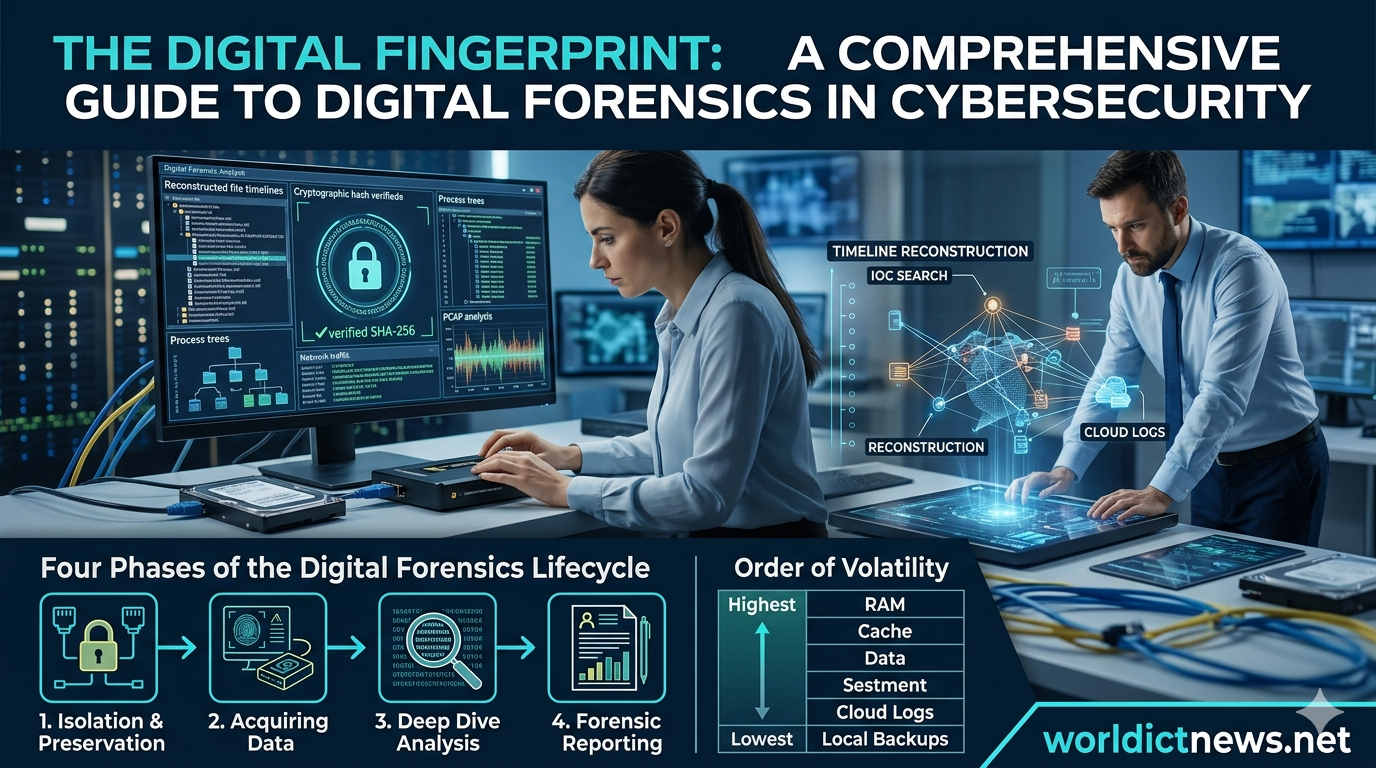
The Four Phases of the Digital Forensics Lifecycle
Digital forensic investigations follow strict, standardized frameworks established by organizations like the National Institute of Standards and Technology (NIST). Deviating from these phases can corrupt data, making the evidence useless in legal proceedings or regulatory compliance audits.
┌────┐ ┌─────┐ ┌───┐ ┌────┐
│ 1. Isolation │ ───> │ 2. Acquiring │ ───> │ 3. Deep Dive │ ───> │ 4. Forensic │
│ & Collection │ │ Data │ │ Analysis │ │ Reporting │
└────┘ └─────┘ └───┘ └────┘
1. Isolation and Preservation
The moment an incident is declared, the compromised machine must be isolated from the network to stop command-and-control (C2) communication. This must be done carefully to avoid changing the target machine's data.
Investigators must document the system's exact state using a clear chain-of-custody log. This log tracks every person who interacts with the hardware or digital images, along with exact timestamps.
2. Acquiring Data
Forensic professionals never run analysis tools directly on live production systems. Instead, they capture a perfect, bit-by-bit duplicate of the digital storage media, known as a forensic image.
To maintain data integrity, investigators use hardware write-blockers. These devices physically prevent the workstation from modifying any data on the target storage drive during the imaging process.
Once imaging is complete, the investigator calculates cryptographic hash values (such as SHA-256) for both the original drive and the new copy. If the hashes match perfectly, the image is verified as a true copy, and analysis can safely begin.
3. Deep-Dive Analysis
With verified copies in hand, investigators use advanced forensic software to search for indicators of compromise (IOCs). They hunt for hidden partitions, parse system registry hives, rebuild fragmented event logs, and extract deleted files from unallocated drive space.
4. Forensic Reporting
The final phase translates complex technical findings into a clear, structured report. The document must outline the investigation's scope, the specific tools used, the artifacts recovered, and the ultimate root-cause conclusion. This report must be written so that non-technical business executives, compliance officers, and legal teams can fully understand the timeline of events.
Order of Volatility: Tracking Modern Digital Artifacts
Data disappears at different rates during an active investigation. When analyzing a system, investigators prioritize collecting evidence based on the Order of Volatility. They gather highly fleeting data first before it is overwritten or lost when the system powers down.
Volatility Rank | Data Classification | Practical Forensic Artifacts |
|---|---|---|
1 (Highest) | CPU Registers & Cache | Active processor instructions, real-time memory states |
2 | System Memory (RAM) | Decryption keys, unencrypted passwords, running processes |
3 | Network States | Active TCP/UDP connections, open routing tables, ARP cache |
4 | Local Storage Drives | Operating system files, application logs, registry hives |
5 (Lowest) | Remote Backups | Offsite cloud storage archives, optical media, cold backups |
Why Volatile RAM Analysis Matters
Historically, computer forensics focused mainly on reading non-volatile hard drives. However, modern malware often runs entirely in memory without writing files to the disk.
Extracting and analyzing a volatile RAM dump allows investigators to recover active encryption keys, find malicious injected code segments, and see open network connections that disappear entirely when the machine reboots.
Core Specialized Sub-Disciplines
Digital forensics covers several specialized domains, each requiring distinct investigative toolsets and technical expertise.
Network Forensics
Network forensics analyzes traffic logs, packet captures (PCAPs), and firewall indicators to monitor data moving across an enterprise network. Investigators review these logs to trace data exfiltration paths, pinpoint lateral movement within a network, and determine exactly how much data an attacker stolen.
Endpoint and Host Forensics
This branch focuses on analyzing individual workstations, laptops, and enterprise servers. Investigators inspect operating system artifacts like Windows Prefetch files, Shimcache, and Shellbags to verify whether specific malicious programs were executed on a user's machine.
Cloud Forensics
As companies move infrastructure to cloud platforms like AWS, Azure, and Google Cloud, investigators must adapt to decentralized environments. Cloud forensics relies heavily on reviewing centralized infrastructure tracking logs (like AWS CloudTrail). This allows investigators to reconstruct identity-based attacks and API exploitation without needing physical access to server hardware.
Mobile Device Forensics
Mobile devices require unique extraction methods because they rely on hardware-level encryption and specialized flash memory layouts. Investigators use advanced techniques to bypass device locks, allowing them to recover deleted text messages, encrypted chat logs, and geolocation history.
Essential Forensic Tools Used by Industry Professionals
Modern forensic examiners use a mix of commercial suites and open-source utilities to conduct comprehensive investigations.
Autopsy / Sleuth Kit: A widely used open-source graphical interface that parses hard drives, extracts web browser histories, and flags hidden file types.
FTK Imager (Forensic Toolkit): An industry-standard utility designed to acquire highly accurate forensic images of storage drives and volatile system RAM.
Volatility Framework: A powerful, open-source command-line tool used worldwide to analyze memory dumps and reverse-engineer in-memory malware.
EnCase Forensic: A comprehensive commercial enterprise suite utilized heavily by law enforcement for deep index searching, metadata triage, and formal report generation.
Overcoming Modern Forensic Challenges
The digital forensics landscape faces continuous challenges as technology evolves and attackers deploy anti-forensic techniques.
1. Widespread End-to-End Encryption
While strong encryption protects user privacy, it presents a hurdle for traditional forensic investigations. If an attacker communicates using encrypted channels or targets an enterprise drive protected by full-disk encryption, investigators cannot read the data without securing the decryption keys directly from active system memory or user configurations.
2. Anti-Forensics Tactics
Modern threat actors actively use anti-forensic techniques to hide their tracks. These tactics include:
Timestomping: Artificially modifying file creation and modification timestamps to disrupt the investigator's timeline analysis.
Log Clearing: Explicitly erasing Windows Event logs or Linux syslog records immediately after gaining administrative access.
Fileless Malware: Executing scripts directly within legitimate administrative utilities (like PowerShell) to avoid generating traditional file artifacts on the hard drive.
3. The Scale of Big Data
Modern storage capacities have grown exponentially. Investigating a breach across dozens of multi-terabyte corporate servers can generate petabytes of raw data. Forensic teams rely on automated ingestion scripts, artificial intelligence filters, and targeted keyword indexing to quickly parse through data volumes and locate critical evidence.
Conclusion
Digital forensics is an essential component of modern cybersecurity defense. By combining structured investigative processes with deep system analysis, digital forensic professionals help organizations accurately reconstruct cyberattacks, protect data integrity, and build resilient defenses.
As cyber threats become more sophisticated, the ability to analyze and interpret digital evidence remains our strongest asset for securing the digital landscape.
Did you find this ICT insight helpful?