An Introduction to Network Security in Cybersecurity
Guarding the Digital Perimeter: An Introduction to Network Security in Cybersecurity.
In an era where global businesses, government infrastructures, and personal lives are completely intertwined with the internet, data has become the world’s most valuable currency. Every financial transaction, medical record, private conversation, and industrial operations plan travels across digital networks. However, this absolute connectivity introduces massive vulnerability.
Cybercriminals, nation-state actors, and malicious insiders constantly search for gaps in digital defenses to steal data, hold systems hostage, or destroy critical infrastructure. This is where network security comes in. As a primary pillar of cybersecurity, network security is the practice of planning, implementing, and monitoring defensive measures to protect a network and its data from unauthorized access, misuse, modification, or destruction.
1. Defining Network Security
To understand network security, one must first distinguish it from the broader umbrella of cybersecurity.
Cybersecurity is an all-encompassing discipline focused on protecting everything in the digital realm—including endpoints, cloud environments, application code, user behaviors, and networks—from digital attacks.
Network Security focuses specifically on the infrastructure. It secures the pipelines, connections, and protocols that allow devices to talk to one another.
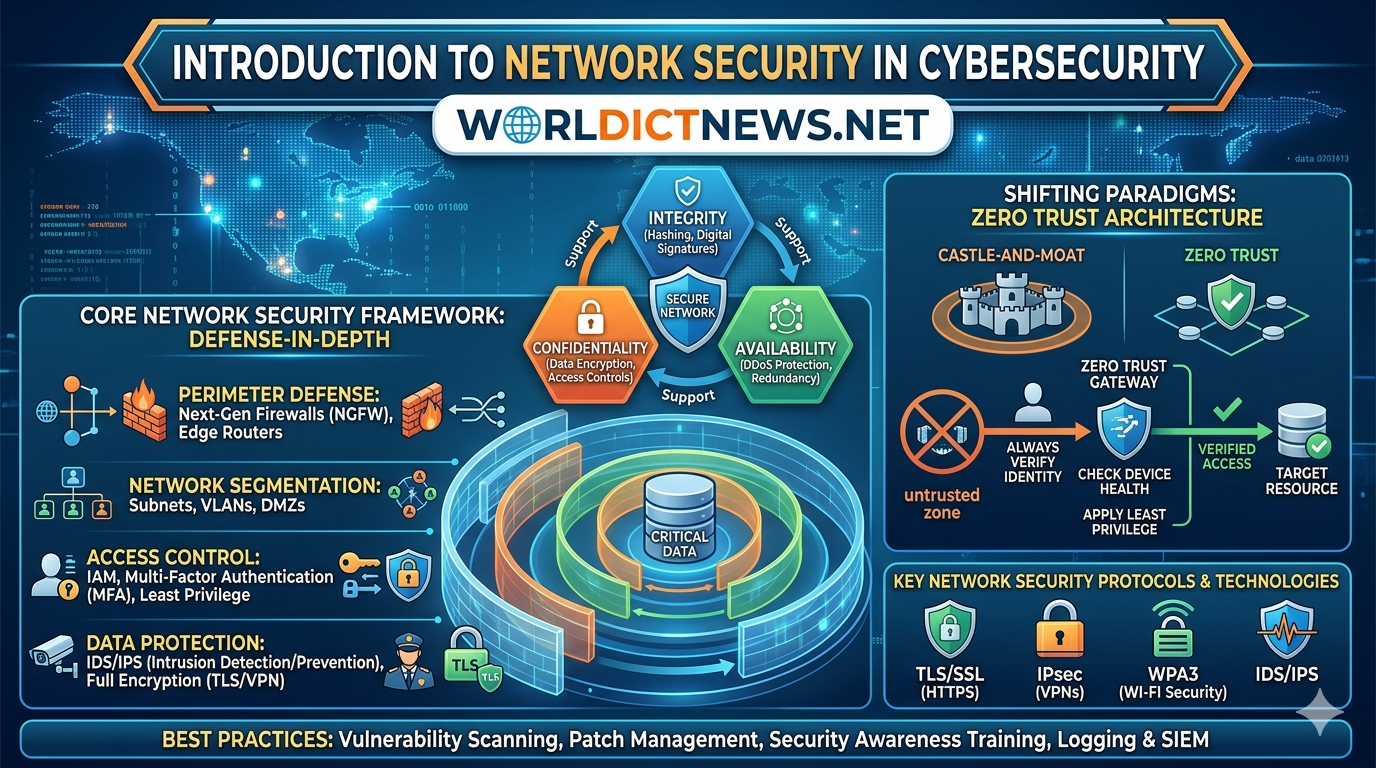
The core mission of network security is universally guided by the CIA Triad: Confidentiality, Integrity, and Availability.
[ Confidentiality ]
/ \
/ \
/ \
[ Integrity ] --- [ Availability ]
Confidentiality
Confidentiality ensures that sensitive data remains hidden from unauthorized eyes while in transit or at rest. Network security achieves this through encryption and strict access controls. If an unauthorized actor intercepts a data packet, encryption ensures they see nothing but unreadable ciphertext.
Integrity
Integrity guarantees that data is not altered, deleted, or tampered with during its journey across the network. Security protocols use cryptographic hashing and digital signatures to verify that a file sent from point A arrives at point B completely unchanged.
2. Common Network Security Threats
Building an effective network defense requires a deep understanding of the tactics and tools adversaries use. The threat landscape is highly diverse, ranging from automated opportunistic scans to highly targeted, multi-stage operations.
Malware
Malware (malicious software) is an umbrella term for code designed to exploit, damage, or disrupt networks.
Viruses and Worms: Self-replicating programs that spread across a network by exploiting software vulnerabilities, consuming massive amounts of bandwidth and crashing systems.
Ransomware: A highly destructive form of malware that encrypts critical network files and demands a financial payout for the decryption key. Modern ransomware variants often target network backups first to prevent organizations from restoring their data for free.
Phishing and Social Engineering
While network security heavily relies on technical hardware and software, human behavior remains a significant vulnerability. Phishing involves sending fraudulent communications—usually emails—designed to trick employees into revealing network credentials or clicking links that download malware directly onto a corporate machine.
Man-in-the-Middle (MitM) Attacks
In a MitM attack, a cybercriminal secretly inserts themselves between two communicating devices (such as a laptop and a corporate server). By tricking the devices into thinking they are speaking directly to each other, the attacker can intercept, view, and alter sensitive information in real time. This frequently occurs on unsecured or public Wi-Fi networks.
Denial-of-Service (DoS) and Distributed Denial-of-Service (DDoS)
Instead of stealing data, DoS and DDoS attacks aim to destroy availability. Attackers weaponize botnets—large networks of compromised, internet-connected devices—to flood a target network server with an overwhelming volume of fake traffic. The server's processor and memory become maxed out, causing the network to crash or freeze for legitimate users.
Advanced Persistent Threats (APTs)
APTs are highly targeted, prolonged cyberattacks orchestrated by well-funded groups, such as nation-state actors or organized crime syndicates. Instead of a quick data theft, an APT group sneaks into a network silently and avoids detection for months or years. Their goal is to continuously spy on operations, steal intellectual property, and harvest data over an extended period.
3. Core Components of Network Security Architecture
Securing a network requires a multi-layered defense strategy, a concept known as Defense-in-Depth. If an attacker breaches the outer layer, subsequent layers are waiting to neutralize the threat.
+-------------------------------------------------------+
| PERIMETER DEFENSE (Firewalls, Edge Routers) |
| +---------------------------------------------------+
| | NETWORK SEGMENTATION (Internal Subnets, DMZs) |
| | +-----------------------------------------------+
| | | ACCESS CONTROL (IAM, MFA, Least Privilege) |
| | | +-------------------------------------------+
| | | | DATA PROTECTION (Encryption, IDS/IPS) |
| | +---|-------------------------------------------+
| +-------|-------------------------------------------+
+-----------|-------------------------------------------+
v
CRITICAL DATA
Firewalls
Firewalls serve as the primary border patrol of a network. They monitor incoming and outgoing network traffic based on an established set of security rules.
Packet-Filtering Firewalls: Inspect basic data points like source IP addresses, destination IPs, and port numbers to accept or drop traffic.
Next-Generation Firewalls (NGFWs): Go beyond basic filtering. They perform deep packet inspection, analyze application-level traffic, and integrate built-in threat intelligence to spot advanced malware signatures.
Access Control and Identity Management
Not every employee needs access to every file on a network. Access control enforces the Principle of Least Privilege (PoLP), which states that users should only have the minimum network access necessary to complete their daily job duties. This is paired with Multi-Factor Authentication (MFA), requiring users to present two or more verification factors (like a password and a smartphone token) before gaining access to the network infrastructure.
Intrusion Detection Systems (IDS) and Intrusion Prevention Systems (IPS)
IDS and IPS tools continuously monitor network traffic for suspicious patterns or known attack signatures.
IDS: Acts as a passive security camera. It analyzes traffic and alerts security administrators if it spots anomalous activity (e.g., an unusual brute-force login attempt).
IPS: Acts as an active security guard. It sits directly in the traffic flow and automatically drops connections, blocks IP addresses, or terminates dangerous sessions the moment a threat is identified.
Virtual Private Networks (VPNs)
With the rise of remote and hybrid work, corporate networks no longer sit entirely inside a single physical office building. A VPN creates an encrypted, secure tunnel over the public internet between a remote user's device and the private corporate network. This ensures that even if an employee connects from a public coffee shop, their corporate data transfers remain completely hidden from interception.
Network Segmentation
Network segmentation involves splitting a large computer network into smaller, isolated subnetworks (zones). For example, a corporation might separate its public-facing guest Wi-Fi, internal finance servers, and building management systems into separate zones. If a hacker compromises a guest Wi-Fi device, network segmentation prevents them from moving laterally into the sensitive finance servers.
4. Key Protocols and Encryption in Network Security
Behind every secure network link lies a framework of cryptographic protocols designed to keep communication lines safe.
Secure Sockets Layer (SSL) and Transport Layer Security (TLS)
TLS (the modern, secure successor to SSL) is the protocol that powers secure web browsing. It encrypts data traveling between a user’s web browser and a website server. When you see https:// and a padlock icon in your browser's address bar, TLS is actively encrypting your session, protecting credit card details and login credentials from interceptors.
IP Security (IPsec)
IPsec is a suite of protocols used to secure internet communication at the IP layer. It is most commonly used to set up highly secure site-to-site VPN configurations, allowing branch offices in different parts of the world to share a secure network tunnel over the internet.
WPA3 (Wi-Fi Protected Access 3)
WPA3 is the latest security protocol for wireless networks. It fixes major cryptographic flaws found in older WPA2 configurations, providing much stronger encryption for wireless data transfers and defending networks against password-guessing dictionary attacks.
5. The Paradigm Shift: Moving to Zero Trust Architecture
For decades, network security relied heavily on the "Castle-and-Moat" framework. Organizations focused nearly all their resources on building a strong perimeter (the moat) using firewalls. Anyone inside the perimeter was automatically trusted.
However, modern cloud environments, mobile devices, and remote workforces have made traditional perimeters obsolete. Furthermore, if an attacker bypasses the firewall using stolen credentials, they gain unfettered access to the entire internal network.
To address these flaws, the cybersecurity industry shifted toward a Zero Trust Architecture. The core principle of Zero Trust is simple: Never Trust, Always Verify.
[ UNTRUSTED ZONE ]
|
( Request to access resource )
v
+---------------------------------------------------+
| ZERO TRUST GATEWAY |
| - Explicitly verify identity & MFA |
| - Check device health & compliance |
| - Apply Least Privilege access rules |
+---------------------------------------------------+
|
[ VERIFIED ACCESS ]
v
[ TARGET RESOURCE ]
Under a Zero Trust framework, entry is never granted based on location. Whether a user connects from a desk inside the main office or a home laptop, the system evaluates their identity, device health, and context before authorizing access to a single, isolated application. Trust is continuously verified throughout the entire digital session.
6. Best Practices for Implementing Network Security
Securing a modern network requires an active, ongoing strategy that combines technology, clear policies, and user education.
Conduct Regular Vulnerability Scanning and Penetration Testing: Use automated scanning software to find unpatched software, open ports, and configuration mistakes before attackers do. Supplement this with penetration testing, where white-hat hackers are hired to safely attack your network to expose hidden gaps.
Enforce Strict Patch Management: Unpatched operating systems and software applications are a primary entry point for network intrusions. Establish an automated patch cycle to verify, test, and install security updates as soon as vendors release them.
Provide Continuous Security Awareness Training: Because technology cannot stop every social engineering attempt, employees must serve as a strong human firewall. Run routine phishing simulations and training sessions so staff can easily spot, flag, and report suspicious messages.
Implement Centralized Logging and Monitoring: Deploy a SIEM (Security Information and Event Management) system to aggregate log data from firewalls, routers, and endpoints across your entire network infrastructure. Centralized logs allow security teams to spot complex, multi-stage attacks and respond to security incidents in real time.
7. Conclusion
Network security is no longer an optional add-on for specialized IT teams; it is a fundamental requirement for business continuity, national safety, and individual privacy. As networks grow more complex through cloud integrations and internet-of-things (IoT) devices, the tactics used by threat actors will continue to evolve.
By deploying a defense-in-depth architecture, enforcing strict identity management, embracing a Zero Trust mindset, and fostering a culture of cybersecurity awareness, organizations can build resilient networks capable of neutralizing modern threats. In the digital world, network security is the ultimate shield that keeps information moving safely, reliably, and privately across the globe
Did you find this ICT insight helpful?