Demystifying Cybersecurity Governance, Risk, and Compliance (GRC)
The Blueprint of Trust: Demystifying Cybersecurity Governance, Risk, and Compliance (GRC).
In the modern corporate ecosystem, data is both a company's most valuable asset and its most volatile liability. As organizations rapidly digitize, migrate to multi-cloud architectures, and deploy advanced systems, their attack surfaces grow exponentially. In parallel, global regulatory frameworks have evolved from simple checklists into strict, legally binding mandates backed by severe financial and criminal penalties.
For decades, organizations treated cybersecurity as a purely technical challenge. Boards of directors delegated security to the IT department, assuming that firewalls, antivirus software, and encryption patches were sufficient to keep threats at bay. However, this siloed approach has proven fundamentally flawed. High-profile data breaches, ransom demands, and system outages have made it clear that technical defenses alone cannot secure an enterprise.
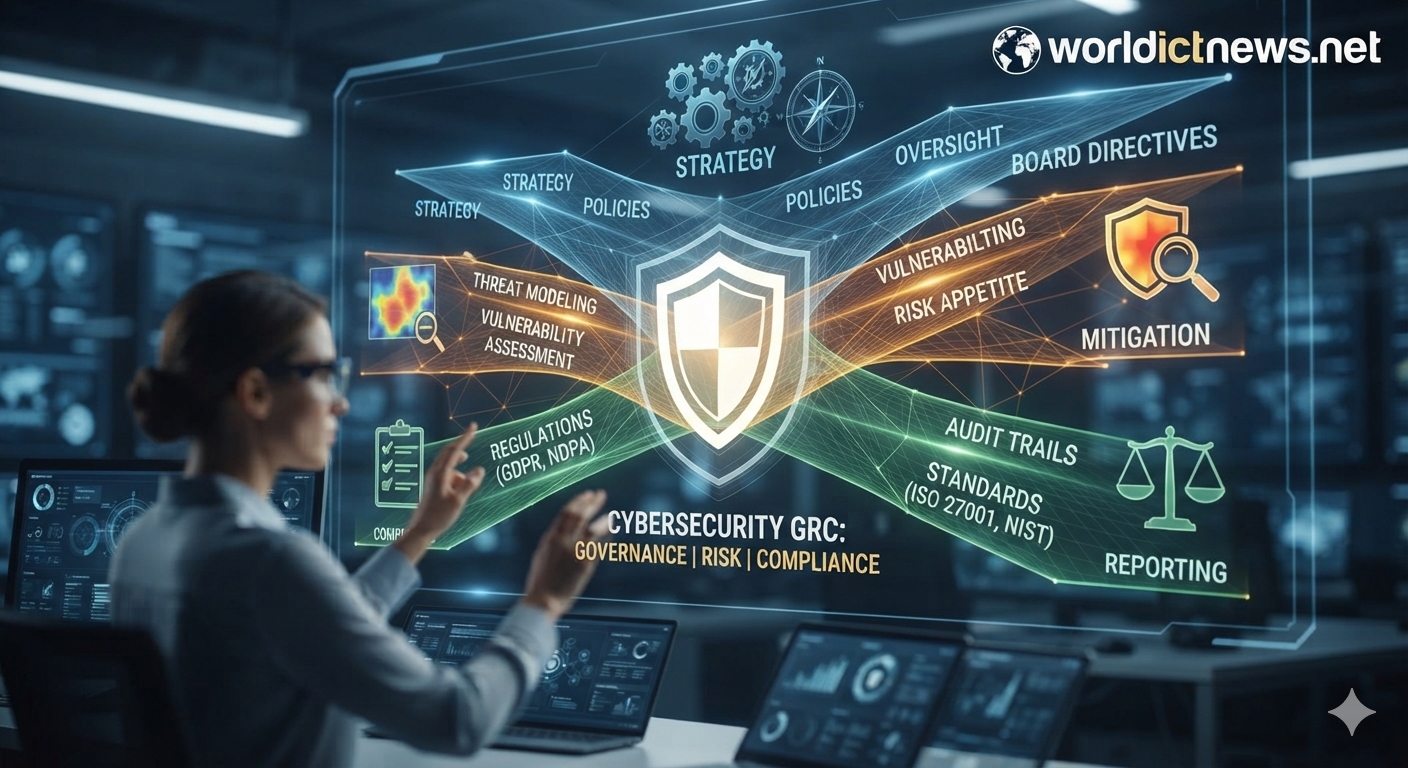
True resilience requires strategic alignment, proactive threat modeling, and institutional accountability. This structural synthesis is known as Cybersecurity Governance, Risk, and Compliance (GRC).
GRC is a unified framework designed to align an organization's information security practices with its overarching business goals, manage digital threats effectively, and maintain compliance with industry standards and legal regulations. This article explores the three pillars of cybersecurity GRC, examines their structural mechanics, analyzes popular frameworks, and details how organizations can implement a robust GRC strategy.
The Three Pillars of GRC
While Governance, Risk, and Compliance are distinct disciplines, they function as an interconnected triad. If one pillar fails, the entire security posture collapses.
       +---------------------------------------------+

       |                  GOVERNANCE                 |
       |  (Policies, Strategies, Board Oversight)   |
       +----------------------++---------------------+
                              ||
        +---------------------+---------------------+

        |                                           |
+-------v-------+                           +-------v-------+

|     RISK      | <=======================> |  COMPLIANCE   |
|  MANAGEMENT   |   (Continuous Syncing)    |  MANAGEMENT   |
| (Mitigation)  |                           | (Regulations) |
+---------------+                           +---------------+
1. Governance: The Strategic Direction
Governance establishes the rules, organizational structures, and strategic direction for information security. It ensures that security initiatives are not isolated technical projects but are directly linked to business objectives. Effective governance answers critical questions: Who is responsible for protecting data? What is the organization’s tolerance for security incidents? How do we measure the success of our security programs?
The core components of security governance include:
Leadership and Oversight: Establishing a dedicated security structure led by a Chief Information Security Officer (CISO) or a cross-functional security committee that reports directly to executive leadership and the board of directors.
Policies and Procedures: Drafting high-level blueprints that outline acceptable user behavior, data classification standards, incident response protocols, and access control models.
Strategic Alignment: Ensuring that security investments support business growth. For example, if a company's business strategy is to expand its digital footprint via a mobile application, governance dictates how security parameters are built directly into that development lifecycle.
2. Risk Management: The Analytical Engine
Risk management is the proactive process of identifying, assessing, evaluating, and mitigating threats to an organization’s digital assets. It recognizes that absolute security is an illusion; no organization can stop 100% of attacks. Therefore, risk management focuses on prioritizing threats based on their likelihood of occurrence and their potential business impact.
The risk management lifecycle consists of four iterative steps:
Identification: Discovering all hardware, software, data assets, and third-party vendors within the organization, and mapping potential vulnerabilities (such as unpatched software) and external threats (such as ransomware groups).
Assessment and Analysis: Evaluating risks using either qualitative metrics (High, Medium, Low) or quantitative metrics (calculating the financial cost of an exploit using formulas like Annualized Loss Expectancy).
Evaluation: Comparing the analyzed risk against the organization’s predefined risk appetite—the level of risk the company is willing to accept to achieve its goals.
Treatment: Deciding how to handle the risk. Organizations have four choices:
Mitigate: Deploy technical controls (e.g., implementing multi-factor authentication to secure weak credentials).
Transfer: Shift the financial burden to a third party (e.g., purchasing a cyber insurance policy).
Avoid: Eliminate the risk entirely by stopping the risky activity (e.g., decommissioning a highly vulnerable legacy software application).
Accept: Acknowledge the risk and document it, usually because the cost of fixing the issue outweighs the potential impact of an exploit.
3. Compliance: The Regulatory Guardrails
Compliance is the process of ensuring that an organization adheres to external legal mandates, industry standards, and internal corporate policies. Compliance provides structured guidelines that validate an organization’s security posture to consumers, partners, and state actors.
Compliance falls into two main categories:
Regulatory Compliance: Legally binding laws enacted by governments. Examples include the European Union’s General Data Protection Regulation (GDPR), the United States' Health Insurance Portability and Accountability Act (HIPAA), and local mandates like the Nigeria Data Protection Act (NDPA). Non-compliance results in severe financial penalties and legal liability.
Standard-Based Compliance: Voluntary frameworks or contractual obligations required to operate within certain industries. The most common example is the Payment Card Industry Data Security Standard (PCI-DSS), which any merchant processing credit card transactions must maintain.
Core Core Frameworks and Standards
Implementing GRC from scratch can be overwhelming. To streamline this process, global standard-setting bodies have developed comprehensive frameworks that act as structured blueprints for organizational security.
NIST Risk Management Framework (RMF) & Cybersecurity Framework (CSF)
Developed by the U.S. National Institute of Standards and Technology, the NIST CSF is widely regarded as the gold standard for structuring organizational defenses. It organizes security activities into five foundational, continuous pillars:
Identify: Gain institutional visibility into assets, business environments, and risks.
Protect: Implement safeguards such as access control, data security, and awareness training.
Detect: Build continuous monitoring pipelines to spot security anomalies rapidly.
Respond: Design playbooks to contain breaches and minimize damage when an incident occurs.
Recover: Construct resilience plans to restore systems and operations post-incident.
ISO/IEC 27001
The International Organization for Standardization (ISO) 27001 is a globally recognized, auditable standard that defines the requirements for establishing, maintaining, and continually improving an Information Security Management System (ISMS). Unlike frameworks that focus purely on technical configurations, ISO 27001 emphasizes management commitment, continuous internal audits, and systemic correction loops. Achieving an ISO 27001 certification is highly valued for B2B enterprises, as it acts as an international stamp of security maturity.
SOC 2 (System and Organization Controls)
Developed by the American Institute of CPAs (AICPA), SOC 2 is an auditing report standard widely demanded by modern Software-as-a-Service (SaaS) and cloud vendors. A SOC 2 assessment evaluates an organization's controls based on five Trust Services Criteria: Security, Availability, Processing Integrity, Confidentiality, and Privacy.
SOC 2 Type I: Evaluates the system's security design at a single specific point in time.
SOC 2 Type II: Evaluates the operational effectiveness of those security controls over a continuous window (typically 3 to 12 months), offering a much higher degree of operational validation.
Implementation Challenges in GRC
While the theoretical benefits of GRC are clear, practical implementation often encounters significant operational hurdles within organizations.
1. Siloed Approaches and "Compliance Fatigue"
A frequent failure mode occurs when compliance is decoupled from actual security risk management. When organizations view compliance as a bureaucratic box-ticking exercise, they create what security professionals call "paper security." An organization can be 100% compliant on paper while remaining highly vulnerable to actual modern attack vectors. GRC systems must be unified so that fulfilling a compliance mandate directly reduces a mapped security risk.
2. The Dynamic Nature of Modern Digital Environments
Traditional GRC workflows relied heavily on manual spreadsheets, point-in-time questionnaires, and annual audits. However, modern infrastructure updates happen in minutes via DevOps pipelines and cloud deployments. A static Excel spreadsheet tracking compliance parameters becomes obsolete the moment a developer spins up a new unsecured AWS instance or an API endpoint. This friction has forced the emergence of Continuous Compliance and automated GRC platforms that dynamically poll system configurations.
3. Third-Party and Vendor Risk Management
Modern enterprises rely on vast networks of SaaS applications, outsourced hosting providers, and third-party vendors. A supply-chain compromise—where attackers breach a target company by exploiting a vulnerability in a smaller vendor's software—is one of the fastest-growing attack vectors. Managing third-party risk requires integrating strict vendor assessment workflows directly into the broader GRC architecture.
Step-by-Step GRC Implementation Strategy
For an organization aiming to deploy or mature its GRC function, a structured implementation lifecycle is vital.
+-----------------------------------------------------------+

|               GRC IMPLEMENTATION LIFECYCLE                |
+-----------------------------------------------------------+

|  1. DEFINE STRATEGY & RISK APPETITE                       |
|     Identify core business goals and leadership vision.   |
+-----------------------------------------------------------+
                             |
                             v
+-----------------------------------------------------------+

|  2. ESTABLISH POLICIES & FRAMEWORKS                       |
|     Adopt standard blueprints like NIST CSF or ISO 27001. |
+-----------------------------------------------------------+
                             |
                             v
+-----------------------------------------------------------+

|  3. CONDUCT COMPREHENSIVE RISK ASSESSMENT                  |
|     Inventory assets and score vulnerabilities.           |
+-----------------------------------------------------------+
                             |
                             v
+-----------------------------------------------------------+

|  4. IMPLEMENT CONTROL TRACKING & MONITORING               |
|     Move away from static spreadsheets to dynamic tools.  |
+-----------------------------------------------------------+
                             |
                             v
+-----------------------------------------------------------+

|  5. AUDIT, MEASURE, AND ITERATE                           |
|     Review performance metrics and update regularly.      |
+-----------------------------------------------------------+
Define Strategy & Risk Appetite: Secure clear executive buy-in. Establish exactly how much economic risk the company can tolerate regarding system downtime or potential data exposure.
Establish Policies & Adopt Frameworks: Select a foundational framework (like NIST CSF) that best fits the company's industry vertical. Draft clear, mandatory policies governing authentication, remote work access, and data ownership.
Conduct a Comprehensive Risk Assessment: Inventory all corporate digital assets and dependencies. Score identified vulnerabilities based on their exploitability and their direct financial or operational impact on the enterprise.
Implement Control Tracking & Monitoring: Deploy controls to mitigate identified risks. Rather than relying on static documents, utilize specialized GRC software or configuration tracking tools to map out how those controls perform in real time.
Audit, Measure, and Iterate: Perform regular simulated breaches, internal audits, and external assessments. Review performance metrics regularly with leadership to refine policies as external threat actors adapt their tactics.
Conclusion
Cybersecurity GRC is no longer an optional framework reserved solely for highly regulated banking conglomerates or enterprise healthcare systems. In today's hyper-connected, adversarial digital landscape, it is a vital operational baseline for any organization seeking long-term resilience.
By integrating Governance to define strategic direction, Risk Management to proactively handle threat models, and Compliance to maintain operational integrity under international regulatory systems, GRC transforms security from an isolated IT expense into a measurable business enabler. Ultimately, an effective GRC strategy protects more than just data—it preserves an organization's reputation, maintains consumer trust, and ensures long-term operational continuity.
Did you find this ICT insight helpful?