Generative AI and Cloud Security Frameworks in 2026
How Generative AI is Reshaping Cloud Security Frameworks in 2026.
The rapid convergence of cloud computing and artificial intelligence has reached a critical tipping point. Modern enterprise infrastructures are no longer just cloud-hosted; they are AI-driven. While this technological evolution has unlocked unprecedented computational efficiency and automated scaling, it has simultaneously introduced an entirely new, highly sophisticated landscape of vulnerabilities.
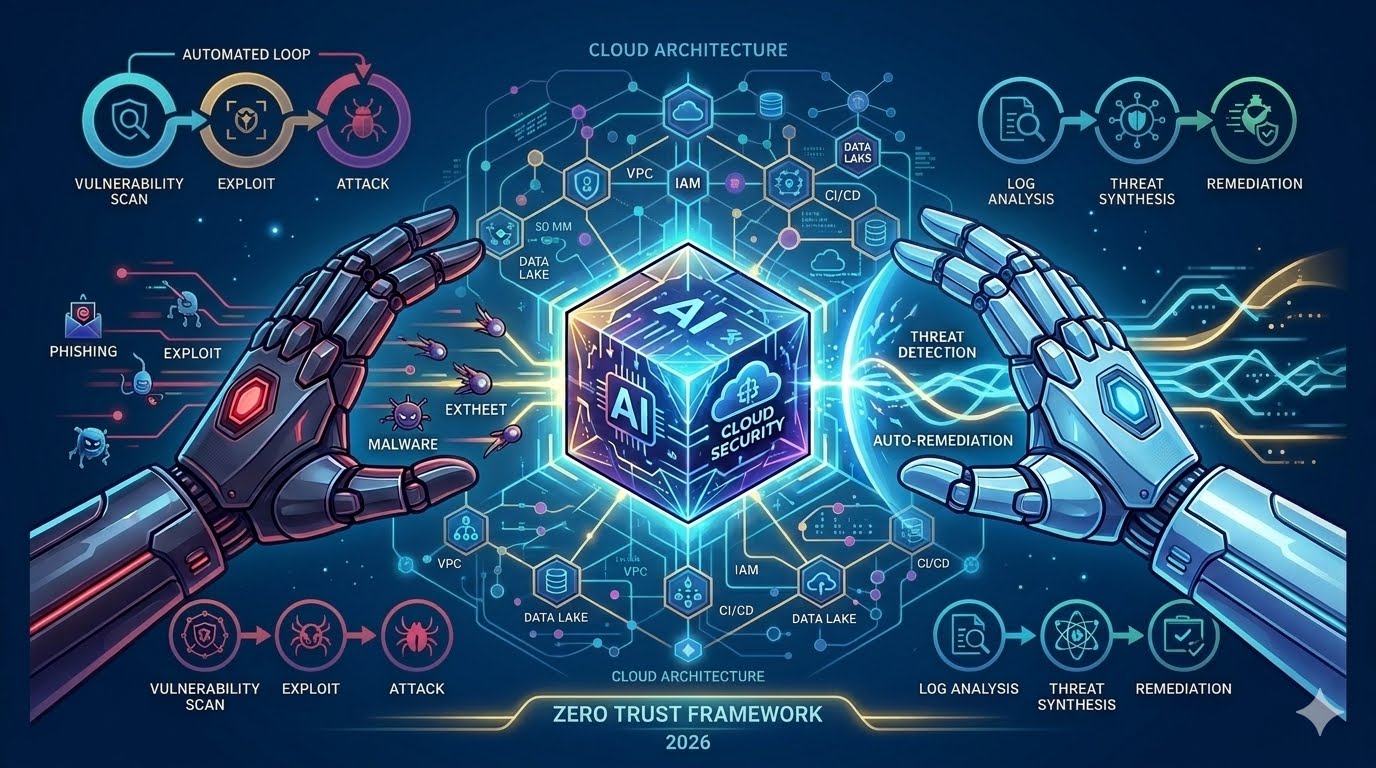
For information and communication technology (ICT) professionals, managing this shift requires a complete overhaul of traditional defense methodologies. Generative Artificial Intelligence (GenAI) is acting as both the ultimate weapon for malicious actors and the shield for modern security operations centers (SOCs). To safeguard enterprise digital assets, security architects must understand this paradigm shift, identify emerging AI-driven threat vectors, and implement zero-trust cloud architectures optimized for the modern era.
1. The Threat Landscape: Weaponized AI in Cloud Environments
The democratization of advanced Large Language Models (LLMs) has inadvertently leveled the playing field for cybercriminals. Malicious entities no longer require advanced programming expertise to orchestrate complex attacks on cloud ecosystems. Instead, automated frameworks are being utilized to scan cloud infrastructures, find misconfigurations, and deploy adaptive exploits at machine speed.
Automated Cloud Misconfiguration Scouting
Human error remains the leading cause of cloud breaches, primarily through open storage buckets, exposed API keys, and overly permissive Identity and Access Management (IAM) policies. Rogue actors are leveraging specialized generative models to continually crawl public cloud footprints, automatically drafting custom exploits the moment a vulnerability is discovered.
Hyper-Personalized AI Phishing and Social Engineering
As documented by recent global cybersecurity intelligence, phishing remains the primary point of entry for over 90% of documented enterprise data breaches. Attackers use GenAI to analyze public records, social engineering profiles, and leaked corporate data to craft highly convincing, context-aware emails.
Furthermore, voice and video deepfakes are increasingly being deployed to bypass traditional multi-factor authentication (MFA) checkpoints by impersonating senior C-suite executives.
Polymorphic Malware Injection
Traditional endpoint detection and response (EDR) tools rely heavily on signature-based detection to stop malware. Today, AI engines are capable of rewriting malicious code on the fly. This results in polymorphic malware that changes its file signature every time it attempts to infiltrate a cloud workload, rendering legacy security tools obsolete.
2. Defensive AI: Empowering the Modern SOC
While the threats are formidable, generative AI provides defensive teams with tools that dramatically minimize the mean time to detect (MTTD) and mean time to respond (MTTR) to security incidents.
[Cloud Traffic / Logs] ---> [AI Threat Synthesis Engine] ---> [Automated Remediation]
|
+---> [Natural Language Alerts for SOC]
Contextual Log Analysis and Threat Synthesis
Cloud environments generate millions of log files daily across various services like AWS CloudTrail, Google Cloud Audit Logs, and Azure Monitor. Humans cannot manually correlate these disparate data points fast enough to stop a lateral movement attack.
GenAI engines excel at ingesting terabytes of unstructured log data, instantly identifying behavioral anomalies, and synthesizing complex alerts into coherent, natural-language threat summaries for analysts.
Automated Code Auditing in CI/CD Pipelines
In a modern DevOps pipeline, security must keep pace with rapid deployment cycles. Generative AI tools integrate directly into code repositories to scan Infrastructure-as-Code (IaC) templates (such as Terraform or Ansible scripts) prior to deployment. If a developer accidentally writes a script that exposes a private database to the public internet, the AI automatically flags the line of code and proposes a remediated alternative before the architecture is provisioned.
3. Securing the AI Pipeline in the Cloud
As organizations build and host their own proprietary AI models within public clouds, the underlying data pipelines themselves become premium targets for corporate espionage and data manipulation. Securing the AI infrastructure is now just as critical as securing standard network architectures.
Organizations must implement safeguards against these critical vectors:
Data Poisoning: Attackers injecting corrupted data into the training sets hosted in cloud data lakes, causing the AI model to output flawed or insecure results.
Prompt Injection Attacks: Malicious users inputting carefully structured prompts designed to force an LLM to bypass its safety guardrails, potentially leaking backend database secrets or proprietary source code.
Model Inversion: Reverse-engineering model outputs to reconstruct the sensitive training data, risking major compliance violations under modern data protection acts.
4. Architectural Best Practices for 2026
To neutralize AI-driven threats, enterprises must shift from reactive security measures to a proactive, resilient framework built around Zero Trust principles.
Security Domain | Legacy Approach | Modern AI-Driven Zero Trust Approach |
|---|---|---|
Identity & Access | Static passwords & periodic MFA | Continuous adaptive authentication analyzing user behavior, location, and device health. |
Data Protection | Encryption at rest and in transit | Continuous automated scanning of data stores to detect and classify shadow data. |
Threat Detection | Signature-based rule matches | Behavioral analysis utilizing machine learning to detect zero-day exploits. |
Enforce Strict Micro-Segmentation
Do not rely on a secure network perimeter. Cloud workloads must be tightly segmented so that if a single container or serverless function is compromised by an AI-driven attack, the threat is entirely contained, preventing lateral movement across the broader network virtual private cloud (VPC).
Immutable Infrastructure and Automated Drift Detection
Enterprise production environments should be completely immutable. Developers should never log directly into production cloud servers to make changes. Instead, any infrastructure modification must go through the version-controlled CI/CD pipeline.
Automated configuration management tools should constantly evaluate the live environment against the approved IaC blueprints, automatically destroying and rebuilding any server that exhibits unauthorized "drift."
Conclusion: The Path Forward for ICT Leaders
Generative Artificial Intelligence has permanently altered the trajectory of cloud security. It is no longer an optional optimization tool; it is a foundational component of both offensive and defensive cybersecurity strategies. The organizations that succeed in this new era will be those that gracefully phase out reactive, legacy monitoring systems in favor of autonomous, self-healing cloud architectures.
For ICT specialists, cloud engineers, and security analysts, the directive is clear: to defend against machine-speed threats, you must deploy machine-speed defenses. Embracing AI-driven security automation, maintaining a strict zero-trust posture, and continuously auditing the cloud-hosted AI data pipeline are the non-negotiable steps required to protect digital assets and drive secure innovation forward.
Did you find this ICT insight helpful?