Microservice and Monoliths in 2026
Microservice and Monoliths.
In 2026, the long-standing debate between Microservices and Monolithic architectures has moved beyond hype and into a phase of "pragmatic maturity." The DevOps landscape has shifted; we are no longer in the era of "microservices for everything." Instead, 2026 is defined by Right-Sizing Architecture, where the choice is driven by team cognitive load, infrastructure cost, and the specific needs of the business rather than industry trends.
The Modern Monolith: Not Your Father's Legacy Code
The biggest surprise of 2026 is the resurgence of the Modular Monolith. For years, "monolith" was a dirty word in DevOps, associated with "spaghetti code" and slow deployment cycles. However, modern tooling has transformed the monolith into a sleek, highly maintainable option.
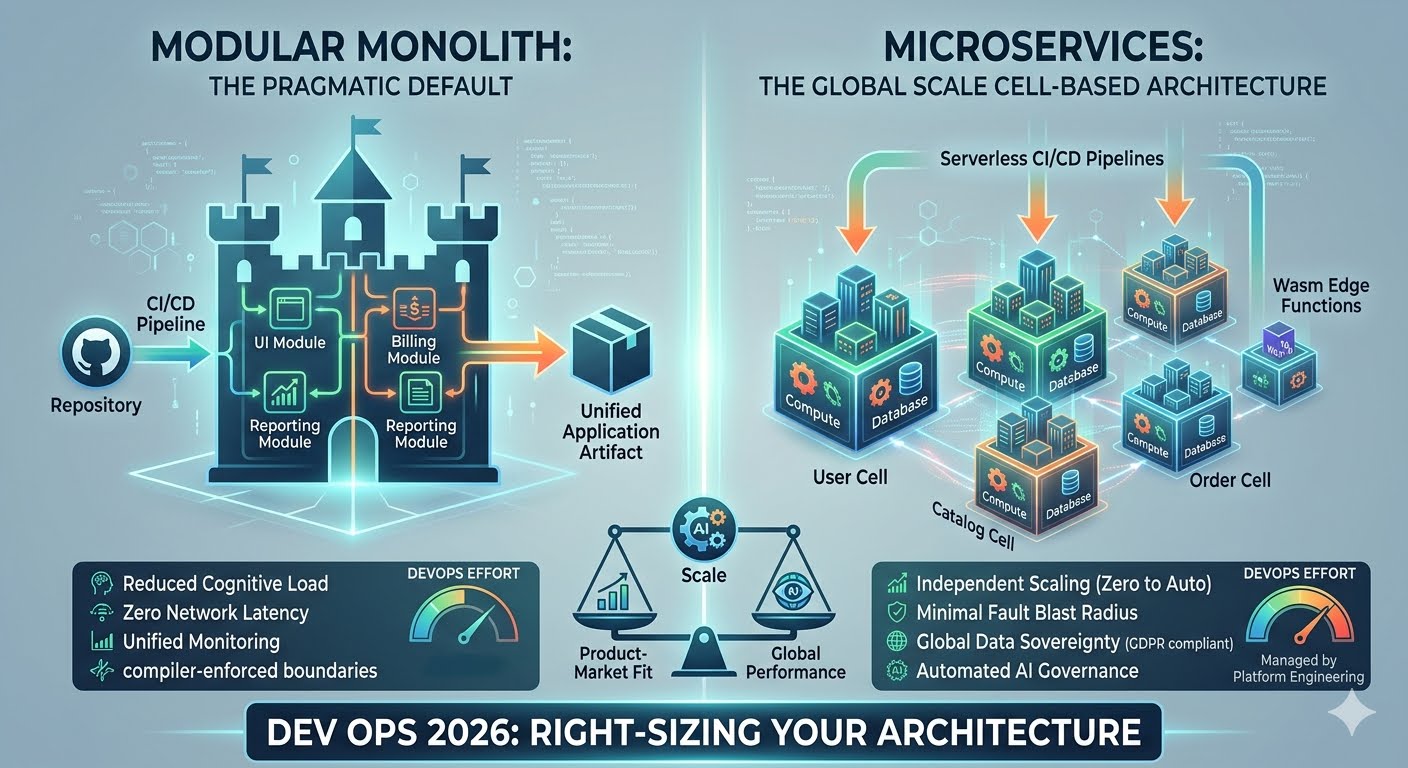
In 2026, developers use advanced static analysis and compiler-enforced boundaries to ensure that a monolithic codebase remains modular. This allows a single deployment unit to behave like separate services internally. The benefits are clear:
Reduced Complexity: No need for complex service meshes (like Istio) or distributed tracing for every minor feature.
Performance: Zero network latency between modules. In-process communication is always faster than an API call over a network.
Simplified DevOps: A single CI/CD pipeline, one monitoring stack, and no "dependency hell" between micro-repos.
For startups and mid-sized teams in 2026, the Modular Monolith is the "default" choice, allowing them to ship faster without the "infrastructure tax" of microservices.
Microservices in 2026: The Specialized Powerhouse
While the monolith has reclaimed territory, Microservices remain the gold standard for global-scale applications. In 2026, microservices have evolved into "Cell-Based Architectures."
Large enterprises like Amazon, Netflix, and Uber no longer just build "services"; they build independent "cells" that contain their own data stores and compute power. This minimizes the "blast radius" of any single failure. The 2026 microservices ecosystem is characterized by:
Serverless Dominance: Most microservices are now "nanoservices" running on advanced serverless platforms that scale to zero instantly, eliminating the cost of idle containers.
WebAssembly (Wasm) at the Edge: Many microservices have moved out of the central cloud and onto the "Edge." By using Wasm, these services run inches away from the user with near-instant cold starts.
Automated Governance: AI-driven DevOps tools now manage the complexity that used to kill microservice projects. AI can automatically detect if a service change will break a downstream dependency before the code is even merged.
The Convergence: Distributed Monoliths and Macro-services
In 2026, we’ve identified a dangerous middle ground: the Distributed Monolith. This happens when a team builds microservices but keeps them so tightly coupled that they must all be deployed together. DevOps engineers now spend significant effort "refactoring back" these failed microservice attempts into "Macro-services"—larger, more logical chunks of code that provide the scalability of services without the fragmentation.
Key Factors for Choosing in 2026
When deciding between the two in the current DevOps environment, teams look at three critical metrics:
Cognitive Load: Can a single developer understand the entire system? If yes, stay monolithic. If the system is too large for one brain, it’s time to break it apart.
Deployment Frequency: If different parts of your app need to be updated at vastly different speeds (e.g., a fast-changing UI vs. a slow-changing billing engine), microservices are essential.
Data Sovereignty: In 2026, global privacy laws are stricter than ever. Microservices make it easier to keep "German user data" on "German servers" while the rest of the app runs globally.
The Role of DevOps and Platform Engineering
The rise of Internal Developer Platforms (IDPs) has leveled the playing field. Whether you choose a monolith or microservices, 2026 DevOps is about "Platform Engineering." Developers don't worry about the underlying architecture as much because the platform provides "Golden Paths"—pre-configured templates for both styles that include security, logging, and scaling out of the box.
Conclusion: The End of the "One Size Fits All" Era
In 2026, the winner of the Microservices vs. Monolith battle is Architecture Agnosticism. The best DevOps teams are those that can evolve their architecture as they grow. They might start with a Modular Monolith to find "product-market fit" and then surgically extract high-load components into microservices as needed.
The "Castles" (Monoliths) and the "Cities" (Microservices) both have their place. The secret to success in 2026 isn't choosing the most "modern" one, but choosing the one that lets your team write code, not manage infrastructure.
Did you find this ICT insight helpful?