The Rise of Platform Engineering
The Rise of Platform Engineering in 2026.
The era of "you build it, you run it" is undergoing a major recalibration. While the DevOps movement successfully broke down the silos between development and operations, it inadvertently created a new problem: cognitive overload. By 2026, the industry has realized that asking every developer to be an expert in Kubernetes, Terraform, IAM roles, and CI/CD pipelines is a recipe for burnout and inefficiency. This realization has fueled the meteoric Rise of Platform Engineering.
Platform Engineering is not a replacement for DevOps; rather, it is the industrialization of DevOps. It is the discipline of designing and building Internal Developer Platforms (IDPs) that provide self-service capabilities, allowing developers to manage their own infrastructure needs within "golden paths" set by the platform team.
The Problem: The "DevOps Tax"
In the early days of DevOps, the mantra was simple: empower developers. However, as the cloud-native ecosystem exploded, the sheer number of tools became overwhelming. A typical developer in 2025 might need to touch 15 different tools just to get a single microservice into production.
This "DevOps Tax" meant that highly paid software engineers were spending 30% to 40% of their time wrestling with YAML files, networking configurations, and security patches instead of writing the business logic that actually generates revenue. Platform Engineering emerged to reclaim this lost time.
What is Platform Engineering?
At its core, Platform Engineering is about treating Infrastructure as a Product. The "customers" of a Platform Engineer are the internal software developers.
The Internal Developer Platform (IDP)
The primary output of a platform team is the IDP. Think of it as a private, company-specific version of AWS or Heroku. An IDP typically includes:
Self-Service Portals: A UI or CLI (like Backstage.io) where a dev can click a button to "Create New Service."
Infrastructure Provisioning: Automated creation of databases, clusters, and storage.
Governance and Compliance: Security policies are baked into the platform, so "default" setups are automatically secure.
Observability: Built-in logging and monitoring that works the moment a service is deployed.
The Core Philosophy: "Golden Paths, Not Cages"
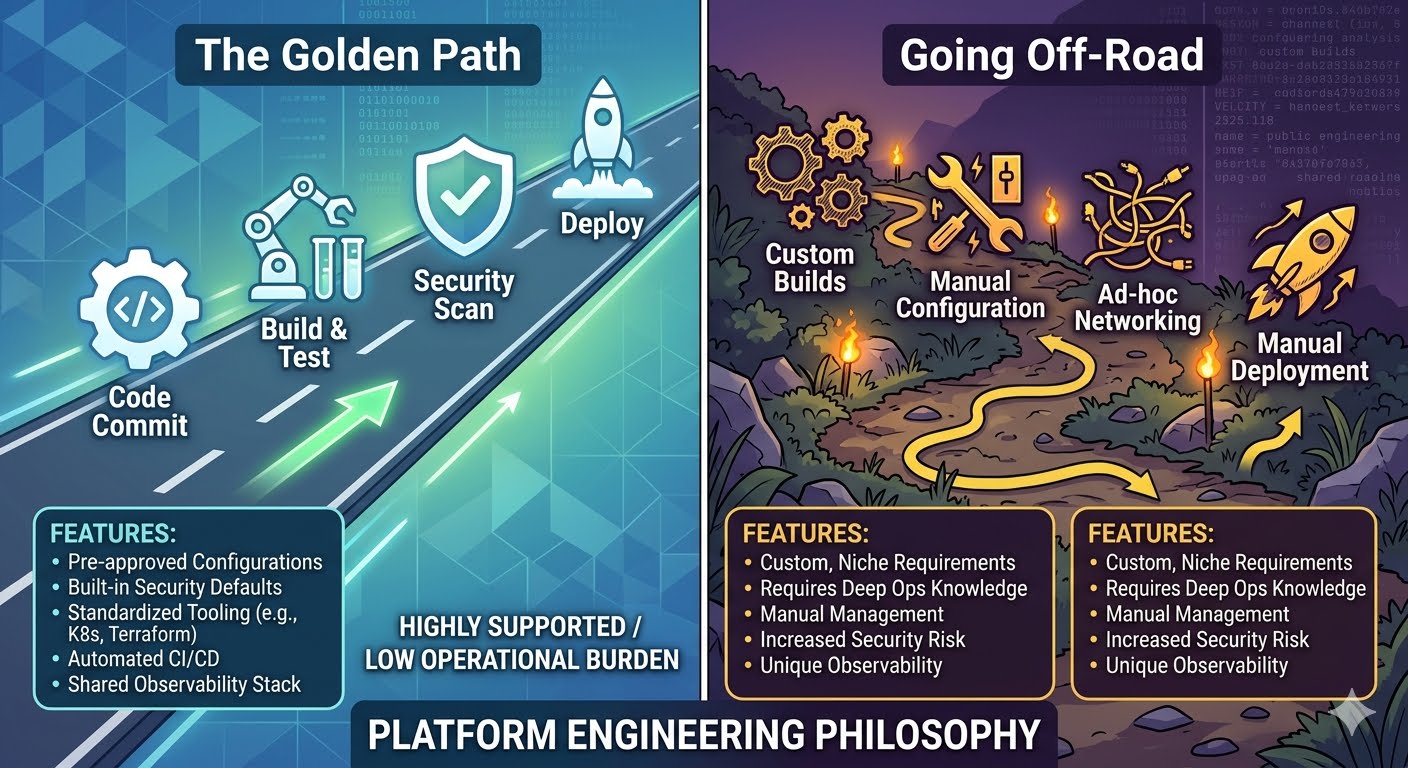
A common fear is that Platform Engineering will restrict developer freedom. The industry has solved this with the concept of Golden Paths.
A Golden Path is a pre-approved, automated way to accomplish a task. If a developer uses the Golden Path to deploy a Laravel app, the platform handles the SSL certificates, the load balancer, and the database backups automatically.
However, if a developer has a unique use case that isn't covered by the Golden Path, they are still free to "go off-road"—but they must then take on the operational burden themselves. This balances standardization with flexibility.
Why It’s Scaling in 2026
The shift toward Platform Engineering is driven by three main factors:
1. Reducing Cognitive Load
By abstracting away the complexity of the underlying infrastructure, Platform Engineering reduces the mental energy required to ship code. This leads to higher Developer Experience (DevEx) scores and better retention of talent.
2. Security and Compliance by Default
In an era of rising cyber threats, "Shift Left" security often failed because developers aren't security experts. Platform Engineering "shifts security into the platform." When the platform manages secrets and network policies, human error—the leading cause of breaches—is significantly reduced.
3. Cost Management (FinOps)
With autonomous teams spinning up cloud resources, costs can spiral. A centralized platform team can implement automated "shutdown" rules for dev environments or enforce the use of cheaper spot instances, saving organizations millions in "cloud waste."
The Difference Between DevOps and Platform Engineering
While they share the same goal (faster, safer delivery), their focus differs:
DevOps is a culture and a set of practices centered on collaboration.
Platform Engineering is the discipline that builds the tools to make those practices scalable.
In 2026, we see "DevOps Engineers" evolving into two roles: Platform Engineers (who build the platform) and Site Reliability Engineers (SREs) (who ensure the platform and services stay up).
The Role of AI in Platform Engineering
By 2026, AI has become the "intelligent glue" of the IDP. Modern platforms now include AIOps features that can:
Predict Failures: Analyze deployment patterns to warn a developer if a change is likely to cause a memory leak.
Natural Language Provisioning: Allow a developer to type "I need a staging environment for the video-upload service" and have the platform generate the necessary resources.
Auto-Remediation: Automatically scale or restart services based on real-time traffic patterns without manual intervention.
Conclusion: The New Standard
The rise of Platform Engineering marks the maturity of the cloud-native era. Organizations have moved past the "Wild West" phase of DevOps and into a structured, product-centric approach to infrastructure.
For the developer, this means a return to the joy of coding. For the organization, it means a more predictable, secure, and cost-effective way to innovate. In 2026, the question is no longer "Do you do DevOps?" but "How good is your platform?"
Did you find this ICT insight helpful?