Post-Quantum Cryptography (PQC)
Post-Quantum Cryptography.
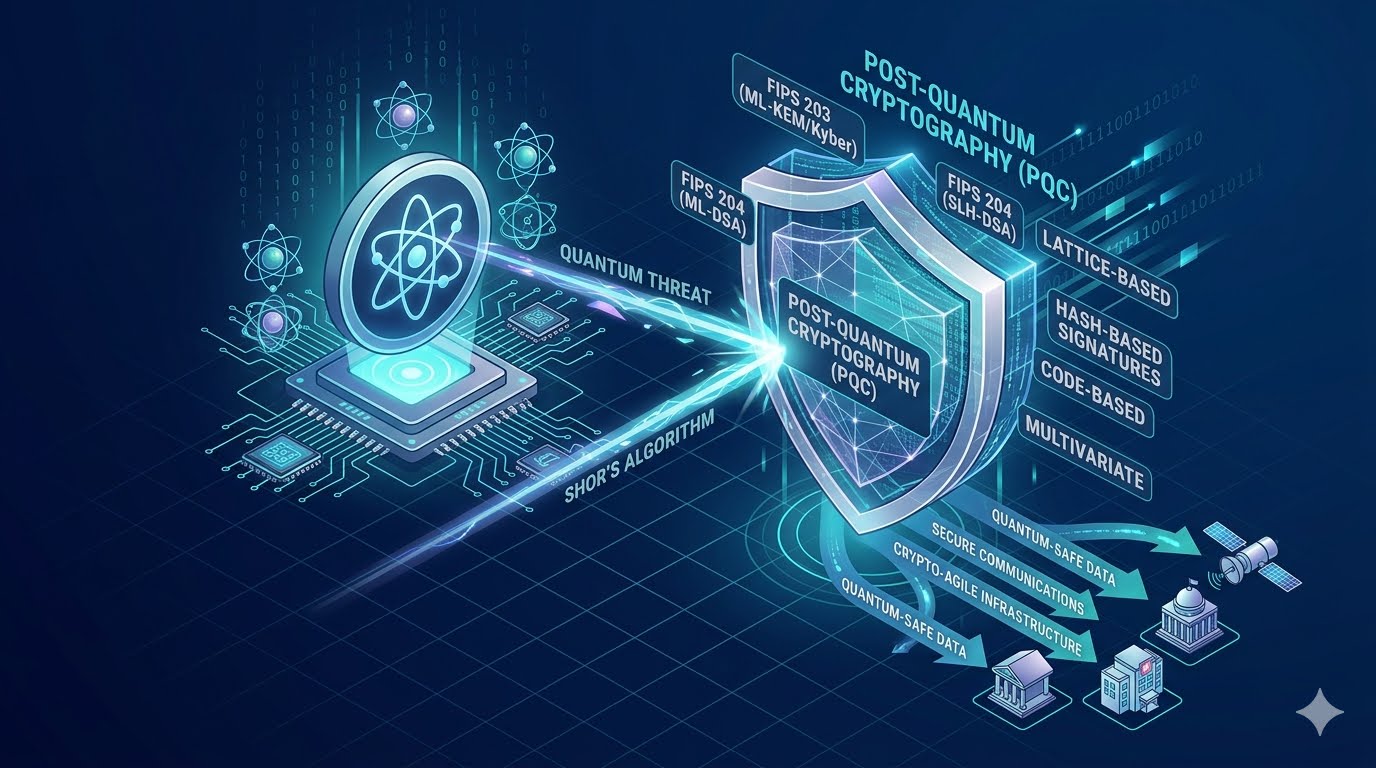
Post-Quantum Cryptography (PQC) is the next critical frontier in cybersecurity, specifically designed to protect digital infrastructure from the theoretical but imminent threat of quantum computers. While traditional encryption relies on the difficulty of factoring large numbers—a task current computers find nearly impossible—quantum computers using Shor's algorithm could potentially solve these problems in minutes.
The Quantum Threat: A Paradigm Shift
Modern cybersecurity relies heavily on public-key infrastructure (PKI) like RSA and Elliptic Curve Cryptography (ECC) to secure everything from bank transfers to private messages. These methods are "pre-quantum" and vulnerable to a Cryptographically Relevant Quantum Computer (CRQC).
A major concern for security experts is the "Harvest Now, Decrypt Later" strategy. Adversaries are currently intercepting and storing high-value encrypted data today, with the intent to decrypt it years from now when sufficiently powerful quantum computers become available. This makes transitioning to quantum-safe protocols an urgent priority, even before quantum computers are fully realized.
Key Approaches to Post-Quantum Cryptography
PQC does not require quantum hardware; it runs on classical computers but uses mathematical problems that are thought to be resistant to both classical and quantum attacks. Research is focused on several distinct mathematical foundations:
Lattice-based Cryptography: These systems use high-dimensional geometric structures called lattices. Even for quantum computers, finding specific paths through these complex multidimensional grids is computationally exhausting. This approach, including algorithms like ML-KEM (formerly Kyber), is favored for its efficiency and scalability.
Hash-based Signatures: These rely on cryptographic hash functions that are naturally resistant to quantum reversal. They offer high security but may have limitations in signature generation speed.
Code-based Cryptography: Relying on error-correcting codes, these systems present quantum computers with difficult decoding problems. One of the oldest and most trusted is the Classic McEliece algorithm.
Multivariate Cryptography: This approach uses systems of complex polynomial equations that are believed to be too difficult for any computer to solve efficiently.
Standardization and Implementation
The National Institute of Standards and Technology (NIST) has spearheaded a global effort to standardize these new algorithms. In August 2024, NIST released its first three official standards:
FIPS 203 (ML-KEM): Based on the CRYSTALS-Kyber algorithm for general encryption.
FIPS 204 (ML-DSA): Based on CRYSTALS-Dilithium for digital signatures.
FIPS 205 (SLH-DSA): Based on SPHINCS+ as an alternative signature scheme.
Organizations are encouraged to adopt "Crypto-Agility"—the ability to rapidly switch cryptographic algorithms without redesigning entire systems. Many are currently using hybrid schemes, which combine traditional classical encryption with post-quantum layers to ensure security remains intact even if one method is eventually compromised.
Challenges and Future Outlook
Transitioning to PQC is not without its hurdles. These new algorithms often require:
Larger Key Sizes: Some PQC algorithms use much larger keys and certificates than RSA, requiring more storage and memory.
Higher Latency: Encryption and decryption can be more computationally intensive, potentially slowing down real-time applications or high-frequency API requests.
Infrastructure Updates: Legacy hardware, particularly in IoT or industrial environments, may lack the processing power needed for these advanced mathematical operations.
Despite these challenges, tech giants like Google, Apple, and Microsoft have already begun integrating post-quantum protections into their platforms. As quantum computing continues to accelerate, the shift to PQC remains the only viable way to ensure long-term data resilience in a post-quantum world.
Did you find this ICT insight helpful?