The Latest in

ICT Articles & Tutorials

World ICT News is a professional platform dedicated to Artificial Intelligence, Cloud Computing, DevOps, and Cybersecurity. Empowering the next generation of ICT specialists. Our exclusive tutorials and articles are designed to serve as a stepping stone for you into the world of ICT industry...

Advanced Data Analytics and Financial Fraud Prevention
May 16, 2026
8 min read

Advanced Data Analytics and Financial Fraud Prevention

How Advanced Data Analytics Prevents Financial Fraud in Modern Banking. The global banking ecosystem is undergoing an unprecedented digital transformation. As institutions shift from legacy physical branches to cloud-native mobile applications, instant payment rails, and decentralized financial architectures, the speed of commerce has accelerated exponentially. Today, billions of dollars cross international borders in milliseconds. However, this friction-less digital experience has introduced an equally sophisticated, hyper-connected threat matrix: automated, distributed financial fraud.Traditional, rules-based fraud detection systems—built on static, "if-then" logic structures—are no longer capable of keeping pace with modern criminal syndicates. These legacy tools are inherently reactive, flagging anomalies only after a vulnerability has been exploited. To shield institutional capital and maintain consumer trust, the financial sector must pivot toward proactive, predictive intelligence.Data analytics, driven by machine learning pipelines, real-time streaming architectures, and behavioral telemetry, has emerged as the foundational pillar of modern banking defense. By processing petabytes of transactional, behavioral, and contextual data simultaneously, financial institutions can identify, isolate, and neutralize fraudulent activities in mid-air before a single cent leaves the network.1. The Anatomy of Modern Financial FraudTo appreciate the disruptive impact of data analytics, one must first analyze the highly technical nature of modern banking fraud. Cybercriminals leverage automated infrastructure, residential proxy networks, and generative artificial intelligence to mimic legitimate consumer profiles.Synthetic Identity TheftSynthetic identity fraud is one of the fastest-growing financial crimes globally. Instead of stealing a real person's complete identity, malicious actors harvest fragments of real credit data (such as stolen Social Security Numbers or national identity tokens) and combine them with completely fabricated personal details (false names, synthetic addresses, and newly registered burner phone numbers). Over several months, these synthetic profiles apply for minor lines of credit, build positive repayment histories, and suddenly "spin out"—maxing out major institutional loans and vanishing without a trace.Account Takeover (ATO) AttacksAccount Takeovers occur when unauthorized entities gain complete administrative control of a legitimate customer’s banking profile. These breaches are rarely executed via simple manual password guessing. Instead, malicious actors deploy automated credential-stuffing botnets across cloud infrastructure, testing millions of leaked username and password combinations across banking login portals within minutes. Once inside, they rapidly alter contact phone numbers, disable multi-factor authentication (MFA) parameters, and drain liquid assets via untraceable peer-to-peer wire transfers.Authorized Push Payment (APP) ScamsUnlike direct hacks, APP scams exploit human psychology. Attackers use sophisticated social engineering, business email compromise (BEC) frameworks, or deepfake audio to convince legitimate users, business accountants, or corporate treasurers to willingly authorize high-value wire transfers to shell corporate accounts. Because the actual transaction is initiated by an authorized user using their correct security tokens, legacy fraud systems see the payment as entirely legitimate.2. The Core Analytics Framework: Transitioning from Rules to PredictionLegacy banking applications protect accounts using static rulesets, such as: "If a transaction exceeds $10,000 and occurs outside the home country, flag for manual review."While straightforward, this approach exhibits two catastrophic flaws:Massive False Positive Rates: Legitimate travelers making normal purchases are locked out of their accounts, destroying the user experience.Susceptibility to Reverse Engineering: Professional fraudsters rapidly test transaction amounts (e.g., executing charges of $9,995 instead of $10,000) to map out and bypass a bank's defensive limits.Advanced data analytics solves this by replacing binary rules with multi-dimensional, continuous risk scoring.[ Incoming Transaction ] │ ├──> Behavioral Telemetry Analytics ───┐ ├──> Graph Theory Network Mapping ──────┼─> [ Machine Learning Engine ] ─> [ Continuous Risk Score ] └──> Device Fingerprint Analytics ─────┘ │ ├──> Score < 30 : Approve Automatically ├──> Score 30-70 : Trigger Adaptive MFA └──> Score > 70 : Instant Freeze & Decline3. Key Analytic Techniques Driving Fraud PreventionTo build a comprehensive, multi-layered fraud prevention stack, banks run three primary data analytics workflows simultaneously across their core processing engines.1. Behavioral Biometrics and User TelemetryEvery human interacts with digital devices in a highly distinct, idiosyncratic manner. Behavioral analytics models ingest unstructured telemetry data directly from mobile apps and web frontends to build an invisible, continuous biometric profile for each client.Keystroke Dynamics: Analyzing the exact millisecond dwell time (how long a key is held down) and flight time (the gap between keys) during a login attempt.Touchscreen Pressures & Angles: Measuring how firmly a user presses their smartphone screen and the precise angle at which they hold the device.Mouse Trajectory Vectoring: Track real-time cursor paths. Real humans move mice in erratic, curved vectors with natural micro-pauses; automated botnets move in perfect, computationally optimal straight lines.If an account logs in with the correct password and passes MFA, but the typing speed and finger pressure vectors match a known botnet signature or a distinct profile, the system instantly triggers an out-of-band identity verification step.2. Graph Database Analytics and Network TopologyFraudsters rarely operate in complete isolation; they rely on interconnected webs of mule accounts, shell companies, and shared digital infrastructure to launder stolen funds. Traditional relational databases (SQL) struggle to track these relationships because mapping deep links across billions of columns requires complex, computationally expensive table joins.Graph analytics utilizes specialized graph databases (such as Neo4j or Amazon Neptune) to treat data as nodes (entities like accounts, names, or devices) and edges (the relationships between them).[ Stolen Device ID ] ──(Shared Link)──> [ Fraudulent Account A ] │ (Rapid Transfer) ▼ [ Mule Account B ] │ (Rapid Transfer) ▼ [ Shell Company C ]By visualizing the banking network as an interconnected topology, graph analytics can detect Fraud Rings instantly. If the system observes ten separate bank accounts opened by completely different individuals, but notes that all ten profiles share a single, hidden variable—such as a matching hardware MAC address or an identical employer tax ID—the graph network flags the entire cluster as a synthetic identity setup before a single credit line can be drawn.3. Real-Time Streaming Analytics and Event ProcessingFraud occurs at machine speed; therefore, remediation must occur at machine speed. Modern banking architectures utilize streaming data platforms like Apache Kafka or Amazon Kinesis to intercept transaction payloads in transit.As a payment request is initiated, the streaming engine matches the event against historical baseline data within a tight 200-millisecond window. The model runs predictive algorithms evaluating historical location drift, spending velocities, merchant categorization codes, and device health. If the transaction deviates significantly from the user's localized spatial-temporal habits, the pipeline changes the transaction state to "Pending Verification," freezing the assets safely before the outbound wire clears the clearinghouse.4. The Engineering Blueprint: Implementing AI/ML Fraud PipelinesBuilding an enterprise-grade analytics engine requires an integrated data engineering pipeline that can handle both massive batch training and ultra-fast real-time scoring.Architecture TierTechnological ToolingPrimary Operational RoleData IngestionApache Kafka, AWS KinesisCaptures clickstream logs, device telemetry, and raw financial transactions concurrently.Storage & Feature StoreSnowflake, Databricks, FeastHouses historical raw logs and processes calculated features (e.g., 24-hour rolling transfer velocity).Model Processing EngineApache Spark, PyTorch, XGBoostExecutes complex machine learning inferences and predictive classification modeling within milliseconds.Orchestration LayerApache Airflow, KubeflowAutomates the continuous retraining, validation, and deployment of updated ML models.Feature Engineering: The Secret to High AccuracyThe predictive accuracy of any AI model rests entirely on the quality of its features. In a financial context, feature engineering takes raw transaction points and translates them into meaningful metrics. For example, instead of passing a raw transaction amount ($500) to an algorithm, data scientists engineer dynamic variables such as:ratio_ of _current_ amount_ to_ historical_ average _30dvelocity _of_ transactions_ in_ last _60_ minutesdistance_ between_ physical_ merchant_ and_ last_ atm_ withdrawalBy providing the machine learning model with highly descriptive, contextual variables, the algorithm can accurately separate an unusual but completely legitimate holiday shopping spree from an actual, active account draining operation.5. Overcoming Ethical and Operational ObstaclesWhile data analytics offers immense power, banking institutions must navigate critical regulatory, privacy, and infrastructure challenges when deploying these systems at scale.Managing False PositivesLocking an active card or freezing a business payroll account due to an incorrect fraud algorithm causes immense customer frustration and reputational damage. Banks must implement Explainable AI (XAI) frameworks. If a model flags a transaction as fraudulent, it cannot simply output a black-box answer. It must provide clear, auditable reasons (e.g., "Flagged due to a 400% deviation in typical transaction value combined with an unverified browser footprint"). This allows customer support teams to resolve issues transparently and efficiently.Regulatory Compliance and Data PrivacyFinancial analytics operates under strict global compliance mandates, including the General Data Protection Regulation (GDPR), Payment Card Industry Data Security Standard (PCI-DSS), and Know Your Customer (KYC) mandates. Banks cannot blindly store unencrypted consumer data in public cloud environments for analytics modeling. Data engineering teams must implement advanced anonymization, tokenization, and differential privacy methodologies, ensuring that models learn transactional patterns without ever exposing the sensitive, personally identifiable information (PII) of individual consumers.Conclusion: The Future of Autonomous Financial DefenseData analytics has completely shifted the power dynamics of global risk management. Financial fraud is no longer an unavoidable operational cost of doing business online; it is an engineered problem that can be actively managed, contained, and neutralized through continuous data intelligence.As cybercriminals continue to integrate sophisticated artificial intelligence into their offensive arsenals, the banking sector's defensive architectures must evolve in parallel. The institutions that thrive in this digital-first era will be those that view data analytics not merely as an IT support tool, but as a core, strategic shield—an autonomous, self-learning ecosystem capable of protecting global capital, preserving system integrity, and maintaining human trust at machine speed.
A Complete Guide to Running Docker Containers on AWS EC2
May 16, 2026
6 min read

A Complete Guide to Running Docker Containers on AWS EC2

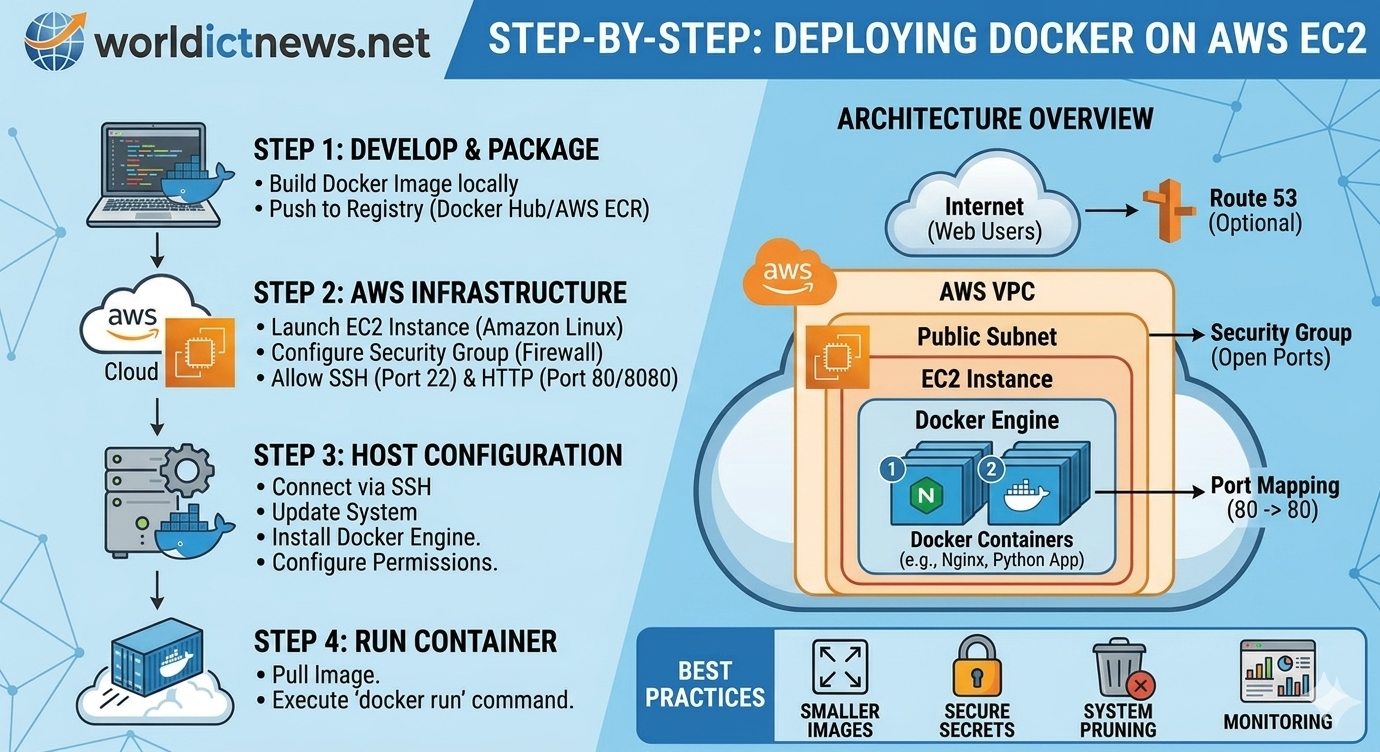
Streamlining Container Deployment: A Complete Guide to Running Docker Containers on AWS EC2. The containerization revolution has completely redefined how modern software is built, packaged, and shipped. By bundling an application alongside all its dependencies, system tools, and configurations, Docker ensures that software runs identically whether it is on a developer's local laptop or a massive corporate server. However, packaging your application into a Docker image is only half the battle; the real value comes from deploying that container to a reliable, scalable cloud infrastructure.For organizations running light-to-medium workloads, or those transitioning from legacy servers to a DevOps model, deploying Docker containers on an Amazon Web Services (AWS) Elastic Compute Cloud (EC2) instance is the perfect middle ground. While managed services like Amazon ECS (Elastic Container Service) or EKS (Elastic Kubernetes Service) handle complex orchestration, running Docker directly on EC2 offers granular control, unmatched transparency, and a cost-effective environment to master cloud deployments.1. Architectural Blueprint: Docker on EC2Deploying a containerized application onto a raw cloud server requires connecting several infrastructure components together securely. The workflow follows a clean, sequential pipeline:[ Developer PC ] ──(Push Image)──> [ Docker Hub / ECR ] │ (Pull Image) ▼[ AWS Cloud ] ──> [ VPC / Security Group ] ──> [ EC2 Instance (Docker Run) ]To achieve this setup successfully, developers must navigate three key deployment phases:Provisioning the Infrastructure: Setting up an AWS virtual server with correct security access.Configuring the Environment: Installing the Docker runtime engine directly onto the Linux host.Deploying the App: Pulling the pre-packaged container image from a registry and running it.2. Phase 1: Launching and Securing Your EC2 InstanceThe foundation of your deployment is the EC2 instance itself. Think of this as renting a blank virtual computer inside Amazon’s secure data centers.Selecting the Right AMILog into your AWS Management Console and navigate to the EC2 Dashboard. Click "Launch Instance". When choosing your Amazon Machine Image (AMI), select Amazon Linux 2023 (or Ubuntu 24.04 LTS). These operating systems are lightweight, highly secure, and optimized to run container workloads efficiently. For basic applications, choosing a t3.micro or t2.micro instance type falls within the AWS Free Tier, providing a risk-free testing ground.Configuring the Security Group (Firewall)A critical pitfall for beginners is misconfiguring network access. A Security Group acts as a virtual firewall controlling inbound and outbound traffic. To configure this properly, add two essential Inbound Rules:SSH (Port 22): Restrict the source to "My IP" so only your computer can log into the command line of the server.HTTP (Port 80 / Port 8080): Set the source to "Anywhere (0.0.0.0/0)" so public users can access your web application once it goes live.Download your private key pair file (.pem or .ppk) securely to your machine; you will need this file to authenticate your connection to the server.3. Phase 2: Preparing the Host System for DockerOnce your instance is up and running, you must connect to it via SSH and install the Docker engine. Open your local terminal (or Git Bash on Windows) and run the following command to log into your cloud server:bashssh -i "your-key-pair.pem" ec2-user@your-ec2-public-ipUse code with caution.Installing the Docker EngineOnce inside the Amazon Linux environment, update the system packages and install Docker using the native package manager:bash# Update the system repositorysudo dnf update -y# Install the latest Docker engine packagesudo dnf install docker -y# Start the background Docker servicesudo systemctl start docker# Enable Docker to automatically turn on whenever the server rebootssudo systemctl enable dockerUse code with caution.Optimizing User PermissionsBy default, the system requires administrative privileges (sudo) for every single Docker command. To prevent typos and enforce security best practices, add your default system user to the docker group:bashsudo usermod -aG docker ec2-userUse code with caution.Note: For these permission changes to take effect, close your terminal connection by typing exit, and then log back into the server using the SSH command provided above. Validate that the engine is running properly by typing docker info.4. Phase 3: Launching Your Containerized WorkloadWith Docker successfully running on your cloud server, you are fully prepared to launch your container. For this standard configuration guide, we will pull and run a production-ready Nginx web server container directly from Docker Hub.Execute the following command to deploy your containerized app:bashdocker run -d -p 80:80 --name my-web-app --restart always nginxUse code with caution.Dissecting the Deployment CommandUnderstanding exactly what happens behind the scenes of this command is vital for any cloud engineer:ParameterFunctionOperational Impact-dDetached ModeRuns the container quietly in the background, keeping your terminal open.-p 80:80Port MappingMaps traffic arriving at Port 80 of the EC2 instance directly into Port 80 inside the container.--nameCustom LabelingAssigns a readable name to the container for simple logging and management.--restartResiliency PolicyInstructs Docker to automatically restart the container if it crashes or if the server reboots.To verify that your deployment is completely healthy, run docker ps. Open any web browser, paste your EC2 instance's Public IPv4 Address into the address bar, and hit enter. You will instantly be greeted by the default Nginx welcome page, proving your container is live to the world.5. Enterprise Best Practices: Security and MaintenanceRunning Docker on raw EC2 instances demands a proactive approach to system security. To ensure your production environments remain resilient against malicious attacks, incorporate these DevOps protocols:Implement Multi-Stage BuildsKeep your production Docker images as small as possible. Use multi-stage builds in your Dockerfile to compile your code in a temporary container, transferring only the finished binary or compiled frontend files into the final production image. This radically slashes your attack surface by stripping away unnecessary compilers and system tools.Never Bake Secrets Into ImagesHardcoding API keys, database passwords, or AWS credentials directly into a Dockerfile or source code is an immense security vulnerability. Instead, leverage runtime environment variables or integrate your instances with AWS Systems Manager (SSM) Parameter Store. Pass these variables securely at runtime using the -e flag:bashdocker run -d -p 80:80 -e DB_PASSWORD=secure_token my-custom-appUse code with caution.Regular Pruning and Resource ManagementOver time, continuous deployment cycles leave behind unused container layers, stopped containers, and dangling images that silently eat up your instance’s limited storage disk space. Set up a cron job or regularly execute the clean-up command to reclaim valuable space:bashdocker system prune -af --volumesUse code with caution.Conclusion: The Stepping Stone to Cloud ArchitectureDeploying Docker containers directly on AWS EC2 is an essential foundational skill for any modern web developer or system administrator. It strips away the complex abstractions of advanced container orchestrators, giving you clear insight into how cloud networks, virtual firewalls, operating system daemons, and isolated application processes interact.Once you feel fully comfortable managing individual container deployments manually on EC2, you can easily automate this entire process using a CI/CD pipeline, or smoothly transition your workloads onto managed services like AWS ECS and Fargate for enterprise-grade scalability.
Introduction to CI/CD Pipelines for Absolute Beginners
May 16, 2026
7 min read

Introduction to CI/CD Pipelines for Absolute Beginners

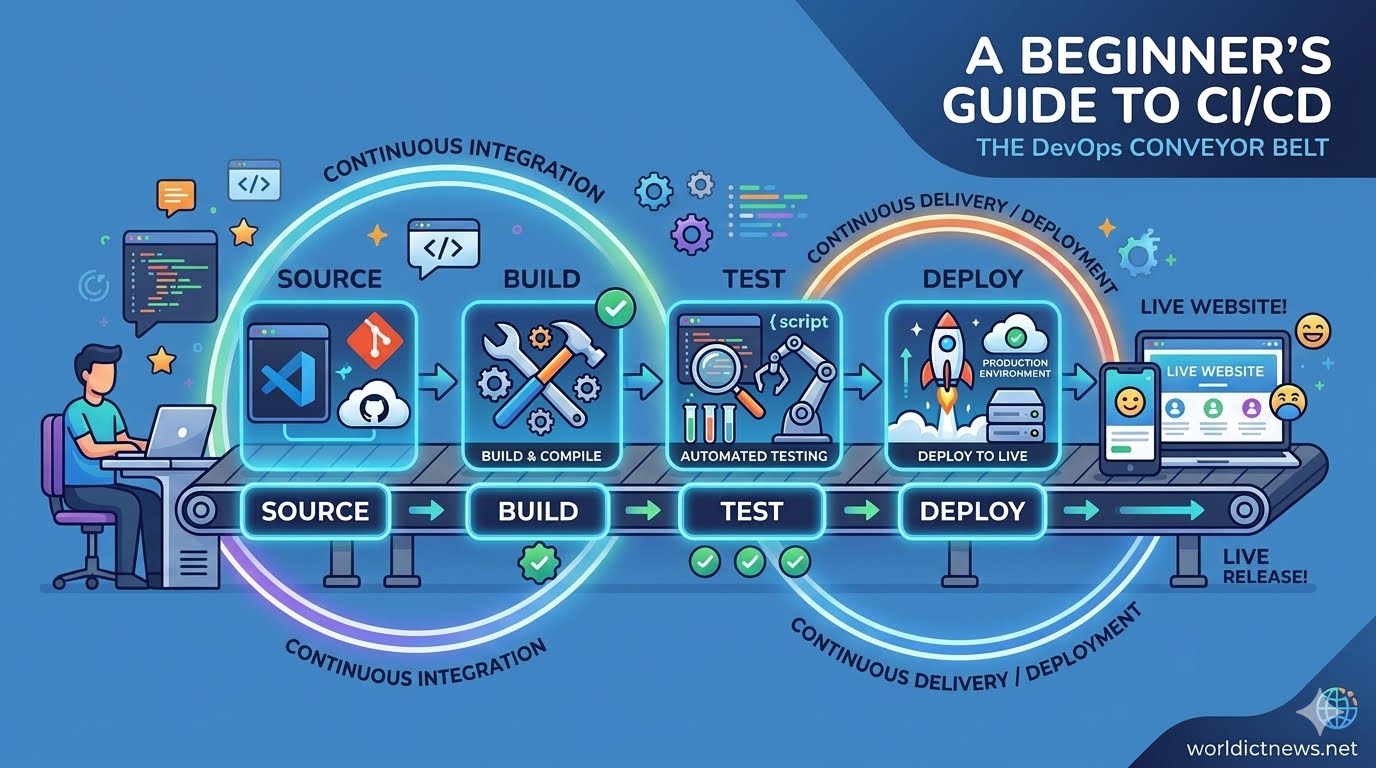
An Introduction to CI/CD Pipelines for Absolute Beginners. In the early days of software engineering, deploying new features to a live website was a stressful, high-stakes event. Developers would spend months writing code in isolation, bundle it all together into a massive update, and manually upload files to a server, often late at night. If a single typo or missing file slipped through, the entire website could crash, forcing teams to scramble for hours to find the error.Today, modern tech giants like Amazon, Netflix, and Google deploy new code thousands of times a day without their users ever noticing a disruption. How do they achieve this level of speed and stability? The secret lies in a core DevOps practice known as the CI/CD Pipeline.For absolute beginners, terms like "DevOps," "Automation," and "Pipelines" can sound incredibly intimidating. However, the core concept behind CI/CD is simple: it is a digital conveyor belt that takes software code from a developer’s computer, tests it to ensure it works perfectly, and safely delivers it to the live users—completely automatically.1. Deconstructing the Acronym: What is CI/CD?To understand how this conveyor belt works, we must break down the two main acronyms that define it: Continuous Integration and Continuous Delivery (or Continuous Deployment).[ Developer Writes Code ] │ ▼┌───────────┐│ CONTINUOUS INTEGRATION │ <-- Automates compiling & testing code└───────────┘ │ ▼┌─────────────┐│ CONTINUOUS DELIVERY │ <-- Automates preparing code for release└─────────────┘ │ ▼┌─────────────┐│ CONTINUOUS DEPLOYMENT │ <-- Automates pushing code to live users└─────────────┘Continuous Integration (CI)Continuous Integration focuses on the first stage of the development process. In an engineering team, multiple developers work on different features of the same application at the same time. If they all try to merge their individual changes back into the main codebase at the end of the month, it results in chaotic code conflicts—often called "merge hell."CI solves this by encouraging developers to merge their code changes back into a central repository frequently—often multiple times a day. Every single time a developer submits code, an automated system kicks into gear. This system automatically builds (compiles) the code and runs a battery of automated tests. If the tests pass, the code is safely integrated. If a bug is detected, the system alerts the developer immediately, allowing them to fix it while it is still fresh in their mind.Continuous Delivery vs. Continuous Deployment (CD)The "CD" half of the acronym can mean two slightly different things depending on how far an organization chooses to automate its process:Continuous Delivery: The automated system ensures that the code passes all tests and is fully prepared to go live. However, it stops just short of publishing it to the real world. A human manager must manually click a "Release" button to authorize the final push to production.Continuous Deployment: This is the ultimate level of automation. There is no human gatekeeper. If the code passes all automated tests in the CI stage, it is immediately and automatically deployed to live production servers.2. The Four Key Stages of a CI/CD PipelineTo visualize how code travels down this automated pipeline, let’s look at the four primary phases that every code update goes through:Pipeline StageWhat HappensWhy It Matters1. SourceDeveloper pushes code to a repository (e.g., GitHub).Triggers the pipeline to begin.2. BuildCode is compiled and packaged into a runnable app.Detects syntax errors and missing files.3. TestAutomated tools check for bugs and performance issues.Prevents broken code from reaching users.4. DeployThe application is pushed to a live server or cloud environment.Makes features visible to the real world.Stage 1: The Source (The Trigger)The pipeline begins the moment a developer finishes writing a feature and saves it to a version control system like GitHub, GitLab, or Bitbucket. This action acts as an electronic trigger, sending a signal to the CI/CD software that says: "New code has arrived. Start the inspection process."Stage 2: The BuildComputers cannot run raw code exactly how humans write it. In the build stage, the pipeline compiles the source code into a clean, executable package. If the application is built using a modern framework (like React, Docker, or Java), this stage gathers all the necessary dependencies, libraries, and files into a single, cohesive bundle. If a developer accidentally left a typo that prevents the app from starting, the build fails right here, halting the conveyor belt before any damage is done.Stage 3: The TestThis is the heart of the pipeline. Instead of relying on a human quality assurance (QA) analyst to manually click every button on a website to check for errors, the pipeline runs automated scripts. These include Unit Tests (checking if individual functions calculate data correctly) and Integration Tests (ensuring different parts of the application talk to each other flawlessly). If even a single test fails, the pipeline sounds an alarm, rejects the update, and notifies the team.Stage 4: The DeployIf the code passes all tests with flying colors, it reaches the final stage. The pipeline automatically moves the completed application bundle onto cloud servers (like AWS, Microsoft Azure, or Google Cloud). Within seconds, users around the world have access to the brand-new feature, entirely without downtime.3. Why is CI/CD Vital for Modern Software?For a beginner, setting up a pipeline might seem like an extra, unnecessary chore. Why not just write code and upload it directly? The benefits of CI/CD completely transform how software businesses operate:Lightning-Fast Releases: Instead of waiting months to bundle hundreds of features together, companies can release value to their customers incrementally, day by day or hour by hour.Trivial Risk: Because code changes are shipped in tiny, bite-sized updates, tracking down bugs is incredibly simple. If something breaks, engineers know exactly which 10 lines of code caused the issue, rather than searching through 10,000 lines.Happier Engineering Teams: Automation removes the boring, repetitive tasks of manual testing and deployment. Developers get to spend their energy doing what they love most: solving problems and writing creative code.4. Popular Tools to Start Your JourneyIf you want to start practicing CI/CD, you don't need to build these automation systems from scratch. There are pre-built tools designed to manage the conveyor belt for you:GitHub Actions: The absolute best starting point for beginners. It is built directly into GitHub, meaning you can set up automation right alongside where you store your code using simple configurations.Jenkins: A powerful, open-source, industry-standard tool. It is highly customizable but has a steeper learning curve because you have to host and manage it yourself.GitLab CI/CD: A robust, all-in-one platform seamlessly woven into GitLab's ecosystem, heavily favored by enterprise enterprise DevOps teams.Conclusion: Take the First StepEmbracing the world of CI/CD requires a mental shift from thinking about software as a static product to seeing it as a living, continuously evolving service. For absolute beginners, mastering the core principles of automation is the single most valuable step you can take toward a professional career in modern web development or DevOps engineering.Start small: write a simple HTML page, host it on GitHub, and use a tool like GitHub Actions to automatically deploy it to a free hosting provider whenever you make a change. Once you watch your first automated pipeline turn code into a live website, you will never want to deploy software manually ever again.
Generative AI and Cloud Security Frameworks in 2026
May 16, 2026
5 min read

Generative AI and Cloud Security Frameworks in 2026

How Generative AI is Reshaping Cloud Security Frameworks in 2026. The rapid convergence of cloud computing and artificial intelligence has reached a critical tipping point. Modern enterprise infrastructures are no longer just cloud-hosted; they are AI-driven. While this technological evolution has unlocked unprecedented computational efficiency and automated scaling, it has simultaneously introduced an entirely new, highly sophisticated landscape of vulnerabilities.For information and communication technology (ICT) professionals, managing this shift requires a complete overhaul of traditional defense methodologies. Generative Artificial Intelligence (GenAI) is acting as both the ultimate weapon for malicious actors and the shield for modern security operations centers (SOCs). To safeguard enterprise digital assets, security architects must understand this paradigm shift, identify emerging AI-driven threat vectors, and implement zero-trust cloud architectures optimized for the modern era.1. The Threat Landscape: Weaponized AI in Cloud EnvironmentsThe democratization of advanced Large Language Models (LLMs) has inadvertently leveled the playing field for cybercriminals. Malicious entities no longer require advanced programming expertise to orchestrate complex attacks on cloud ecosystems. Instead, automated frameworks are being utilized to scan cloud infrastructures, find misconfigurations, and deploy adaptive exploits at machine speed.Automated Cloud Misconfiguration ScoutingHuman error remains the leading cause of cloud breaches, primarily through open storage buckets, exposed API keys, and overly permissive Identity and Access Management (IAM) policies. Rogue actors are leveraging specialized generative models to continually crawl public cloud footprints, automatically drafting custom exploits the moment a vulnerability is discovered.Hyper-Personalized AI Phishing and Social EngineeringAs documented by recent global cybersecurity intelligence, phishing remains the primary point of entry for over 90% of documented enterprise data breaches. Attackers use GenAI to analyze public records, social engineering profiles, and leaked corporate data to craft highly convincing, context-aware emails.Furthermore, voice and video deepfakes are increasingly being deployed to bypass traditional multi-factor authentication (MFA) checkpoints by impersonating senior C-suite executives.Polymorphic Malware InjectionTraditional endpoint detection and response (EDR) tools rely heavily on signature-based detection to stop malware. Today, AI engines are capable of rewriting malicious code on the fly. This results in polymorphic malware that changes its file signature every time it attempts to infiltrate a cloud workload, rendering legacy security tools obsolete.2. Defensive AI: Empowering the Modern SOCWhile the threats are formidable, generative AI provides defensive teams with tools that dramatically minimize the mean time to detect (MTTD) and mean time to respond (MTTR) to security incidents.[Cloud Traffic / Logs] ---> [AI Threat Synthesis Engine] ---> [Automated Remediation] | +---> [Natural Language Alerts for SOC]Contextual Log Analysis and Threat SynthesisCloud environments generate millions of log files daily across various services like AWS CloudTrail, Google Cloud Audit Logs, and Azure Monitor. Humans cannot manually correlate these disparate data points fast enough to stop a lateral movement attack.GenAI engines excel at ingesting terabytes of unstructured log data, instantly identifying behavioral anomalies, and synthesizing complex alerts into coherent, natural-language threat summaries for analysts.Automated Code Auditing in CI/CD PipelinesIn a modern DevOps pipeline, security must keep pace with rapid deployment cycles. Generative AI tools integrate directly into code repositories to scan Infrastructure-as-Code (IaC) templates (such as Terraform or Ansible scripts) prior to deployment. If a developer accidentally writes a script that exposes a private database to the public internet, the AI automatically flags the line of code and proposes a remediated alternative before the architecture is provisioned.3. Securing the AI Pipeline in the CloudAs organizations build and host their own proprietary AI models within public clouds, the underlying data pipelines themselves become premium targets for corporate espionage and data manipulation. Securing the AI infrastructure is now just as critical as securing standard network architectures.Organizations must implement safeguards against these critical vectors:Data Poisoning: Attackers injecting corrupted data into the training sets hosted in cloud data lakes, causing the AI model to output flawed or insecure results.Prompt Injection Attacks: Malicious users inputting carefully structured prompts designed to force an LLM to bypass its safety guardrails, potentially leaking backend database secrets or proprietary source code.Model Inversion: Reverse-engineering model outputs to reconstruct the sensitive training data, risking major compliance violations under modern data protection acts.4. Architectural Best Practices for 2026To neutralize AI-driven threats, enterprises must shift from reactive security measures to a proactive, resilient framework built around Zero Trust principles.Security DomainLegacy ApproachModern AI-Driven Zero Trust ApproachIdentity & AccessStatic passwords & periodic MFAContinuous adaptive authentication analyzing user behavior, location, and device health.Data ProtectionEncryption at rest and in transitContinuous automated scanning of data stores to detect and classify shadow data.Threat DetectionSignature-based rule matchesBehavioral analysis utilizing machine learning to detect zero-day exploits.Enforce Strict Micro-SegmentationDo not rely on a secure network perimeter. Cloud workloads must be tightly segmented so that if a single container or serverless function is compromised by an AI-driven attack, the threat is entirely contained, preventing lateral movement across the broader network virtual private cloud (VPC).Immutable Infrastructure and Automated Drift DetectionEnterprise production environments should be completely immutable. Developers should never log directly into production cloud servers to make changes. Instead, any infrastructure modification must go through the version-controlled CI/CD pipeline.Automated configuration management tools should constantly evaluate the live environment against the approved IaC blueprints, automatically destroying and rebuilding any server that exhibits unauthorized "drift."Conclusion: The Path Forward for ICT LeadersGenerative Artificial Intelligence has permanently altered the trajectory of cloud security. It is no longer an optional optimization tool; it is a foundational component of both offensive and defensive cybersecurity strategies. The organizations that succeed in this new era will be those that gracefully phase out reactive, legacy monitoring systems in favor of autonomous, self-healing cloud architectures.For ICT specialists, cloud engineers, and security analysts, the directive is clear: to defend against machine-speed threats, you must deploy machine-speed defenses. Embracing AI-driven security automation, maintaining a strict zero-trust posture, and continuously auditing the cloud-hosted AI data pipeline are the non-negotiable steps required to protect digital assets and drive secure innovation forward.
Introduction to Probability Distribution
May 15, 2026
11 min read

Introduction to Probability Distribution

Probability Distribution - Function, Formula, Table. A probability distribution is a mathematical function that assigns the probabilities of different outcomes to the possible values of a random variable. It provides a way of modeling the likelihood of each outcome in a random experiment.While a Frequency Distribution shows how often outcomes occur in a sample or dataset, a probability distribution assigns probabilities to outcomes abstractly, theoretically, regardless of any specific dataset. These probabilities represent the likelihood of each outcome occurring. Common types of probability distributions include:Probability DistributionProperties of a probability distribution include:The probability of each outcome is greater than or equal to zero.The sum of the probabilities of all possible outcomes equals 1.In this article, we will cover the key concepts of probability distribution, types of probability distribution, along with the applications in CS.Probability Distribution of a Random VariableNow the question comes, how to describe the behavior of a random variable?Suppose that our Random Variable only takes finite values, like x1, x2, x3,... and xn. i.e., the range of X is the set of n values is {x1, x2, x3,... and xn}.The behavior of X is completely described by giving probabilities for all the values of the random variable X.EventProbabilityx1P(X = x1)x2P(X = x2)x3P(X = x3)The Probability Function of a discrete random variable X is the function p(x) satisfying.P(x) = P(X = x)Random VariableExample: We draw two cards successively with replacement from a well-shuffled deck of 52 cards. Find the probability distribution of finding aces.Answer: Let's define a random variable "X", which means number of aces. Since we are drawing two cards with replacement from a deck of 52 cards , X can only take on the values 0,1 or 2 as the cards are drawn with replacement, the two draws are independent experiments.Calculating the probabilities:P(X = 0) = P(both cards are non-aces)= P(non-ace) x P(non-ace) = 4852×4852=1441695248​×5248​=169144​P(X = 1) = P(one of the cards in ace) = P(non-ace and then ace) + P(ace and then non-ace)= P(non-ace) x P(ace) + P(ace) x P(non-ace)= 4852×452 +452×4852=241695248​×524​ +524​×5248​=16924​P(X = 2) = P(Both the cards are aces) = P(ace) x P(ace)= 452×452=1169524​×524​=1691​Now we have the probability distribution for the discrete random variable X. It can be represented in the following table:X 012P(X = x)144/16924/1691/169It should be noted here that each value of P(X = x) is greater than zero and the sum of all P(X = x) is equal to 1.Types of Probability DistributionsWe have seen what Probability Distributions are; now we will see different types of Probability Distributions. The Probability Distribution's type is determined by the type of random variable. There are two types of Probability Distributions:Discrete Probability Distributions for Discrete VariablesContinuous Probability Distribution for Continuous VariablesWe will study in detail two types of discrete probability distributions..Discrete Probability DistributionsDiscrete Probability Functions applies to discrete random variables, which take countable values (e.g., 0, 1, 2, …). These distributions assign probabilities to individual outcomes.It includes distributions such as Bernoulli, Binomial and Poisson, which are used to model outcomes that can be counted, as explained below:Bernoulli TrialsTrials of the random experiment are known as Bernoulli Trials, if they are satisfying below given conditions :Finite number of trials are required.All trials must be independent. (when the outcome of any trial is independent of the outcome of any other trial.) Every trial has two outcomes : success or failure.Probability of success remains constant across all trials.Example: Can throwing a fair die 50 times be considered an example of 50 Bernoulli trials if we define:Success is getting an even number (2, 4 or 6),Failure as getting an odd number (1, 3 or 5)Answer:Yes, this can be considered as example of 50 Bernoulli trailsThere are 3 even numbers out of 6 possible outcomes, so p = 3/6 = 1 /2There are 3 odd numbers out of 6, so q = 3/6 = 1 /2So, throwing a fair die 50 times with this definition is a classic example of 50 Bernoulli trials, with p=1/2 and q = 1/2Binomial DistributionThe binomial distribution models the number of successes (x) in n independent Bernoulli trials, each with success probability p.For example,For 1 success in 6 trials, there are 6 possible sequences (e.g., PQQQQQ, QPQQQQ, …PQQQQQ, QPQQQQ,…), each with probability p . (1−p)5Therefore the total Probability is given as = 6. p .(1-p)5Generalizing the idea, if Y is a Binomial Random Variable, the Probability Function P(Y) for the Binomial Distribution for n number of trials is given as:P(Y) = nCx px(1-p)n-x wherep is the probability of success in a given trial,'x' be the number of successes, x = 0,1,2...nExample: When a fair coin is tossed 10 times, find the probability of getting i. exactly six heads. ii. at least six heads.Answer:Every coin tossed can be considered as the Bernoulli trial. Suppose X is the number of heads in this experiment: We already know, n = 10, p = 1/2P(X = x) = nCx px(1-p)n-x  When x = 6, (i) P(x = 6) = 10C6 p6 (1-p) 4 = 10!6!4!(12)6(12)4 = 7×8×9×101×2×3×4×1210 = 2101024 = 1055126!4!10!​(21​)6(21​)4 = 1×2×3×47×8×9×10​×2101​ = 1024210​ = 512105​(ii) P(at least 6 heads) = P(X >= 6) = P(X = 6) + P(X=7) + P(X=8)+ P(X=9) + P(X=10) =10!6!4!(12)10+10!7!3!(12)10+10!8!2!(12)10+10!9!1!(12)10+10!10!(12)10 = (10!6!4!+10!7!3!+10!8!2!+10!9!1!+10!10!)(12)10 = (210+120+45+10+1)×11024=3861024 = 1935126!4!10!​(21​)10+7!3!10!​(21​)10+8!2!10!​(21​)10+9!1!10!​(21​)10+10!10!​(21​)10 = (6!4!10!​+7!3!10!​+8!2!10!​+9!1!10!​+10!10!​)(21​)10 = (210+120+45+10+1)×10241 ​= 1024386​ = 512193​Negative Binomial DistributionNegative binomial distribution models the number of trials (n) needed to get k successes, where successes are fixed, but trials vary.P(X=n)=n−1k−1pk(1−p)n−kP(X=n)=k−1n−1​pk(1−p)n−kWhere:n = total trials (including the k-th success),k = required successes (fixed),p = probability of success on a single trial,n−1k−1k−1n−1​ , the number of ways to arrange (k−1) successes in the first (n−1) trials.For example,Probability of getting exactly 3 coupons in 10 pizzas given that probability of success (per pizza): p=0.3k=3, p = 0.3, n = 10Therfore, total probability is P(X=10)=(29)(0.3)3(0.7)7≈0.08P(X=10)=(92​)(0.3)3(0.7)7≈0.08(8%)Poisson Probability DistributionThe Poisson distribution models the number of times an event occurs in a fixed interval of time or space. It is expressed asf(x; λ) = P(X = x) = (λxe-λ)/x!where,x is the number of times the event occurrede = 2.718...λ is the mean valueExample: A bakery sells an average of 5 cupcakes per hour. What’s the probability they sell exactly 3 cupcakes in the next hour?λ=5 (average rate), k=3 (desired events).P(X=x)=e−λλkx!P(X=3)=e−5533!≈0.14P(X=x)=x!e−λλk​P(X=3)=3!e−553​≈0.14Continuous Probability DistributionsProbability distributions for continuous random variables (uncountable outcomes, e.g., time, height, temperature), such as Uniform and Normal distributions, are explained below.Uniform DistributionUniform Distribution models equally likely outcomes over a closed interval [a,b], where the probability is uniform.Probability Density Function (PDF) of a Uniform Distribution is given by,f(x)={1b−aif a≤x≤b,0otherwise.f(x)={b−a1​0​if a≤x≤b,otherwise.​Cumulative Distribution Function (CDF) of a Uniform Distribution is given by,F(x)={0for x<a,x−ab−afor x∈[a,b],1for x>b.F(x)=⎩⎨⎧​0b−ax−a​1​for x<a,for x∈[a,b],for x>b.​Mean (μ): μ=a+b2μ=2a+b​​Variance (σ²): σ2=(b−a)212σ2=12(b−a)2​Example:Random number generator between 0 and 1.Normal (Gaussian) DistributionNormal distribution models symmetric, bell-shaped data around a mean (μ) with a spread (σ). It describes data that clusters around a central value, with probabilities decreasing exponentially as values deviate from the mean.PDF of Normal Distribution is given by,f(x)=1σ2πe−(x−μ)22σ2f(x)=σ2π​1​e−2σ2(x−μ)2​CDF of Normal Distribution is given by,F(x)=12[1+erf(x−μσ2)]F(x)=21​[1+erf(σ2​x−μ​)]Mean = Median = Mode = μ Variance = σ²Example:Heights of adults in a population (μ=170, σ=10).Chi-Square DistributionThe chi-square distribution used in hypothesis testing, especially for goodness-of-fit and independence tests. It only takes non-negative values and is positively skewed.Degrees of freedom refer to the number of independent values or quantities that can vary in the calculation of a statistic.For simple experiments, k = Number of Categories - 1In contingency table, k = (Rows - 1) × (Columns - 1)Mean: k Variance :2k, where k is the degree of freedomCritical values are used in hypothesis testing to determine whether observed frequencies in a contingency table differ significantly from expected frequencies.Example,Observed data; Oi: 55 heads, 45 tails in 100 flips.Expected (fair coin): Ei: 50 heads, 50 tails.Null Hypothesis (H0): The coin is fair (P(Heads)=0.5).Alternative Hypothesis (Ha​): The coin is biased.Chi-Square Statistic: χ2=∑(Oi−Ei)2Ei=(55−50)250+(45−50)250=1.0χ2=∑Ei​(Oi​−Ei​)2​=50(55−50)2​+50(45−50)2​=1.0Degrees of freedom: k = 2 − 1 = 1.  (since there are 2 categories: heads/tails).Critical value (α=0.05): χ0.952(1)=3.84χ0.952​(1)=3.84Since 1.0 < 3.84, fail to reject H0 (coin may be fair). The data does not show significant evidence of bias.Application of Probability Distribution in Computer ScienceProbability distributions are used in many areas of computer science are as follows:In machine learning, they help make predictions and deal with uncertainty.In natural language processing, they are used to model how often words appear.In computer vision, they help understand image data and remove noise.In networking, distributions like Poisson are used to study how data packets arrive.Cryptography uses random numbers based on probability.Software testing and reliability also use distributions to predict bugs and failures.Overall, probability distributions help in building smarter, more reliable and efficient computer systems.Solved Questions on Probability DistributionQuestion 1: A box contains 4 blue balls and 3 green balls. Find the probability distribution of the number of green balls in a random draw of 3 balls.Solution:Given that the total number of balls is 7 out of which 3 have to be drawn at random. On drawing 3 balls the possibilities are all 3 are green, only 2 is green, only 1 is green and no green. Hence X = 0, 1, 2, 3.P(No ball is green) = P(X = 0) = 4C3/7C3 = 4/35P(1 ball is green) = P(X = 1) = 3C1 × 4C2 / 7C3 = 18/35P(2 balls are green) = P(X = 2) = 3C2 × 4C1 / 7C3 = 12/35P(All 3 balls are green) = P(X = 3) = 3C3 / 7C3 = 1/35Hence, the probability distribution for this problem is given as followsX0123P(X)4/3518/3512/351/35Question 2: From a lot of 10 bulbs containing 3 defective ones, 4 bulbs are drawn at random. If X is a random variable that denotes the number of defective bulbs. Find the probability distribution of X.Solution:Since, X denotes the number of defective bulbs and there is a maximum of 3 defective bulbs, hence X can take values 0, 1, 2 and 3. Since 4 bulbs are drawn at random, the possible combination of drawing 4 bulbs is given by 10C4.P(Getting No defective bulb) = P(X = 0) = 7C4 / 10C4 = 1/6P(Getting 1 Defective Bulb) = P(X = 1) = 3C1 × 7C3/10C4 = 1/2P(Getting 2 defective Bulb) = P(X = 2) = 3C2 × 7C2/10C4 = 3/10P(Getting 3 Defective Bulb) = P(X = 3) = 3C3 × 7C1/10C4 = 1/30Hence Probability Distribution Table is given as followsX0123P(X)1/61/23/101/30Practice Problem Based on Probability Distribution FunctionQuestion 1. A coin is flipped 8 times. What is the probability of getting exactly 5 heads? (Assume the coin is fair.)Question 2. A dice is rolled until a 4 is rolled. If the first success (rolling a 4) occurs on the 6th roll, how many failures occurred before the success?Question 3. A customer service center receives an average of 3 calls per hour. What is the probability that they receive exactly 5 calls in an hour?Question 4. The heights of adult women in a certain population follow a normal distribution with a mean of 64 inches and a standard deviation of 3 inches. What is the probability that a randomly selected woman has a height greater than 66 inches?Question 5. For a continuous uniform distribution between 2 and 8, find the probability that the random variable is between 4 and 6.Question 6. A researcher performs a chi-square test to examine if there is a relationship between gender and voting preference in a survey of 150 people. The degrees of freedom for this test are 3. What is the critical value for the chi-square statistic at a 0.05 significance level?Question 7. A sample of 12 students was taken from a population to test their exam scores. The sample mean is 78 and the sample standard deviation is 5. Test if the sample mean significantly differs from a population mean of 75 at a 0.05 significance level.Question 8. In a factory, 95% of the machines work well and 5% are defective. If a machine is randomly selected and found to be defective, what is the probability that it was not properly maintained, given that 20% of the machines are poorly maintained? Use Bayes' Theorem to calculate this.Answer:-0.21875.50.1009.0.2546.0.3333.7.81.There is no significant difference between the sample mean and the population mean at the 0.05 significance level.11.11%.
Snort: Modern IDS Tool
May 15, 2026
8 min read

Snort: Modern IDS Tool

Snort: Modern IDS Tool. Snort monitors and analyses your network traffic with its powerful Intrusion Detection System (IDS) and Intrusion Prevention System (IPS). With the help of IDS and IPS, it identifies if there are any malicious activities on your network. It is often referred to as a Network Intrusion Prevention and Detection System (NIPDS). From the term itself, it is evident that the primary role of Snort is to detect and prevent any suspicious intruders from corrupting your network.Being an open-source system, Snort is available for everyone to use and setup for their network. It is capable of detecting any kind of Denial-of-Service (DoS) attacks, distributed DoS (DDoS) attacks, port scans, buffer overflows and Common Gateway Interface (CGI) attacks.How Does Snort Work?Snort basically does real-time monitoring for your network and uses rule-based language to detect intruders or cyber attacks. The rule-based language is a collaboration of anomaly, protocol and signature inspections associated with suspicious attacks.It employs a network traffic capturing interface called Packet Library capture (Libpcap). With the help of this, Snort will capture the network traffic and compare them with its language to detect if there are any attacks or intruders. If there are any attacks, it will alert the network in real-time.Key Features of SnortThere are certain key features of Snort which will make it the best system for your network. Here is the list of its key features for you to choose it:1) Easy-to-apply RulesTo detect any suspicious activities, Snort should know what might come under those categories of suspicion. To differentiate these activities, Snort uses a language rule which allows it to read the regular network activity from suspicious one. The rule language setup is very flexible and easy, so that anyone can write their own regular network activity.2) OS FingerprintingIn general, all platforms will have their own Internet Protocol (IP) or Transmission Control Protocol (TCP) stack. With Snort, you’ll be able to identify the OS platform which tries to attack your network. This process is referred to as OS fingerprinting.3) Open-source and FreeSnort is an open-source and free software; accessible to all the people who wish to implement IDS and IPS to secure their network. The ultimate goal is to be available for everyone, and cost should not be a barrier from installing it for your network.4) Packet Capture and LoggingPacket capture and logging is also known as packet sniffing or network sniffing. Snort acts as a packet sniffer to collect, intercept and store the network traffic to the disk. It even logs the network’s IP addresses in a hierarchical manner.5) Protocol Analysis CapabilitiesSnort performs the role of a protocol analyser for a network. It means, it will inspect the packet captures of a network traffic for any suspicious activities. The data of several protocol layers of a network is captured for analysis.6) Cross-platform CompatibilityThe one thing that makes Snort fit in your choice is its compatible nature. This is because it could be installed on all networks and operating systems, including Linux and Windows. No matter in which network or system you installed initially, it is flexible if you’re changing from one system to another.7) Real-time Traffic MonitoringSnort is a real-time attack indicating system. It continuously supervises the traffic that goes in and out of a network. If it detects any suspicious attack, it will intimate you in real-time as well.Prevent the risks for your network by signing up for Security Management, Planning, and Asset Protection Training today!8) Content Inspection and MatchingWhen it comes to the language of Snort, it not only uses protocols or signatures, but it also includes contents. Content inspection involves multi-pattern matcher which will look out for the match in content. It takes the help of Hypertext Transfer Protocol (HTTP) to do this work.The above are the key features of Snort, aimed at providing a robust detecting support system and security protection.Snort Operating ModesThere are three different modes that a Snort can operate depending on the flag command it has. Let's have a short gist of those modes:1) Packet Sniffing ModeSnort’s packet sniffing mode monitors the TCP or IP packets that come in and out of a network and stores the collected details on a console. It has a (-v flag) coding.2) Packet Logging ModeThe packet logger mode of Snort will document the TCP or IP packets that visit your network. It helps you to understand who is visiting your network, including their protocols and OS. It works on (-l flag) coding.3) Network Intrusion Prevention and Detection System (NIPDS) ModeThe NIPDS mode detects network traffic for any malicious packets and logs them. The language that has been set earlier will assist them in determining what is malicious traffic. It has (-c flag) coding.Uses of Snort RulesThe Snort rules are set up to do certain actions. Depending on the rules, Snort knows exactly what needs to be done. Here are some of the actions carried out with Snort rules:1) Alert GenerationSnort is coded in a way to alert when there are suspicious attacks or intrusions. The criteria of suspicious attacks will be determined by coding what the actual or normal packets of a network are. If a packet doesn’t match the coding, then Snort will alert you in real-time about the suspicion.Become aware of network protocols with our Introduction to Networking Training - Join today!2) Custom Rule CreationWith Snort, you can create a new rule that suits your network. You can also change the rules by adding any new rules whenever you require. This makes the rule section customisable as per the nature of your network and preference.3) Packet Sniffing CapabilitiesWith packet sniffing, Snort will collect and store the network traffic details and also the data that travels in and out of a network. With those details, you can check how traffic is transmitted in your network.4) Network Traffic DebuggingThe next step after storing or logging the network traffic involves analysis of those data to check for any intrusion. If any suspicious activity is found, Snort works to eliminate those packets with debugging techniques.Benefits of Using Snort in Your NetworkApart from monitoring and detecting the network traffic for suspicious actions, Snort has other benefits too. Here are some other benefits of it:1) Flexible UsageBeing an open-source system, Snort is available to anyone. Even with its structure and functionality, it is simple and convenient to code it for your network. It is easy to access and modify, which makes it more flexible in its usage.2) High Detection AccuracySince Snort works on language based detection, it is high in accuracy about the suspicious activities with your network. It will show you all the activities which deviate from your language. Sometimes, a non-suspicious activity might also be found since it is deviated from the rule language.3) Fast and Efficient Threat ResponseSnort provides real-time data on suspicious attacks with the help of language detection. It is quick in finding varied traffic in your network, thereby immediately altering and blocking the attack. Due to this feature, it ensures robust screening and security.Snort Installation and Setup on LinuxInstalling and setting up Snort on Linux involves certain steps to follow. Let’s check what those steps are:1) Install Snort: The primary step is to install Snort on Linux. Sometimes, it might require its dependencies like its own libraries to be installed along with it.2) Decide the Network Interface: Once the installation is done, you will be asked to select a convenient type of interface for your Snort. Then you can configure the interface in the required area.3) Snort Configuration: In this section, you can code what action your Snort should perform, like which traffic it should alert.4) Understanding Language Rules: The language rules have certain specifications. The header of it contains its actions, protocol, IP address’ source and so on. With these details, the rules are designed.5) Testing: Once the rules are set, it is important to test and check if it is working as expected. For that you can run fake traffic to your network.6) Service Creation: After completing all the steps, your Snort is now ready to launch as software, and you will be provided with a service file for automatic and continuous running systems.By following the above steps, you can successfully install and run Snort on your Linux.ConclusionNetwork building requires a lot of effort and maintenance. In the same way, it could be easily lost if it is not built with a robust security system and detection software. Prevention is indeed better than rectification of an issue. Therefore, no matter how big or small your network is, running a system like Snort will always let you work in peace with a strong alliance!
Introduction to Email Marketing
May 13, 2026
8 min read

Introduction to Email Marketing

Email Marketing: Meaning, Types, Process, Benefits and Drawbacks. Email marketing involves sending commercial emails to promote business offerings to existing and potential customers. It is a digital marketing strategy used to engage existing customers and attract new ones. Effective emails have compelling subject lines, personalized content, visuals, clear calls-to-action, and mobile optimization. Campaigns promote updates, offers, events, and content to communicate the brand story. In this article, let’s understand what email marketing is, along with its benefits and drawbacks.What is Email Marketing?Email marketing refers to a digital marketing strategy that uses email to promote business offerings and build relationships with potential or existing customers. The core goal is driving sales revenue through email communications. In email marketing, businesses create customized email campaigns targeted at certain subscriber lists. For example, they may send promotional newsletters or product updates to customers who have purchased before or signed up to receive such emails. The business may also acquire new email list contacts interested in their offerings to expand their subscriber base.Each email campaign involves carefully crafting compelling subject lines and content that speaks to the unique interests and needs of the recipients. Calls-to-action are integrated at key points, guiding the next click. The business works to build trust and nurture ongoing dialogues with its email subscribers over time. The success of email campaigns can be measured by metrics like open rates, click-through rates on links, and conversion rates on desired outcomes like purchases. Email marketing analytics provide insight into optimizing messages and segments for improved results. When used correctly and following best practices, email allows meaningful customer connections that may ultimately lead to sales.Types of Email MarketingMarketers have lots of choices for how to contact customers by email. But some kinds of emails work better than others to help your company, which are as follows:1. Promotional Emails: These are emails focused on promoting special offers, sales, new products, or other commercial announcements to drive purchases and transactions. For example, coupon emails, sale announcement emails, or new product launch emails. They advertise the business's latest deals.2. Newsletters: Newsletters are regular, recurring emails that provide new and updated content like articles, company news, blog summaries, tips, or other useful information to subscribers. Rather than directly promoting products, they aim to build engagement.3. Welcome Emails: Welcome emails are some of the most important emails sent. They are the first email contact when a person signs up and sets the tone of the subscriber relationship. Well-crafted welcome emails introduce the business, highlight subscription benefits, and start subscriber engagement.4. Cart Abandonment Emails: When customers add items to an online shopping cart but don't complete the purchase, cart abandonment emails remind them to return and check out. These transactional emails recover lost sales from shoppers needing an extra prompt to buy.5. Customer Re-engagement Emails: These emails target subscribers who have been inactive for some time by re-engaging with them in an attempt to bring them back for repeat business. Tactics may include sending promo codes, linking to the newest content, or showcasing recently added inventory.6. Onboarding Drip Campaigns: These nurture new subscribers by sending helpful orientation content over their first thirty, sixty, or ninety days. The onboarding series covers topics, like frequently asked questions, product tutorials, sizing guides, user community details, or member benefits to aid in getting started.7. Holiday or Event Emails: These capitalize on major holidays, events, or cultural moments to send relevant communications. For example, Independence Day sales emails, Mother's Day gift ideas emails, or event promotion emails around occasions like music festivals or industry tradeshows. They tie into seasonal moments.8. Ratings and Reviews Emails: These requests satisfy customer reviews or star ratings post-purchase. The feedback allows businesses to monitor satisfaction and improve products. Review emails tend to see high open rates as customers want to share evaluative input.Process of Email Marketing1. Define your Audience: Clearly define your target audience by developing customer personas. Analyze your current customer base to determine key demographics like location, age, income level, gender, occupation, etc. Group them by common interests and behaviors. Get very specific in terms of their unique preferences and needs to shape content that resonates with them.2. Establish your Goals: Decide on the purpose and goals of your email campaigns. Are you aiming to drive traffic, generate leads, increase sales, boost customer engagement, and promote brand awareness? Set specific KPIs related to your objectives, such as email open rates, click-through rates, conversion rates, revenue metrics, or subscribers gained.3. Create your Email List: Build your list through methods like offering opt-in forms on your website, blog, or social channels, capturing leads at in-person events and promotions, and through strategic list acquisition and partnerships. Focus on acquiring email contacts within your target personas. Incentivize subscribers.4. Pick an Email Campaign Type: Select campaign categories that align with audience preferences and business goals. Campaign types include promo emails, content newsletters, win-back offers, post-purchase follow-ups, holiday themes, and more. Map a campaign calendar to your KPIs with campaigns scheduled.5. Make a schedule: Build an email cadence and systematic schedule for how often to send emails to each segment—weekly, monthly, etc. Welcome new subscribers with an onboarding drip series. Leverage automation tools to schedule recurring campaigns like win-back offers. Maintain a sense of exclusivity and anticipation without fatigue.6. Measure your Results: Link the email platform to Google Analytics and add campaign UTM tracking to monitor performance. See what emails drove the most website traffic, subscriber growth, and sales to double down on those while reworking laggards.Benefits of Email Marketing1. Boosted Brand Awareness: Regularly connecting with subscribers through value-driven email campaigns is a proven way to grow meaningful awareness of your brand, offerings, and what sets you apart. Emails that resonate with audiences in a cluttered inbox successfully gain mindshare.2. Cost-Effective Reach: Email is considered an extremely cost-effective marketing channel, often with higher ROI than traditional print or direct mail campaigns. When using email service provider tools, there is very little incremental spending associated with adding more contacts and limited variable costs involved in scaling campaigns.3. Driving Website Traffic: Calls-to-action within email campaigns can effectively direct engaged subscribers to targeted pages on your website or online store. Things like promotional offers, gated content previews, and newsletter highlights convert existing awareness into tangible website visits.4. Lead Generation: Email often sits at the top of the purchase funnel, moving subscribers from awareness into consideration. Asking for a lead-generating action within emails, such as downloading an educational whitepaper or eBook, subscribing to a service trial, registering for a demo, etc., can capture key contact information on hot prospects.5. Enhanced Customer Retention: Ongoing email nurturing beyond the initial sale or sign-up helps retain customers longer. Transactional and promotional emails focused squarely on existing purchasers or loyal members build satisfaction and brand affinity, improving customer lifetime value.6. Sales Growth: Calls-to-action that directly elicit desired conversion events—be it a purchase, account sign-up, or service enrollment—directly generate incremental revenue and pipeline velocity. Of all marketing channels, properly executed email marketing fuels some of the highest customer conversion rates over time.Drawbacks of Email Marketing1. Reaching Inboxes is Hard: With so many emails sent, it can be difficult to have your emails make it into subscriber inboxes instead of getting marked as spam or promotions. Standing out will be a challenge.2. Audience Burnout: If you send too many emails or emails that are not relevant or valuable, subscribers will disengage, open fewer emails, and may even unsubscribe from your list altogether. Preventing this requires continual optimization.3. Time-Consuming to Create: Designing great-looking email templates with compelling content takes extensive time and creative effort. For best results, dedicated staff may be needed, which is an added expense.4. Advanced Analytics requires Work: While email providers offer basic reporting, integrating deeper web and customer analytics requires manually implementing additional tracking tools that may be outside of their core capabilities.5. Reliance on Tech Platforms: Executing email campaigns relies on third-party email service providers. If their deliverability or functionality faces technical issues, your email reliability may suffer through no direct fault of your own.ConclusionEmail marketing can be super helpful for connecting with customers and growing a business when done right. With the perfect foundation built on customer needs, creativity, and constantly optimizing based on data, an email marketing program can be a game-changer. By understanding the dynamics and employing best practices, businesses can leverage the strengths of email marketing while mitigating its drawbacks. Ultimately, a well-executed email strategy will have the potential to promote meaningful connections, drive sales, and fortify brand loyalty.
Statistics: Skewness and Kurtosis
May 13, 2026
9 min read

Statistics: Skewness and Kurtosis

Skewness in Statistics. Skewness is used to determine how asymmetrical a distribution is. It tells you whether your data leans toward one side of the mean or the other.The mean, median, and mode are all equal in a perfectly normal distribution. The curve is symmetrical on both sides. However, most real-world data isn’t perfectly balanced. The values are concentrated at one end, so the tail is pulled towards the other end. Skewness measures that "pull".A skewness value of zero indicates a perfectly symmetric distributionPositive values point to a right-leaning tailNegative values point to a left-leaning tail The further the value moves from zero, the more asymmetric your data is.Skewness is important because it directly affects the interpretation of the mean. In a skewed distribution, the mean is pulled towards the tail, and it no longer accurately represents a typical value. Early awareness of the meaning helps you select appropriate statistical methods and avoid drawing conclusions unsupported by the data.Kurtosis DefinitionAs skewness tells you of the direction of the lean in your data, kurtosis meaning tells you: "how sharp or how flat the peak of your distribution is, and how much the weight lies in the tails."To be more precise, kurtosis is used to understand how many extreme values you have, relative to a normal distribution. A high-peaked, sharp-tailed distribution has very different behavior from a broad and flat one, even if both have the same mean and standard deviation. That difference is captured by kurtosis.The kurtosis value of a normal distribution is 3 and is used as the reference point. Some analysts use excess kurtosis, obtained by subtracting 3 from the raw value, so that the scores of the normal distribution are zero, making comparisons easier to interpret.When kurtosis is high, you are more likely to find extreme values in your dataWhen it is low, the distribution has lighter tails, meaning fewer extreme valuesThis makes kurtosis particularly useful in areas such as finance and risk analysis, where knowing the likelihood of extreme outcomes is not only helpful but necessary.Did you know? Data is typically considered approximately normal only when skewness and excess kurtosis both fall between -1 and +1. (Source: PMC, Descriptive Statistics and Normality Tests)Types of SkewnessThere are three types, and the distinction is straightforward.1. Positive Skewness (Right-Skewed)In a positively skewed (right-skewed) distribution, most values are concentrated on the left side, while the tail extends toward the right. Because of the long right tail, the mean is typically greater than the median, and the median is greater than the mode.In this distribution, Mean > Median > ModeFigure: Positive Skewness2. Negative Skewness (Left-Skewed)In a negatively skewed, or left-skewed, distribution, most data points are concentrated toward the right side, while the tail extends toward the left. Because of this longer left tail, the mean is typically less than the median, and the median is less than the mode.In this distribution, Mode > Median > MeanFigure: Negative Skewness3. Zero Skewness (Symmetric)A perfectly balanced distribution on either side gives a zero skewness. Mean, median, and mode are all equal, and neither tail is heavier than the other. This is the normal distribution in its ideal form.Types of KurtosisKurtosis has three types, based on the value.1. Leptokurtic (Positive Kurtosis)A leptokurtic distribution is one with a kurtosis greater than 3.Leptokurtic (Positive Kurtosis)It has a tall, sharp peak and thick tails; that is, data is extremely concentrated around the mean; however, when extreme values occur, they may be important. There is a higher likelihood of outliers in this type than in the normal distribution.2. Platykurtic (Negative Kurtosis)Platykurtic distributions have a kurtosis value below 3.Platykurtic (Negative Kurtosis)The peak is flatter and wider, and the tails are thinner. Here, the data are more widely distributed, with fewer extreme values. The distribution is nearly stretched compared to a normal curve. A good example of platykurtic behavior is a uniform distribution.3. Mesokurtic (Kurtosis = 3)Mesokurtic KurtosisThis is the baseline, the normal distribution itself. The kurtosis of a mesokurtic distribution is exactly 3, with balanced peaks and tails, which is taken as the reference point for comparing leptokurtic and platykurtic distributions.Did You Know? A 2025 study found that the power and reliability of normality tests vary substantially with skewness and kurtosis, especially in small samples. (Source: Springer Link, BMC Medical Research Methodology, ‘as of Sep 2025’.)Formula for Skewness and KurtosisHaving understood the meaning of skewness and kurtosis in principle, the next step is to learn how to calculate them. The formula for skewness and kurtosis is a direct result of the concepts; both of them represent the shape of a distribution in the form of a number that you can calculate, compare, and operate on.Skewness FormulaPearson's skewness coefficient is the most commonly employed, and it exists in two forms:Pearson's First Coefficient of Skewness = (Mean - Mode)/Standard deviationPearson's Second Coefficient of Skewness = 3(Mean - Median)/Standard deviationWhen the mode is unclear or unstable, as with continuous data, the second coefficient is usually used. The two formulas are used to determine the distance between the mean and the center of the distribution, normalized by the standard deviation, to make the outcome similar across data sets.Interpreting skewness values:-0.5 to 0.5 → Approximately symmetric-1 to -0.5 or 0.5 to 1 → Moderately skewedLess than -1 or greater than 1 → Highly skewedKurtosis FormulaThe kurtosis formula quantifies how steep the peak is and the weight of the tails when compared to a normal distribution:K = [Σ(X - X̄)⁴ / n] / s⁴Where:X = each data pointXˉ= mean of the datasetn = number of data pointss = standard deviationThis gives you the raw kurtosis value, where 3 is the baseline for a normal distribution. Practically, excess kurtosis has often been used by many analysts, which is computed as:Kexcess = K-3This is just a simple re-centering of the scale so that a normal distribution assigns a score of zero, making it easy to quickly determine whether the distribution has heavier or lighter tails than normal.When excess kurtosis is positive, tails are heavier,When it is negative, they are lighter.Difference Between Skewness and KurtosisDimensionSkewnessKurtosisWhat it measuresAsymmetry of the distributionPeakedness and tail weightCore question answeredWhich direction does data lean?How extreme are the tails?Reference value0 (perfectly symmetric)3 (normal distribution)Positive value meansThe right tail is longerSharper peak, heavier tails (Leptokurtic)Negative value meansThe left tail is longerFlatter peak, lighter tails (Platykurtic)Effect on the meanMean is pulled toward the tailMean may remain centered, but outliers increaseTypical use caseDetecting directional bias in dataDetecting outlier-proneness and tail riskReal-world exampleIncome distribution, exam scoresStock market returns, insurance claimsThe key takeaway is that kurtosis and skewness complement each other. Skewness describes the direction of distortion in a distribution, and kurtosis describes the degree to which the distribution's tails extend. Both are required to see the whole picture.Why Skewness and Kurtosis Matter in Statistics?Mean and standard deviation are great starting points; however, they don't give you all the information about your data. What those summary statistics lack is filled in by skewness and kurtosis in statistics.Here's why they matter in practice:They expose when the mean is misleading. The mean in a skewed distribution is pulled towards the tail. When you are making decisions using it, budgeting, performance, and risk estimation, skewness in statistics informs you on whether the mean is actually credible.They reveal outlier risk. High kurtosis indicates heavier tails, meaning extreme values are more likely than a normal distribution would suggest. Many financial models that failed during market downturns did so because they assumed normality and overlooked this entirely.They determine which statistical tests are valid. Tests such as t-tests, ANOVA, and linear regression assume approximate normality. Once skewness or kurtosis deviates significantly, those assumptions fail, and so do your results.They're essential in machine learning. Highly skewed features can distort model training. Checking and correcting skewness before modeling is a standard preprocessing step that directly affects performance.Skewness and Kurtosis Quick Diagnosis ChecklistBefore running any statistical analysis, run through this:Calculate the skewness value:Between -0.5 and 0.5 → proceed normallyBetween ±0.5 and ±1 → consider median over meanBeyond ±1 → apply log or square root transformation before analysisCalculate kurtosis value:Close to 3 (excess ≈ 0) → distribution is normal, proceedAbove 3 → flag for outlier review before modelingBelow 3 → data is spread flat; verify test assumptions still holdFinal Check:If both deviate significantly → avoid t-tests, ANOVA, and standard regression without adjustmentExamples of Skewness and KurtosisReal-world data is rarely textbook-perfect, and these examples of kurtosis and skewness show up across different fields.Income Distribution: Positive SkewnessThe majority of people earn less than the national average, and a small group of very high earners lies much farther to the right in the tail.This pulls the mean upward, rendering it an inaccurate depiction of average income. It's why median income is a more honest benchmark.Exam Scores: Negative SkewnessWhen an exam is straightforward, most students score high and only a few score very low. Data clusters toward the upper end with a long left tail, a clean example of negative skewness that teachers encounter regularly.Stock Market Returns: LeptokurticDaily returns have a small average, though large gains or losses are much more frequent than they would be according to a normal distribution.These include the so-called "fat tails," which are characteristic of high kurtosis and are precisely why conventional risk models tend to underestimate the likelihood of a market crash.Rainfall Data: PlatykurticIn places where seasonal rains occur regularly, there are no peaks or extreme variations in monthly rainfall. This flat, wide distribution is typical platykurtic behavior, with kurtosis below 3 and no surprises at either end.Manufacturing Quality Control: Zero SkewnessA well-functioning production process keeps measurements like component dimensions or fill weights symmetrically centered around a target value. Skewness near zero means the process is on track. Any drift signals something's gone wrong.Key TakeawaysKurtosis and skewness are not limited to the mean; they describe the true shape of a distribution, making them essential for any honest data analysisSkewness tells you which direction your data leans; kurtosis tells you how extreme the tails are. You need both to understand a distribution fullyHigh kurtosis or heavy skewness may invalidate other commonly used statistical tests, making these checks a non-negotiable step before any analysisIn practice, in fields such as finance, healthcare, and machine learning, these two measures are directly involved in decision-making, including risk assessment and model preprocessing
Introduction to HTML Skeleton and Elements
May 11, 2026
6 min read

Introduction to HTML Skeleton and Elements

The HTML Basic Structure. <!DOCTYPE html><html lang="en"><head> <meta charset="UTF-8"> <meta name="viewport" content="width=device-width, initial-scale=1.0"> <title>Document</title></head><body> </body></html>The HTML codes above is the basic boilerplate structure for an HTML5 document, representing the essential "skeleton" needed for any webpage to function correctly.Here is a breakdown of what each part does:<!DOCTYPE html>: Tells the browser that this is an HTML5 document so it renders the page correctly.<html lang="en">: The root element that wraps all your content. The lang="en" attribute tells search engines and screen readers that the page is in English.<head>: This section contains metadata—information about the page that doesn't show up on the screen (like the character set, scale, and the tab title).<meta charset="UTF-8">: Ensures that almost all written languages and symbols (like emojis) display correctly.<meta name="viewport" content="...">: Essential for responsive design; it makes sure the website looks right on mobile phones by setting the width to the device's screen size.<title>: Sets the name that appears on the browser tab.<body>: This is where you put everything you actually want people to see, such as text, images, buttons, and links.Meaning of HTML as a Computer LanguageHTML (HyperText Markup Language) is the standard computer language used to create the structure and content of everything you see on the web.Think of a website like a house: if CSS is the paint and furniture, and JavaScript is the electricity and plumbing, HTML is the wooden frame and the bricks. It defines where things go and what they are.1. The Core MeaningHyperText: Refers to "links" that connect webpages to one another.Markup Language: It doesn't "think" (like a programming language); it simply "marks up" plain text with tags to tell a browser, "This is a heading," "This is a paragraph," or "This is an image."2. How It Works: Tags and ElementsHTML uses tags enclosed in angle brackets (<>). Most come in pairs: an opening tag and a closing tag.<h1>This is a Title</h1> → The <h1> tag tells the browser to make the text big and bold.<p>This is a paragraph.</p> → The <p> tag organizes text into a readable block.3. The "Tree" Structure (The DOM)HTML follows a hierarchy. Every page has a Root (<html>), which splits into two main branches:The Head (<head>): The "brain" of the page. It contains behind-the-scenes info like the page title, SEO keywords, and links to CSS files.The Body (<body>): The "visible" part. Everything you see—videos, text, buttons—lives here.4. Why It MattersAccessibility: Proper HTML helps screen readers describe websites to people with visual impairments.SEO (Search Engines): Google uses your HTML tags (like <header>, <footer>, and <article>) to understand what your website is about so it can show it to the right people.Universal Standard: Every single browser (Chrome, Safari, Firefox) is designed specifically to read and translate HTML code into a visual interface.5. Evolution (HTML5)The current version is HTML5. It introduced powerful features that allow us to play video and audio directly in the browser without needing extra plugins (like the old "Flash Player") and added "semantic" tags that make code much easier for humans to read.Key Elements in HTML:<section>: Groups related content together, which helps with organization and SEO.<img>: Adds an image. The alt attribute is important—it's what screen readers say if the image doesn't load.<strong>: Makes text bold to show importance.<ul> and <li>: Create an "Unordered List" (bullet points).<a>: Creates a hyperlink. The href attribute tells the browser where to go when the link is clicked.<h1>: Creates a heading. The h ranges from 1 to 6.<p>: Creates a paragraph.<div>: Creates a layout for related contents to be grouped together.Roles of HTML in Website DevelopmentHTML is the structural foundation of every website, acting as the "skeleton" that holds all other web technologies together. In the professional world of web development, its role is defined by three specific functions:1. Defining Document ArchitectureHTML provides the logical structure of a page. Without it, a browser wouldn't know the difference between a random string of text and a navigation menu. It uses Semantic Tags (like <header>, <main>, <nav>, and <footer>) to tell the browser and search engines exactly what each part of the page is for.2. The Entry Point for Other LanguagesHTML acts as the "host" for the other two pillars of web development:CSS (Styling): HTML provides the elements (the hooks) that CSS targets to apply colors, fonts, and layouts.JavaScript (Interactivity): HTML provides the DOM (Document Object Model), which is the map JavaScript uses to find elements and make them move, change, or react to clicks.3. Communication with Search Engines (SEO)HTML is how a website talks to Google. By using correct tags like <h1> for titles and alt attributes for images, developers ensure that search engines can "read" the page content, which determines where the site ranks in search results.4. Ensuring AccessibilityA primary role of HTML is making the web usable for everyone. When written correctly (Accessible HTML), it allows screen readers to navigate the site for users with visual impairments, ensuring the content is inclusive.Summary TableFeatureHTML's RoleContentWhat is on the page (Text, Images).StructureWhere things are placed (Grids, Sections).MeaningWhat the content represents (Titles, Links).

Stay Ahead in Tech

Get the latest ICT tutorials, DevOps guides, and AI news delivered directly to your inbox.