The Latest in

ICT Articles & Tutorials

World ICT News is a professional platform dedicated to Artificial Intelligence, Cloud Computing, DevOps, and Cybersecurity. Empowering the next generation of ICT specialists. Our exclusive tutorials and articles are designed to serve as a stepping stone for you into the world of ICT industry...

Lecture Notes: Introduction to Python Functions by T. C. Okenna
Sep 16, 2026
4 min read

Lecture Notes: Introduction to Python Functions by T. C. Okenna

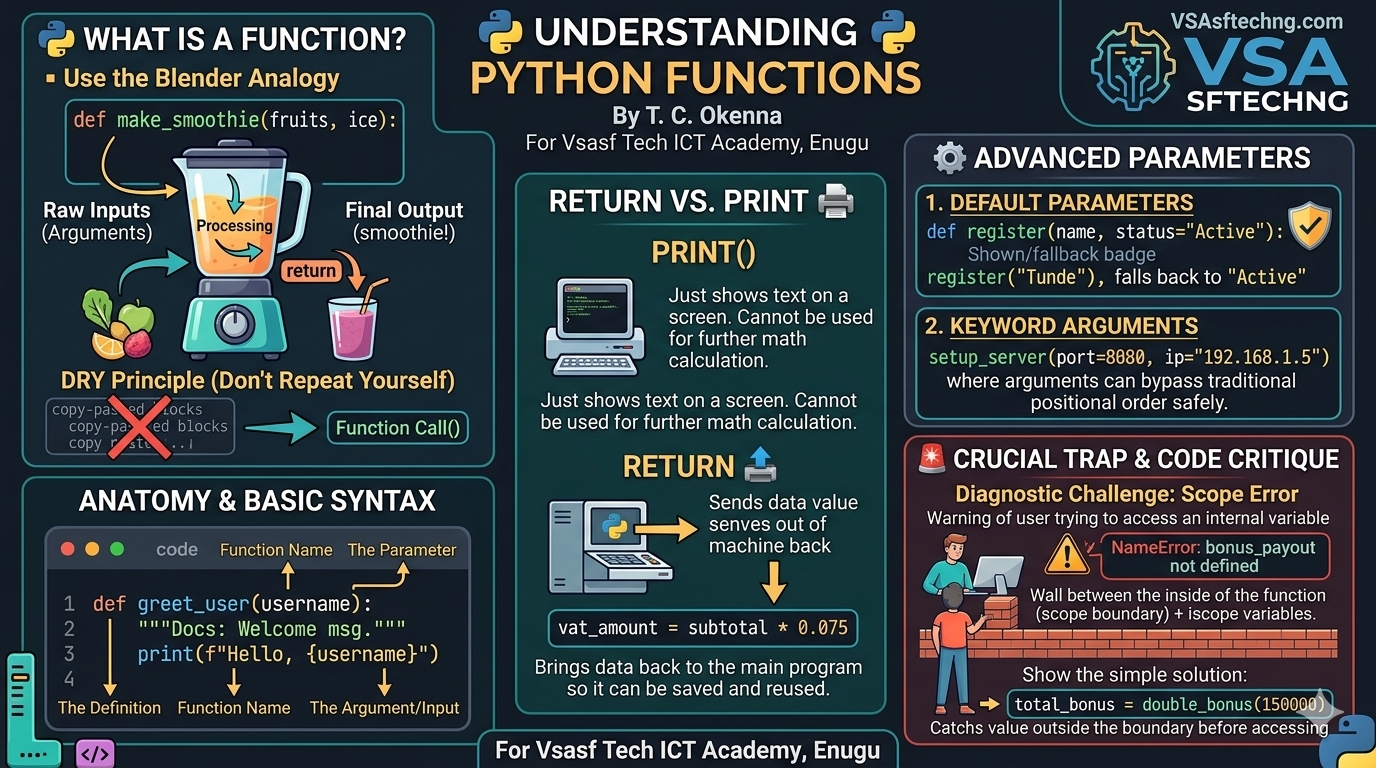
Lecture Notes: Introduction to Python Functions. By T. C. OkennaFunctions are self-contained blocks of reusable code designedto perform a specific, single action. By shifting code away from long,repetitive scripts into modular functions, developers make theirapplications significantly more organized, easier to test, and maintainable.📋 Lesson OverviewTarget Audience: Beginner to Intermediate Python LearnersDuration: 60 MinutesPrerequisites: Python variables, operational data types,and logical conditional blocks (if/else).Learning Objectives: By the end of this lesson, students will be able to:Define and call functions using the def keyword.Differentiate between parameters (inputs) and arguments (actual values).Return calculations using the return statement.Implement positional, keyword, and default parameters correctly.👩‍🏫 Lesson Structure1. Introduction: The "Why" of Functions (10 Mins)The Real-World Analogy: A kitchen blender. The blender has adefined mechanism. You pass raw inputs into it (fruits, ice),it processes them internally according to a fixed design, and it pours outa final result (a smoothie). You don't rebuild the blender everytime you want a drink; you just call upon it.The DRY Principle: Don't Repeat Yourself. If you copy-paste the samefive lines of code three or more times across a script,it should be refactored into a reusable function.2. Basic Syntax & Anatomy of a Function (15 Mins)A function definition uses the def keyword, followed by a uniquefunction name, parental parameters inside parentheses,a colon (:), and an indented block of code.python# 1. Defining the Function (Building the Blender) def greet_user(username): """Docstring: Prints a welcome message to a user.""" print(f"Welcome back to the system, {username}!") # 2. Calling the Function (Using the Blender) greet_user("Chinedu") # Output: Welcome back to the system, Chinedu! greet_user("Amaka") # Output: Welcome back to the system, Amaka! Use code with caution.Parameters vs. ArgumentsParameter: The structural variable placeholder listedinside the function definition (username).Argument: The actual, concrete value passed intothe function when invoking it ("Chinedu").3. Returning Values vs. Printing (15 Mins)A very common point of confusion for beginners isthe difference between print() and return.print() simply displays text on the screen for a humanto look at. It has no structural computation value.return terminates function execution and sends data back to themain program stream so it can be assigned to variablesor utilized in subsequent math calculations.python# Real-World Scenario: E-commerce VAT sales calculation def calculate_vat(subtotal): vat_amount = subtotal * 0.075 # 7.5% VAT rate return vat_amount # Handing the computation value back # Capturing the returned value to use later order_vat = calculate_vat(12000) final_invoice = 12000 + order_vat print(f"Total Invoice Cost: N{final_invoice}") # Output: Total Invoice Cost: N12900.0 Use code with caution.4. Advanced Parameter Handling (15 Mins)Default ParametersYou can assign default values to parameters. If an argumentis missing during execution, the default value acts as a safe fallback.python# Real-World Scenario: User profile setup with default status values def register_member(name, status="Active"): return f"Member: {name} | Account Status: {status}" print(register_member("Tunde")) # Output: Member: Tunde | Account Status: Active print(register_member("Fatima", "Suspended")) # Output: Member: Fatima | Account Status: Suspended Use code with caution.Positional vs. Keyword ArgumentsPositional: Arguments matched purely by theirspecific placement sequence order.Keyword: Arguments explicitly linked by name (parameter_name=value),allowing you to completely pass variables out of sequence order safely.pythondef setup_server(ip, port, Protocol="HTTPS"): return f"Hosting server at {ip}:{port} via {Protocol}" # Using Keyword arguments out of original definition order print(setup_server(port=8080, ip="192.168.1.5")) # Output: Hosting server at 192.168.1.5:8080 via HTTPS Use code with caution.🎯 Diagnostic Challenge & Code CritiqueAsk the Class: Look at this block of script logic. What will printwhen we execute it, what structural variable scopeerror did the developer make, and how do we resolve it?pythondef double_bonus(salary): bonus_payout = salary * 2 return bonus_payout employee_salary = 150000 double_bonus(employee_salary) print(bonus_payout) # 💥 CRASH! Use code with caution.Expected Solution CritiqueThe Error: This script throws a NameError: name 'bonus_payout' is not defined.The Reason: Variable scope rules. The variable bonus_payoutis defined inside the function. It lives and dies exclusivelywithin that internal scope ecosystem. The main program scope(global line footprint) cannot look inside the function boundary box directly.Furthermore, although the function returned the value, thedeveloper forgot to save it into an outside variable!The Refactored Fix: Catch the return data stream safely:pythonemployee_salary = 150000 # Store the returned outcome value inside #a globally visible variable frame total_bonus = double_bonus(employee_salary) print(total_bonus) # Output: 300000 Use code with caution.For Vsasf Tech ICT Academy, Enugu
Lecture Notes: Object-Oriented Programming (OOP) in Python by T. C. Okenna
Sep 16, 2026
5 min read

Lecture Notes: Object-Oriented Programming (OOP) in Python by T. C. Okenna

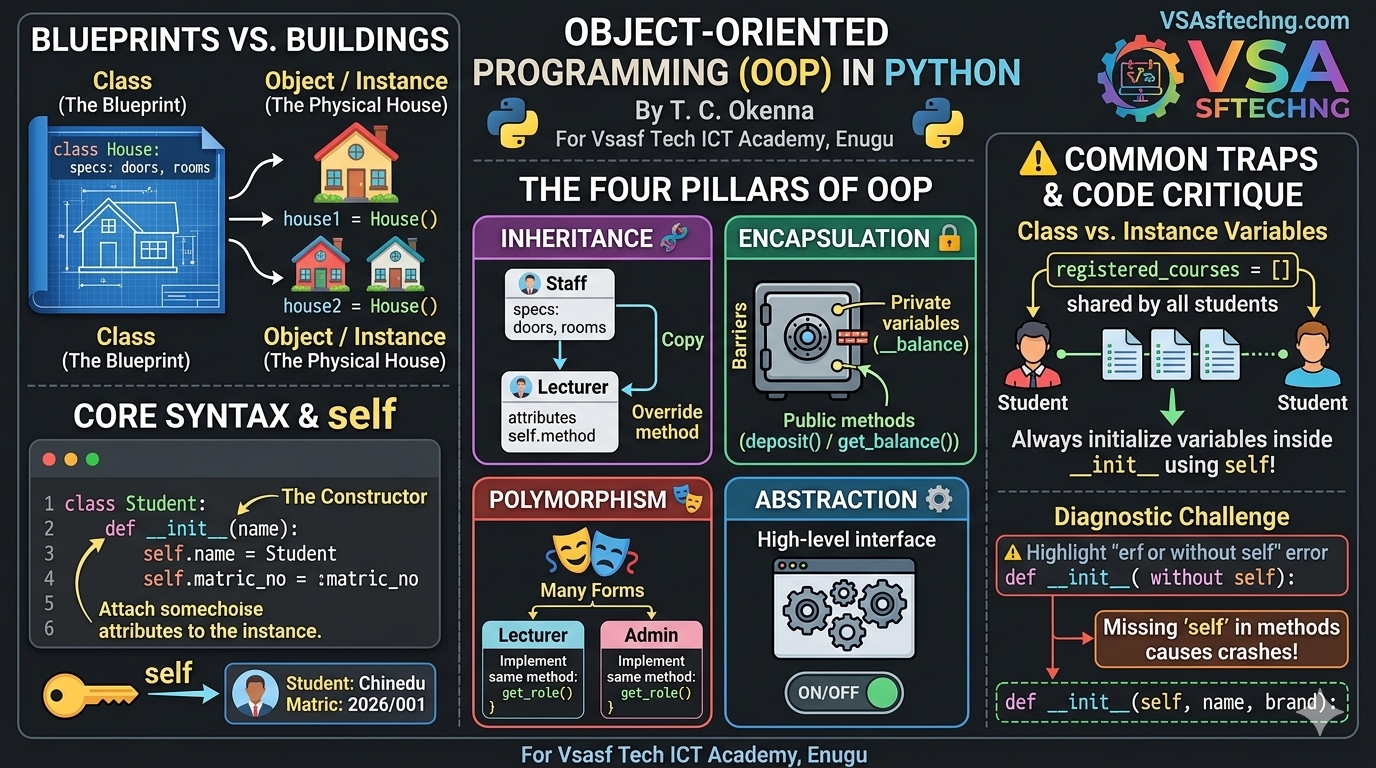
Lecture Notes: Object-Oriented Programming (OOP) in Python. By T. C. OkennaObject-Oriented Programming (OOP) is a programming paradigm thatorganizes software design around data, or objects, rather than functionsand logic. It allows developers to bundle related properties and behaviorsinto individual, reusable structures, mirroring how real-world entities exist.📋 Lesson OverviewTarget Audience: Intermediate Python LearnersDuration: 60 MinutesPrerequisites: Python functions, dictionaries, and basic loop constructs.Learning Objectives: By the end of this lesson, students will be able to:Differentiate between a Class and an Object.Implement instance attributes using the __init__ constructor method.Explain and apply the four pillars of OOP: Inheritance, Polymorphism,Encapsulation, and Abstraction.👩‍🏫 Lesson Structure1. Introduction: Blueprints vs. Buildings (10 Mins)The Real-World Analogy: Think of an architectural blueprint for a house.The blueprint itself isn't a house; it's a design document containingspecifications (number of rooms, doors) and capabilities (wiring, plumbing layouts).A Class is that architectural blueprint.An Object (or Instance) is the actual physical house built usingthat blueprint. You can build 50 completely distinct houses from one single blueprint.2. Core Syntax: Classes, Objects, and self (15 Mins)Defining a Class and ConstructorThe __init__ method is the constructor. It initializes an object'sstate when it is created. The self keyword represents thespecific instance of the class currently being modified.python# Real-World Scenario: Simulating a student registration profile class Student: # The Constructor Method def __init__(self, name, matric_no, department): self.name = name # Instance Attribute self.matric_no = matric_no # Instance Attribute self.department = department # Instance Attribute # Instance Method def display_profile(self): return f"Student: {self.name} | Matric: {self.matric_no} | Dept: {self.department}" # Instantiating (Creating) distinct objects student1 = Student("Chinedu", "2026/001", "Computer Science") student2 = Student("Amaka", "2026/042", "Electronic Engineering") print(student1.display_profile()) # Output: Student: Chinedu | Matric: 2026/001... print(student2.name) # Output: Amaka Use code with caution.3. The Pillars of OOP (25 Mins)🧬 Pillar 1: InheritanceInheritance allows a new child class to adopt the attributesand methods of an existing parent class, eliminating redundant code.python# Parent Class class Staff: def __init__(self, name, staff_id): self.name = name self.staff_id = staff_id def get_role(self): return "General Staff Member" # Child Class inheriting from Staff class Lecturer(Staff): def __init__(self, name, staff_id, course_assigned): super().__init__(name, staff_id) # Call parent constructor self.course_assigned = course_assigned # Method Overriding (Polymorphism) def get_role(self): return f"Lecturer teaching {self.course_assigned}" lecturer = Lecturer("Dr. Okoye", "L-902", "Python Programming") print(lecturer.get_role()) # Output: Lecturer teaching Python Programming Use code with caution.🔒 Pillar 2: EncapsulationEncapsulation restricts direct access to an object's componentmethods and variables to prevent accidental manipulation.In Python, we prefix variable names with a doubleunderscore (__) to denote private variables.pythonclass BankAccount: def __init__(self, owner, initial_balance): self.owner = owner self.__balance = initial_balance # Private attribute # Getter method to read private data safely def get_balance(self): return self.__balance # Setter method to update private data safely with validation def deposit(self, amount): if amount > 0: self.__balance += amount else: print("Invalid deposit amount!") account = BankAccount("Kelechi", 50000) # print(account.__balance) # 💥 CRASH! Throws AttributeError account.deposit(15000) print(account.get_balance()) # Output: 65000 Use code with caution.4. ⚠️ Common Pitfalls: Class vs. Instance Variables (5 Mins)Instance Variables: Variables defined inside constructormethods using self. They belong uniquely to that specific object.Class Variables: Variables declared directly in the class body outsideany method. They are shared collectively by all instances of that class.python# 🚫 THE INCORRECT USE-CASE (Class variable trap) class Registry: registered_courses = [] # Shared by ALL student instances accidentally! def __init__(self, student_name): self.student_name = student_name student_a = Registry("Tunde") student_b = Registry("Fatima") student_a.registered_courses.append("CSC 201") # Fatima has unexpectedly been registered for Tunde's course! print(student_b.registered_courses) # Output: ['CSC 201'] Use code with caution.🎯 Diagnostic Challenge & Code CritiqueAsk the Class: Examine this script snippet. Why will it throw a runtime crash exception when executed, and how should we refactor it?pythonclass SmartDevice: def __init__(name, brand): name = name brand = brand def power_on(): print(f"{name} is now powered online.") phone = SmartDevice("Pixel 8", "Google") phone.power_on() # 💥 CRASH! Use code with caution.Expected Solution CritiqueThe Error: This script breaks with a missing argumentexception or local scope lookup errors (NameError: name 'name' is not defined).The Reason:The developer forgot to pass self as the very firstposition parameter in both __init__ and power_on().The variables inside the constructor were assigned locally (name = name) instead of attaching them structurally tothe object scope instance using self.name = name.The Refactored Fix:pythonclass SmartDevice: def __init__(self, name, brand): # Added self self.name = name # Bound to object self.brand = brand def power_on(self): # Added self print(f"{self.name} is now powered online.") Use code with caution.For Vsasf Tech ICT Academy, Enugu
Lecture Notes: Regression Analysis with Python by T. C. Okenna
Sep 15, 2026
4 min read

Lecture Notes: Regression Analysis with Python by T. C. Okenna

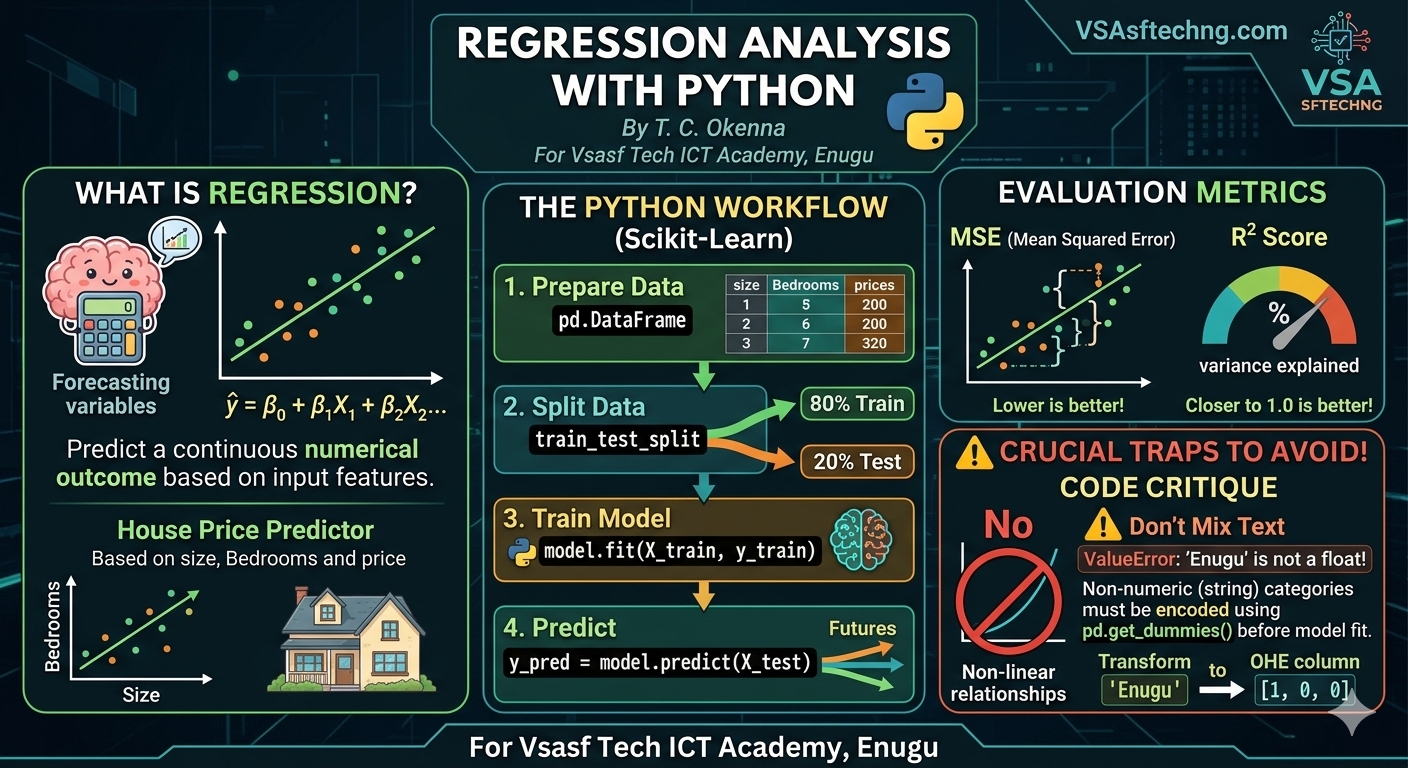
Lecture Notes: Regression Analysis with Python. By T. C. OkennaRegression Analysis is a fundamental statistical and machine learning technique used to model, investigate, and quantify the relationship between a dependent variable (target/outcome) and one or more independent variables (predictors/features).📋 Lesson OverviewTarget Audience: Intermediate Python Learners & Aspiring Data AnalystsDuration: 60 MinutesPrerequisites: Python fundamentals, core packages (Pandas, NumPy), and foundational algebra.Learning Objectives: By the end of this lesson, students will be able to:Differentiate between Simple and Multiple Linear Regression.Implement an end-to-end regression model pipeline using the Scikit-Learn Regression API.Interpret key parameters like coefficients, intercept, and evaluation metrics.👩‍🏫 Lesson Structure1. Introduction: The "Why" of Regression (10 Mins)The Real-World Analogy: Predicting your monthly electricity bill. The bill doesn't change randomly; it depends predictably on measurable factors like daily temperature, the square footage of your home, and the total runtime of your air conditioner.The Objective: We fit a line (or hyperplane) through data points so we can predict continuous numerical variables based on input inputs.The Mathematics:\(\^{y}=\beta {0}+\beta {1}X_{1}+\beta {2}X{2}+...+\beta {n}X{n}\)\(\^{y}\): The predicted value (Dependent variable).\(\beta _{0}\): The Intercept (Where the line crosses the y-axis when \(X=0\)).\(\beta_1, \beta_2\): The Coefficients (The slope/weight showing how much \(y\) updates per unit change in \(X\)).2. Core Concepts: Simple vs. Multiple Regression (10 Mins)TypeIndependent Variables (\(X\))Use-Case ExampleSimple Linear RegressionExactly One (\(X_{1}\))Predicting home value based only on its size (square feet).Multiple Linear RegressionTwo or More (\(X_1, X_2, \dots\))Predicting home value based on size, location rating, and construction year.3. Step-by-Step Implementation with Python (25 Mins)Here is a real-world coding solution predicting real estate prices based on spatial properties.pythonimport numpy as np import pandas as pd from sklearn.model_selection import train_test_split from sklearn.linear_model import LinearRegression from sklearn.metrics import mean_squared_error, r2_score # 1. Create a mock Real Estate dataset data = { 'Size_SqFt': [1500, 1800, 2400, 3000, 1200, 2100, 1600, 2800], 'Bedrooms': [3, 3, 4, 4, 2, 3, 3, 4], 'Price_USD': [250000, 290000, 380000, 470000, 190000, 330000, 265000, 430000] } df = pd.DataFrame(data) # 2. Separate Features (X) and Target (y) X = df[['Size_SqFt', 'Bedrooms']] y = df['Price_USD'] # 3. Split dataset into Training (80%) and Testing (20%) sets X_train, X_test, y_train, y_test = train_test_split(X, y, test_size=0.2, random_state=42) # 4. Instantiate and Train the Linear Regression Model model = LinearRegression() model.fit(X_train, y_train) # 5. Generate Predictions using the test partition y_pred = model.predict(X_test) # 6. Extract Parameters print(f"Intercept (Beta 0): {model.intercept_:.2f}") print(f"Coefficients (Beta 1, Beta 2): {model.coef_}") Use code with caution.4. Evaluating Model Performance (10 Mins)To measure how well our model fits the data, we use standard evaluation metrics:Mean Squared Error (MSE): Measures the average squared difference between actual values and predicted values. Lower is better.\(R^{2}\) Score (Coefficient of Determination): Represents the proportion of variance in the dependent variable that is predictable from the independent variables. Ranging from 0 to 1 (Higher is better, where 1.0 means a perfect fit).python# Continuing from the script above... mse = mean_squared_error(y_test, y_pred) r2 = r2_score(y_test, y_pred) print(f"Mean Squared Error: {mse:.2f}") print(f"R2 Score: {r2:.4f}") # e.g., 0.9850 means 98.5% variance explained Use code with caution.5. ⚠️ Crucial Traps & Checklist (5 Mins)When applying linear regression in production, look out for these pitfalls:Non-Linear Relationships: Linear regression assumes a straight-line relationship. If your data bends dramatically, consider Polynomial features or alternate models.Multicollinearity: If your independent variables (\(X_{1}\) and \(X_{2}\)) are highly correlated with each other (e.g., house size in square feet vs house size in square meters), it destabilizes coefficient tracking. Drop one of the redundant variables.🎯 Diagnostic Challenge & Code CritiqueAsk the Class: Look closely at this implementation fragment. What major data data structural mistake did the developer make before fitting the model?pythonimport pandas as pd from sklearn.linear_model import LinearRegression # Loading regional sales logs df = pd.DataFrame({ 'City': ['Enugu', 'Lagos', 'Abuja', 'Enugu'], 'Marketing_Spend': [500, 1200, 900, 600], 'Revenue': [4500, 11000, 8500, 5200] }) X = df[['City', 'Marketing_Spend']] y = df['Revenue'] model = LinearRegression() model.fit(X, y) # 💥 CRASH! Use code with caution.Expected Solution Critique:The Error: This script throws a ValueError: could not convert string to float: 'Enugu'.The Reason: Linear regression is a purely mathematical optimization algorithm. It cannot handle raw string data like categorical city names directly.The Fix: Convert the string column into numerical vectors before fitting. Use data encoding techniques like One-Hot Encoding via pd.get_dummies(df, columns=['City']) to prepare it correctly.For Vsasf Tech ICT Academy, Enugu
Lecture Notes: Lists & Dictionary Manipulation with Loops by T. C. Okenna
Sep 15, 2026
5 min read

Lecture Notes: Lists & Dictionary Manipulation with Loops by T. C. Okenna

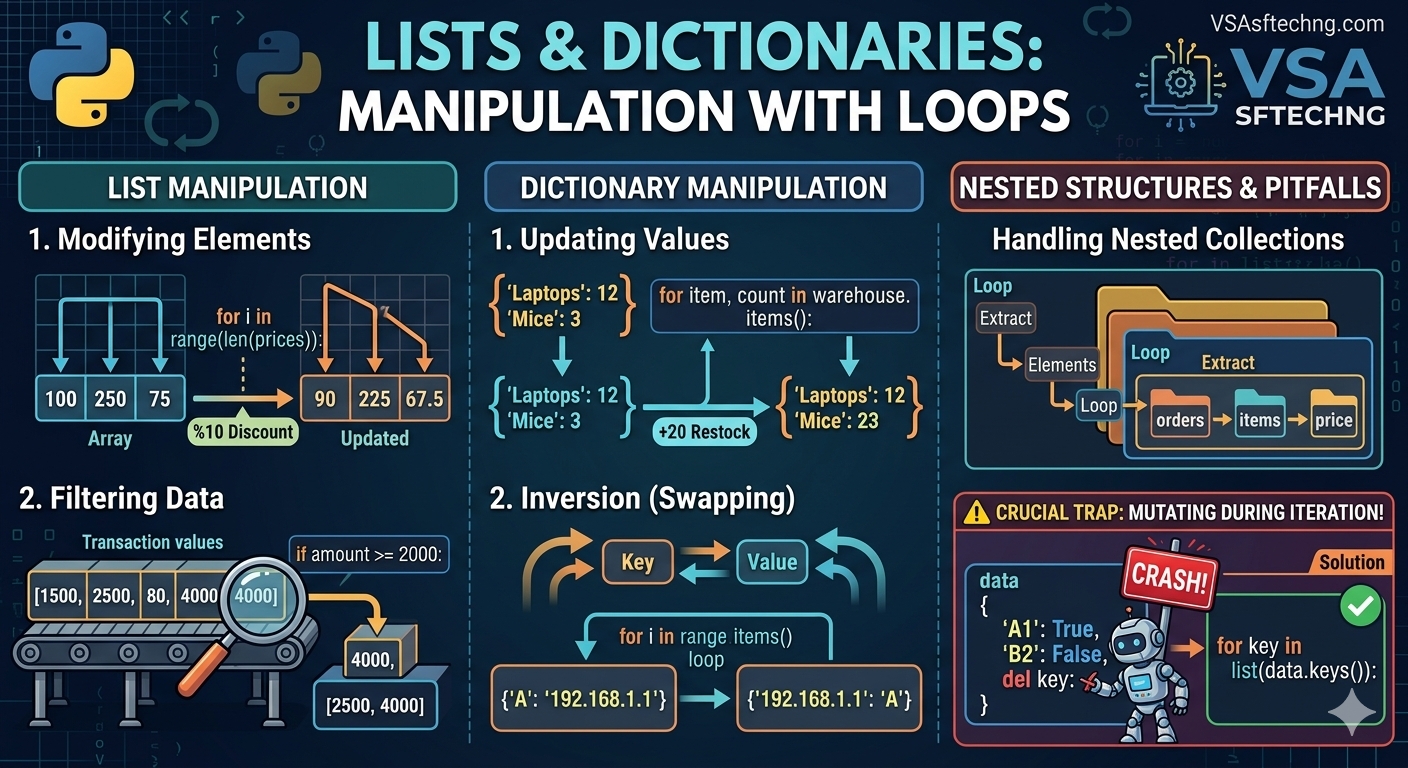
Lecture Notes: Lists & Dictionary Manipulation with Loops. By T. C. OkennaThis lesson covers iterating through and modifying Python data structures.Students will learn how to combine loops with lists and dictionaries to dynamicallyfilter data, aggregate values, and safely update collections in real-world applications.Lesson OverviewTarget Audience: Intermediate Python LearnersDuration: 60 MinutesPrerequisites: Python Lists, Python Dictionaries, and basic for / while loop syntax.Learning Objectives: By the end of this lesson, students will be able to:Traverse lists and nested structures using loops.Perform data aggregation (sums, counts) and filtering dynamically.Extract keys, values, and items from dictionaries during iteration.Avoid common pitfalls like mutating a collection while iterating over it.Lesson Structure1. Introduction: The Need for Automation (10 Mins)The Problem: Modifying index variables or dictionary keys manually is fine for one or two data points.But what if you need to apply a 10% discount to 10,000 items in an e-commerce catalog,or filter out spam accounts from a subscriber list of millions?The Solution: Combining loops with data structures allows your program toautomate structural data changes efficiently based on logical rules.2. List Manipulation with Loops (15 Mins)Modifying List Elements by IndexTo update items within an existing list during execution, you must use their indices.The range(len()) pattern allows you to target each element directly.python# Real-World Scenario: Processing a list of e-commerce prices to apply a 10% discount prices = [100.0, 250.0, 75.0, 500.0] for i in range(len(prices)): prices[i] = prices[i] * 0.9 # Reduce each item by 10% print(prices) # Output: [90.0, 225.0, 67.5, 450.0] Use code with caution.Filtering Data into New ListsInstead of updating the existing structure, a very common practice isevaluating elements and using the .append() method to build a filtered collection.python# Real-World Scenario: Filtering high-value transactions for fraud review transactions = [120, 4500, 80, 2300, 15, 6000] flagged_transactions = [] for amount in transactions: if amount >= 2000: flagged_transactions.append(amount) print(flagged_transactions) # Output: [4500, 2300, 6000] Use code with caution.3. Dictionary Manipulation with Loops (15 Mins)When looping through dictionaries, you can iterateover keys, values, or key-value pairs concurrently.Updating Specific Dictionary ValuesUsing .items() unzips the dictionary entries into key and valuevariables, making conditional updates clean and readable.python# Real-World Scenario: Increasing the stock count of low inventory items warehouse_stock = {"Laptops": 12, "Mice": 3, "Monitors": 5, "Keyboards": 2} for item, count in warehouse_stock.items(): if count < 5: warehouse_stock[item] += 20 # Add emergency restocking batch print(warehouse_stock) # Output: {'Laptops': 12, 'Mice': 23, 'Monitors': 5, 'Keyboards': 22} Use code with caution.Dynamic Aggregation & InversionYou can loop through structural collections to createentirely new transformed calculations or mappings.python# Real-World Scenario: Reversing a data route mapping server_routes = {"Server_A": "192.168.1.1", "Server_B": "192.168.1.2"} ip_to_server = {} for server, ip in server_routes.items(): ip_to_server[ip] = server # Swap key and value print(ip_to_server) # Output: {'192.168.1.1': 'Server_A', '192.168.1.2': 'Server_B'} Use code with caution.4. Advanced Concept: Handling Nested Collections (10 Mins)Real-world systems pass complex JSON strings that translate directlyto lists filled with nested dictionaries. Unpacking them requires acombination of nested access loops.python# Real-World Scenario: Calculating custom invoice run totals orders = [ {"customer": "Alice", "items": [50, 100, 20]}, {"customer": "Bob", "items": [200, 300]}, {"customer": "Charlie", "items":} ] for order in orders: total_spent = 0 # Loop through the list nested inside the current dictionary for price in order["items"]: total_spent += price print(f"{order['customer']} spent a total of ${total_spent}") # Output: # Alice spent a total of $170 # Bob spent a total of $500 # Charlie spent a total of $15 Use code with caution.5. Crucial Trap: Mutating While Iterating (5 Mins)The Golden Rule: Never add or remove elements directly from a dictionaryor list while looping over that specific variable layout. This causesunexpected logic skipping or throws runtime exceptions.python# BAD CODE: Will break or skip elements active_users = {"A1": True, "B2": False, "C3": False} for user_id, active in active_users.items(): if not active: del active_users[user_id] # Throws RuntimeError: dictionary changed size during iteration Use code with caution.python# GOOD CODE: Iterate over a copy of the keys/structure instead active_users = {"A1": True, "B2": False, "C3": False} for user_id in list(active_users.keys()): if not active_users[user_id]: del active_users[user_id] # Perfectly safe execution print(active_users) # Output: {'A1': True} Use code with caution.Diagnostic Challenge & Code CritiqueAsk the Class: Look closely at this loop block. What does the developer ntend to do, what error will it crash into, and how do we resolve it?pythonlogins = [10, 0, 15, 0, 22, 0, 8] # Intention: Clean up system database logs by purging zero login cycles for activity in logins: if activity == 0: logins.remove(0) print(logins) Use code with caution.Expected Solution CritiqueThe Trap: While it might not crash with an explicit exception,it creates a silent semantic bug. When .remove() alters the list, indices shift leftward.The iteration loop jumps ahead, skipping the very next structural index element.The Output Result: It prints [10, 15, 0, 22, 8]. It completely skipped one of the zeros!The Fix: Use a list comprehension to construct a clean output copy:logins = [activity for activity in logins if activity != 0]For Vsasf Tech ICT Academy, Enugu
Lesson Plan & Lecture Notes: Python Dictionaries by T. C. Okenna
Sep 15, 2026
5 min read

Lesson Plan & Lecture Notes: Python Dictionaries by T. C. Okenna

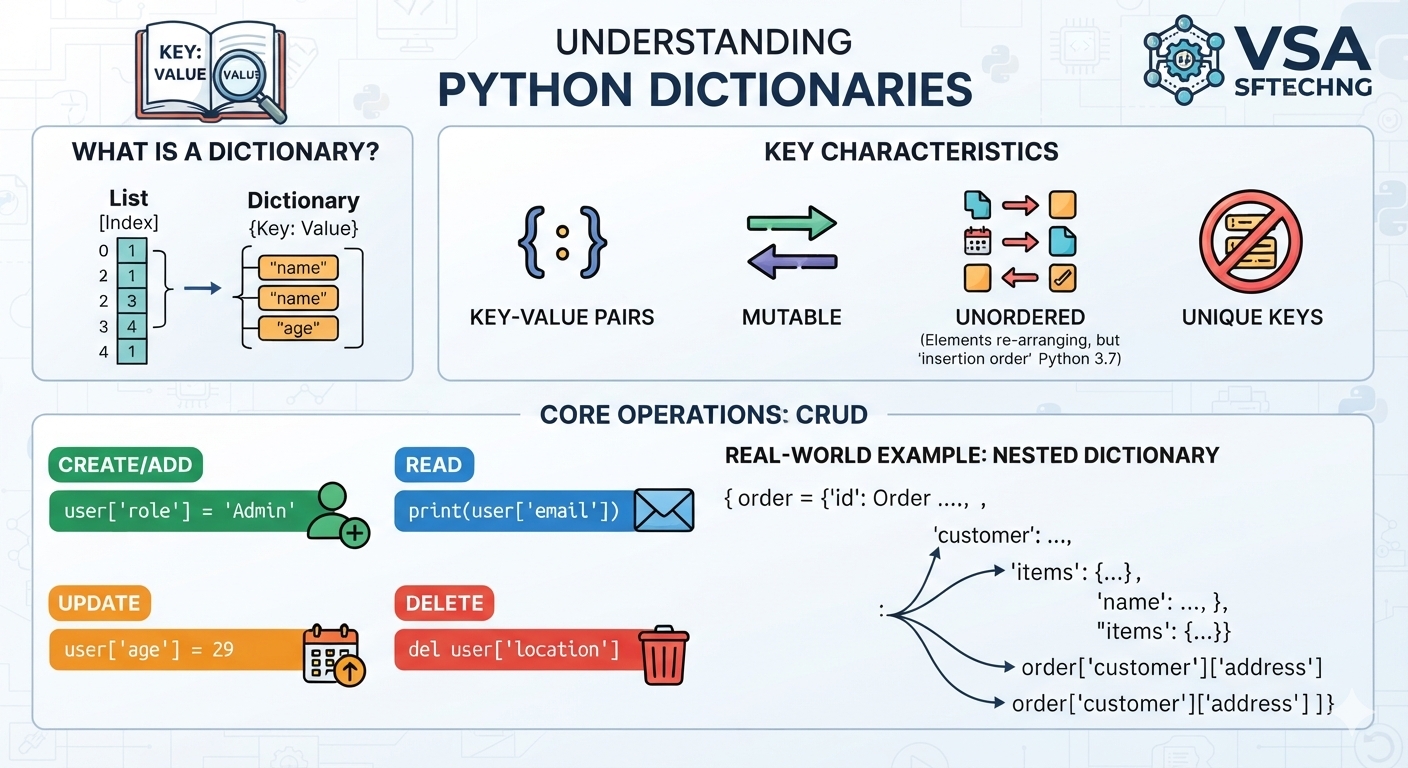
Lesson Plan & Lecture Notes: Python Dictionaries by T. C. Okenna. Python Dictionaries are mutable, unordered (but ordered by insertion since Python 3.7), and indexed collections of data. Unlike lists that store elements by sequential position, dictionaries store data in key-value pairs, making them ideal for modeling real-world objects and structural data.📋 Lesson OverviewTarget Audience: Beginner to Intermediate Python LearnersDuration: 60 MinutesPrerequisites: Python variable assignments, data types, and basic loops.Learning Objectives: By the end of this lesson, students will be able to:Define a dictionary using key-value mapping.Perform CRUD operations (Create, Read, Update, Delete) on dictionary data.Traverse dictionaries using loops.Apply dictionaries to manage data structures in real-world scenarios.👩‍🏫 Lesson Structure1. Introduction: The "Why" (10 Mins)The Real-World Analogy: A classic language dictionary or a phone book.You look up a Key (a person's name) to find their corresponding Value (their phone number).The Problem: Imagine storing a user's profile information in a list: ["John Doe", 28, "Engineer", "Lagos"].If you want to grab the city, you have to remember it is at index 3.If the list order changes, your code breaks.The Solution: A dictionary allows you to explicitly label your data: {"name": "John Doe", "age": 28, "role": "Engineer", "city": "Lagos"}.2. Core Concepts & Syntax (15 Mins)Dictionaries use curly braces {} with elements separated by commas. Each element contains a key and a value separated by a colon (key: value).Key Constraints:Keys must be unique: Duplicating a key overrides the existing value.Keys must be immutable: You can use strings, integers, or tuples as keys, but never lists.python# Real-World Scenario: A product catalog entry product = { "id": "PROD-1029", "name": "Wireless Headphones", "price": 89.99, "in_stock": True, "tags": ["audio", "bluetooth", "gadget"] # Values can be any data type! } Use code with caution.3. CRUD Operations: Managing Data (15 Mins)🟢 Create & UpdateYou add or update data using square brackets []. If the key exists, it updates; if it does not, it adds a new entry.python# Real-World Scenario: A ride-hailing app tracking driver details driver = {"name": "Amadi", "rating": 4.8} # Update an existing key driver["rating"] = 4.9 # Create/Add a new key-value pair driver["vehicle"] = "Toyota Corolla" print(driver) # Output: {'name': 'Amadi', 'rating': 4.9, 'vehicle': 'Toyota Corolla'} Use code with caution.🔵 Read (Accessing Values)You can fetch values using square brackets or the safety-first .get() method.python# Scenario: Fetching configuration settings for an app settings = {"theme": "dark", "notifications": True} # Method 1: Square Brackets (Throws KeyError if key doesn't exist) print(settings["theme"]) # Output: dark # Method 2: .get() method (Returns None or a default value instead of crashing) print(settings.get("font_size", 14)) # Output: 14 (default fallback) Use code with caution.🔴 DeleteRemove items using the del keyword or the .pop() method.python# Scenario: Inventory management tracking a shopping cart cart = {"apples": 3, "milk": 1, "bread": 2} # Remove 'milk' and get its value milk_qty = cart.pop("milk") print(cart) # Output: {'apples': 3, 'bread': 2} print(milk_qty) # Output: 1 Use code with caution.4. Iterating Through Dictionaries (10 Mins)You can loop through keys, values, or both simultaneously using specific built-in methods.python# Scenario: User contact database user_contacts = { "Alice": "alice@email.com", "Bob": "bob@email.com", "Charlie": "charlie@email.com" } # 1. Loop through keys only for name in user_contacts.keys(): print(name) # 2. Loop through values only for email in user_contacts.values(): print(email) # 3. Loop through both keys and values using .items() for name, email in user_contacts.items(): print(f"Send email to {name} at {email}") Use code with caution.5. Advanced Layout: Nested Dictionaries (10 Mins)Dictionaries can hold other dictionaries. This structure mimics JSON data, which powers modern web backend APIs.python# Scenario: E-Commerce warehouse order management orders = { "order_001": { "customer": "Kelechi", "items": {"Laptop": 1, "Mouse": 2}, "total": 1250.00 }, "order_002": { "customer": "Fatima", "items": {"Keyboard": 1}, "total": 75.00 } } # Accessing deeper levels print(orders["order_001"]["customer"]) # Output: Kelechi print(orders["order_001"]["items"]["Mouse"]) # Output: 2 Use code with caution.🎯 Diagnostic Challenge & Live Code ReviewAsk the Class: What will happen when we execute this block of code? Spot any potential errors and describe the exact console output.pythonstudent_scores = { "Chidi": 85, "Tunde": 92, "Chidi": 95 } # Modifying structural items student_scores[["Grace", "Zainab"]] = [78, 88] print(student_scores["Chidi"]) print(student_scores) Use code with caution.Expected Solution Analysis:The Duplicate Key Conflict: The value for "Chidi" will simply be overwritten by the latest entry (95).The Breaking Error: The line student_scores[["Grace", "Zainab"]] will throw a TypeError: unhashable type: 'list'. This happens because lists are mutable data structures and cannot be used as dictionary keys.
 LAUNCH YOUR TECH CAREER IN 6 MONTHS!
Sep 09, 2026
1 min read

LAUNCH YOUR TECH CAREER IN 6 MONTHS!

🚀 LAUNCH YOUR TECH CAREER IN 6 MONTHS! 🚀 . Are you ready to transition into tech, upgrade your skills, or become a highly sought-after professional? Vsasf Tech ICT Academy, Enugu is now accepting registrations for our intensive 6-Month Certificate Courses starting this September/October session! Gain hands-on experience, learn from industry experts, and master the skills that top global employers are looking for. 🌟 Choose Your Path from Our Premium Courses:• 💻 Software Development & Computer Programming• 🛡️ Cybersecurity• 📊 Data Science & Data Analysis• 🤖 Robotics, AI Automations & Artificial Intelligence• 🌐 Digital Marketing• 📱 Mobile Development• 🔌 Computer Networking Whether you are a beginner or looking to advance your current tech career, we have a structured learning path built just for you. 📍 Visit Us Today:381 Community Estate Layout, Off Nike Lake Road, Trans-Ekulu, Enugu. 📞 Secure Your Seat Now:Call or WhatsApp us at 08031936721 to register or make inquiries. Sign up now through: https://lnkd.in/ddTaBpdq#TechAcademyEnugu #LearnTech #SoftwareDevelopment #Cybersecurity #DataScience #ArtificialIntelligence #EnuguTech #TechSkills #VsasfTechAcademy
Automated POS Powerhouse Unleashing Low-Cost Scale for Nigerian Retailers
Aug 20, 2026
3 min read

Automated POS Powerhouse Unleashing Low-Cost Scale for Nigerian Retailers

CloseDealsNG: The Automated POS Powerhouse Unleashing Low-Cost Scale for Nigerian Retailers. For small and medium enterprises (SMEs) across Nigeria, running a retail business is an exercise in plugging leaks. Between tracking disappearing inventory, managing multiple cashiers, and waiting for agonizingly slow bank transfer confirmations, shop owners lose millions annually to operational chaos.Enter CloseDealsNG.com, a smart, multi-user Point-of-Sale (POS) and inventory automation ecosystem engineered by VSASF NIG LTD. Under the leadership of CEO Okenna ThankGod Chibuike, the platform has evolved from a standard stock tracker into a full-scale fintech and retail growth engine.Here is a breakdown of the powerful new features driving the next generation of automated retail.💡 1. Seamless Native Fintech: Automatic Virtual AccountsThe traditional headache of "Please wait, I haven't seen the alert" is officially over. CloseDealsNG now features instant virtual account creation directly inside the merchant admin panel.Instant Verification: Shop owners can generate dedicated virtual bank accounts to receive customer transfers seamlessly during checkout.Leak-Proof Reconciliation: Because payments are tied natively to the POS system, cashiers cannot fake transfers, and every single Kobo is automatically reconciled against current sales data.📈 2. Built for Viral Growth: The 20% Recurring Marketer ChannelTo rapidly scale the platform across major commercial hubs, CloseDealsNG has launched a highly lucrative Marketer Channel designed to reward growth partners with recurring passive income.How it works: Marketers are assigned a unique referral code. When onboarding a new merchant, entering this code permanently links the shop to the marketer's profile.Monthly Passive Income: Marketers earn a 20% lifetime commission on a monthly basis for every active, subscribing shop they refer. If a shop remains on the platform for years, the marketer gets paid every single month.📊 3. Transparent, Flexible, and Affordable Pricing TiersCloseDealsNG removes the barrier to entry with a 14-day free trial for all new shop owners, letting merchants experience the automated system completely risk-free.To accommodate everything from neighborhood kiosks to massive multi-location wholesale warehouses, the platform offers six highly competitive subscription tiers:Tier LevelMonthly SubscriptionStaff RestrictionsProduct CapacityTarget Business🥉 Starter Tier₦6,000 / MoOwner OnlyMax 10,000 ProductsSolopreneurs & Kiosks🥈 Growing Store Tier₦8,000 / MoOwner + 2 CashiersMax 10,000 ProductsSmall Retail Shops🥇 Enterprise Tier₦15,000 / MoOwner + 5 CashiersMax 10,000 ProductsStandard Supermarkets🥇 N-Enterprise Tier₦30,000 / MoOwner + 15 CashiersMax 50,000 ProductsLarge Retail Hubs🥇 S-Enterprise Tier₦50,000 / MoOwner + 35 CashiersMax 100,000 ProductsMega Stores & Distributors🥇 K-Enterprise Tier₦100,000 / MoOwner + 80 CashiersMax 200,000 ProductsMassive Wholesale Chains🌟 4. The Core Features That Define CloseDealsNGThese updates complement an already robust suite of retail management tools built into the application:Interactive Grid (Bulk Editing): Modify prices, quantities, and categories across thousands of items simultaneously with an intuitive, spreadsheet-like interface.Batch-Level Expiry & FIFO: Protect margins by tracking specific delivery batches, ensuring older stock is sold first before expiration hits.Offline Resiliency: Keep checkouts moving even when local internet drops; data automatically syncs back to the cloud once connectivity resumes.WhatsApp Receipts: Eliminate expensive paper rolls by automatically firing branded, digital receipts directly to customers via WhatsApp
Revolutionizing Retail Management: A Comprehensive Deep Dive into CloseDealsNG
Aug 04, 2026
9 min read

Revolutionizing Retail Management: A Comprehensive Deep Dive into CloseDealsNG

Revolutionizing Retail Management: A Comprehensive Deep Dive into CloseDealsNG. Managing a modern retail or wholesale business requires a balancing act between frontend sales and backend inventory logistics. Business owners often find themselves juggling disconnected software systems—one for point-of-sale (POS) transactions, another for inventory, a separate tool for accounting, and manual spreadsheets to manage suppliers. This fragmentation leads to human error, lost revenue, stock discrepancies, and operational fatigue.CloseDealsNG addresses these pain points by offering an all-in-one inventory management, cloud-based accounting, and point-of-sale architecture. Designed specifically to cater to the fast-paced nature of modern trade, the platform bridges the gap between digital efficiency and physical store operations.Below is an exhaustive analysis of the core features powering CloseDealsNG, demonstrating how they work together to optimize business operations, prevent financial leaks, and scale retail and wholesale enterprises.1. Frontend Sales & Point-of-Sale (POS) MasteryThe frontend sales console serves as the primary interface for cashiers and store managers. CloseDealsNG has optimized this environment to ensure checkout speeds remain high while maintaining flawless backend synchronization.+-----------------------------------------------------------------+ | SALES CONSOLE (POS) | +-----------------------------------------------------------------+ | [ Search / Scan ] -> [ Item A ] -> [ Retail / Wholesale Toggle ] | | | | Payment Modes: [X] Cash [X] Transfer [X] Credit | | Tax Configuration: [X] VAT Toggle [ Split Payment Calculator ] | +-----------------------------------------------------------------+ Hybrid Offline and Online Sales ConsoleInternet instability can bring a retail business to a halt. CloseDealsNG solves this with a hybrid offline and online sales console.Online Mode: The POS operates as a real-time terminal cloud-synced directly with central servers. Every transaction instantly updates inventory levels and registers across admin financial dashboards.Offline Mode: If local internet connectivity drops, the sales console switches to a local caching mechanism. Cashiers can continue scanning items, applying discounts, and processing transactions without interruption. Once connection is restored, the cached queue automatically syncs up with the central cloud database without duplicating records or drops in precision.Dynamic Wholesale and Retail Price TogglerMany businesses cater to both walk-in retail shoppers and bulk purchase wholesalers. Manually changing item pricing or creating separate product listings for these groups is highly inefficient. The platform features an instant price toggler on the sales console. With a single click or keyboard shortcut, the cashier can switch the active basket between retail and wholesale price tiers. This eliminates checkout friction, protects profit margins, and allows a single terminal to handle diverse customer profiles.Barcode Scanner & Smart Product Name SearchSpeed is critical during peak operational hours. CloseDealsNG natively supports plug-and-play USB/Bluetooth hardware barcode scanners.Scanning an item immediately appends it to the active checkout bill, preventing manual entry errors.For products missing visible barcodes, an optimized predictive lookup search bar is built into the terminal. Cashiers can type partial fragments of a product name, and the system filters matching inventory entries with real-time stock levels visible inside the results.Adaptive VAT Calculator TogglerTax compliance varies depending on the product category or customer classification (e.g., tax-exempt entities or corporate clients). The system features an on-the-fly Value Added Tax (VAT) calculator toggler. Cashiers can switch VAT processing on or off directly inside the checkout window. When enabled, it computes configured tax rates against subtotal figures transparently, displaying individual tax break downs on customer receipts while logging the tax components cleanly into accounting logs.Multi-Mode Split Payment EngineModern consumers rarely rely on a single payment method. CloseDealsNG accommodates this flexibility through an advanced split payment calculator. A single checkout transaction can be broken down across three core modes:Cash: Paper currency received at the till.Transfer: Direct bank transfers or mobile payments requiring verification.Credit: Debt balances deferred to a customer's accounts receivable record.The system enforces perfect accounting balances; a transaction cannot be closed until the sum of all assigned payment vectors perfectly matches the post-tax subtotal.2. Advanced Product Architecture & Admin ControlsThe foundational integrity of any retail app depends on how it organizes and tracks data. The platform provides administrators with structural controls over catalog entries, cost controls, and staff permissions.Structural Product CategorizationThe admin control panel features a hierarchical product categorization subsystem. Grouping products into clear taxonomies simplifies high-level inventory tracking and helps filter sales analytics. Clean category definitions prevent unorganized product sheets and allow owners to apply global adjustments across specific groups of goods.Comprehensive 8-Point Product Logging Data FieldsEvery single product entry added to CloseDealsNG stores an extensive matrix of metadata. This 8-point data structure eliminates guesswork and provides complete transparency over your stock profile:Data FieldOperational PurposeProduct NameClear alphanumeric identification string for cashiers and customers.BarcodeUnique identifier linking physical items directly to electronic records.Cost PriceDirect unit acquisition expense; forms the foundation for profit calculations.Retail PriceBase selling price applied to standard customer lookups.Wholesale PriceDiscounted volume pricing tier applied via the console toggler.Quantity (Qty)Real-time physical count available within storage or floor shelves.DiscountPre-configured promotional markdowns applied automatically at checkout.Expiry DateExpiration timestamp protecting consumers and tracking waste.3. Financial Intelligence & Cash flow AuditingA business can process millions in revenue and still collapse if it loses track of margins and operating expenses. CloseDealsNG acts as an automated digital accountant by logging every variable dollar flowing through the business.Dedicated Expenses LoggingAn accurate net profit calculation requires tracking costs beyond just the cost of goods sold (COGS). The platform includes a dedicated expenses logging ledger. Managers can record operational costs like electricity, rent, logistics, and staff salaries. Each entry requires a category, amount, timestamp, and optional remarks, creating a clear audit trail for overhead costs.High-Fidelity Sales History LedgerThe platform records every transaction in a permanent, searchable sales history database. This ledger does more than just list past transactions; it serves as a powerful auditing tool with advanced multi-tier filtering parameters:Payment Modality Filters: Instantly isolate cash, bank transfers, or credit liabilities.Pricing Tiers: Track volumes moving through retail vs. wholesale channels.Personnel Accountability: Filter transactions by individual cashiers to audit drawer balances and track staff performance.Chronological Intervals: Pull historical records across custom date ranges.Financial Calculations: Displays both gross revenue and true net profit (Revenue minus Cost Price and Expenses) for any filtered view.Automated WhatsApp Receipt SharingSay goodbye to expensive thermal paper dependency. CloseDealsNG integrates directly with messaging gateways to support one-click receipt reprints and automated WhatsApp sharing. As soon as a transaction closes, the system can automatically send a digital invoice directly to the customer's phone number, reducing paper costs and keeping your business connected with its clientele.Graphical Financial Analytics DashboardTo help business owners quickly understand their performance, CloseDealsNG translates raw table rows into visual insights. The platform features an automated financial analytics pipeline that aggregates VAT collections, cost prices, and logged expenses against incoming revenue.This dashboard clearly displays your profit efficiency status, making it easy to identify seasonal trends, sudden expense spikes, or drops in margin health.4. B2B Collaboration & Multi-User GovernanceScaling a retail business means delegating tasks to cashiers and collaborating directly with product suppliers. CloseDealsNG includes built-in multi-user management and supplier portals to make this process seamless.Granular User Models & Cashier Access ControlProtecting your business from internal shrinkage requires strict access controls. The platform features a multi-tenant user governance model managed entirely by the shop owner.Owners can create distinct accounts for individual cashiers.A master toggle switch allows owners to instantly enable or disable a cashier's access to the sales console. This gives you complete control over terminal security during shift changes or unexpected absences. +-----------------------------------+ | SHOP OWNER ADMIN | +-----------------------------------+ | +-----------------------+-----------------------+ | | +-----------------------+ +-----------------------+ | CASHIER ACCESS ENGINE| | SUPPLIER LINK GATEWAY | +-----------------------+ +-----------------------+ | [Toggle On/Off] | | [Generate Unique URL] | | -> Terminal Security | | -> Remote Restocking | +-----------------------+ +-----------------------+ B2B Supplier Portal & Restocking Link IntegrationTraditional restocking often involves manual ordering, phone calls, and manual entry errors upon delivery. CloseDealsNG modernizes this workflow with an innovative supplier link generation gateway.The system generates a secure, unique link that shop owners can send directly to verified external suppliers.Using this portal, suppliers can log new product entries and update stock levels for existing items themselves.The shop owner retains full control and can toggle the supplier's link access on or off at any time, ensuring data security and streamlining your supply chain.5. Granular Inventory Management & Loss ControlThe difference between a profitable retail business and a failing one often comes down to inventory control. Spoiled stock, expired products, and unexplained inventory shrinkage can quickly eat away your profits. CloseDealsNG provides advanced tools to help you manage batches and minimize waste.Spread sheet Bulk Category EditingUpdating individual product details one by one can take hours. The platform solves this with an inline spreadsheet bulk editor. Owners can load an entire product category into an interactive grid layout to quickly update quantities, expiration dates, cost profiles, and price structures across dozens of items simultaneously.Batch-Level Expiry Tracking ArchitectureUnlike basic inventory trackers that only display a single total stock number, CloseDealsNG organizes inventory using a row-format restock batch database.[Product: Powdered Milk] ├── Batch #101 | Received: 12-B2-2026 | Expiry: 05-04-2026 | Qty: 40 -> [Near Expiry Alert!] └── Batch #204 | Received: 18-05-2026 | Expiry: 12-11-2027 | Qty: 150 -> [Healthy Status] This batch tracking system monitors every delivery independently, complete with its unique cost price and expiration date. This allows you to follow a strict First-In, First-Out (FIFO) inventory workflow, ensuring older stock is sold before it expires.Proactive Expiry Alert EngineThe system includes an automated notifications control panel that acts as an early warning system for your stock. It continuously scans your batch databases and highlights items that are approaching their expiration dates or have already expired. This gives you the visibility needed to launch promotional sales or markdown strategies before stock becomes unsellable.Loss Management: Mark Sold, Dispose, and DeductWhen inventory issues occur, CloseDealsNG provides precise options to keep your records accurate:Mark Sold: Quickly clear out near-expiry inventory through promotional clearance channels.Mark Dispose: Cleanly remove fully expired items from active stock, tracking the loss against your gross margins without messing up your sales data.Deduct Button: Easily adjust stock levels for specific batches when items are damaged, stolen, or broken, ensuring your digital records always match your physical shelves.Summary of Core Business ValueBy bringing these 18 features together into a single platform, CloseDealsNG transforms how retail businesses operate:Plugs Financial Leaks: Every transaction is tied to a specific cashier, payment method, and batch cost, eliminating unaccountable losses.Saves Administrative Time: Automated WhatsApp messaging, bulk spreadsheet editing, and self-service supplier portals cut out hours of manual work.Protects Profit Margins: Real-time expense tracking, batch-specific cost auditing, and clear financial charts give you the insights needed to make smart, data-driven decisions.
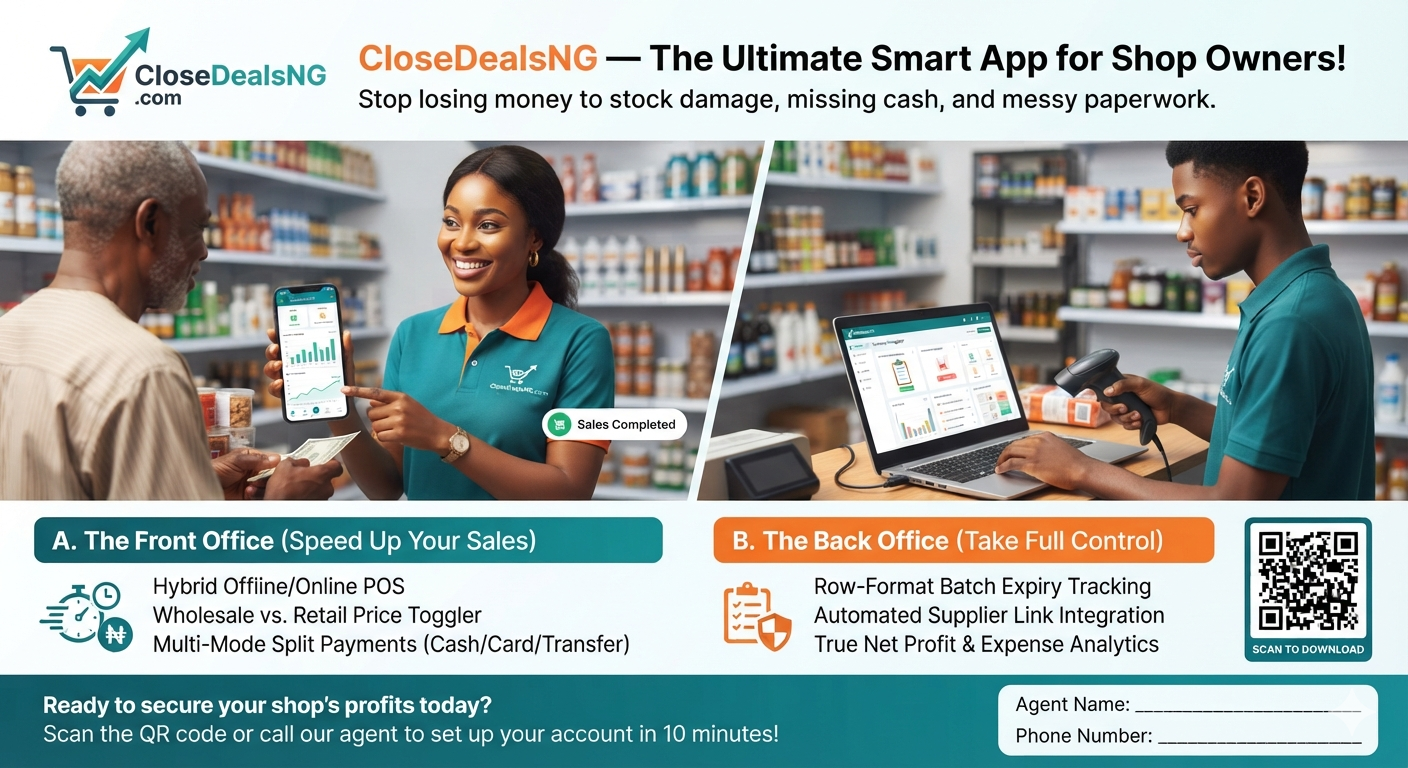
CloseDealsNG Multi-User Offline POS & Enterprise Terminal
Jun 25, 2026
2 min read

CloseDealsNG Multi-User Offline POS & Enterprise Terminal

CloseDealsNG Multi-User Offline POS & Enterprise TerminalAre you tired of stressful manual typing at checkouts, missing sales records, or losing track of customer debts? 🛑 It’s time to stop the leakages and secure your retail profits!Introducing closedealsng.com – The ultimate Multi-User POS & Sales Management Web App built explicitly to scale your shop, empower your cashiers, and protect your hard-earned money. 🚀Whether you run a micro-vendor kiosk, a busy boutique, or a multi-branch supermarket, we’ve got your retail operations covered with features that matter:👉 WHAT MAKES CLOSEDEALSNG THE ULTIMATE CHOICE?🔌 Multi-User Offline POS – Ring up customers and keep your business moving even when the internet drops.🔍 Smart Product Search – Speed up sales using a hardware barcode scanner or instant product name-search.💸 Split-Payment Ready – Accept a mix of Cash + Bank Transfer + Store Credit in a single transaction.📑 Bulletproof Debt Tracking – Monitor who owes you money with automated debtor control.📱 WhatsApp Auto-Share – Skip expensive paper receipts! Auto-generate and share branded receipts directly to your customer's WhatsApp.⚖️ Flexible VAT Calculator – Toggle VAT calculations ON or OFF instantly at checkout with one simple click.👉 TOTAL CONTROL IN THE PALM OF YOUR HAND🔐 Cashier Access Controller – Protect your money by deciding exactly what your staff can see or modify.🎛️ Cashier Controller Toggler – Enable or disable specific counter terminals instantly from your master dashboard.📊 Admin Sales Logging Panel – Generate internal barcodes automatically for your inventory and filter real-time sales by specific cashiers or debtors.💸 GROWTH PLANS BUILT FOR YOUR SCALE (Cancel, Upgrade, or Downgrade Anytime):🔹 Tier 1 (Micro Vendor): Owner-only access, up to 10k products — ₦6,000/mo🔹 Tier 2 (Small Boutique): Owner + 2 Cashiers, up to 10k products — ₦8,000/mo🔹 Tier 3 (Growing Retailer): Owner + 5 Cashiers, up to 10k products — ₦15,000/mo🔹 Tier 4 (Busy Supermarket): Owner + 15 Cashiers, up to 50k products — ₦30,000/mo🔹 Tier 5 (Large Mega Store): Owner + 35 Cashiers, up to 100k products — ₦50,000/mo🔹 Tier 6 (Enterprise): Owner + 80 Cashiers, up to 200k products — ₦100,000/mo🎁 RISK-FREE LAUNCH OFFER:Get started today with our 14-DAY FREE TRIAL! Access every single premium feature instantly. No credit card required.🔗 Click the link below to set up your store in minutes:👉 closedealsng.com📲 Need help onboarding or setting up your inventory?Chat with our support team directly on WhatsApp: 08031936721hashtag#RetailPOS hashtag#NigeriaBusiness hashtag#SupermarketPOS hashtag#SalesTracking hashtag#SmallBusinessNigeria hashtag#CloseDealsNG

Stay Ahead in Tech

Get the latest ICT tutorials, DevOps guides, and AI news delivered directly to your inbox.