The Latest in

ICT Articles & Tutorials

World ICT News is a professional platform dedicated to Artificial Intelligence, Cloud Computing, DevOps, and Cybersecurity. Empowering the next generation of ICT specialists. Our exclusive tutorials and articles are designed to serve as a stepping stone for you into the world of ICT industry...

Microservice and Monoliths in 2026
May 10, 2026
4 min read

Microservice and Monoliths in 2026

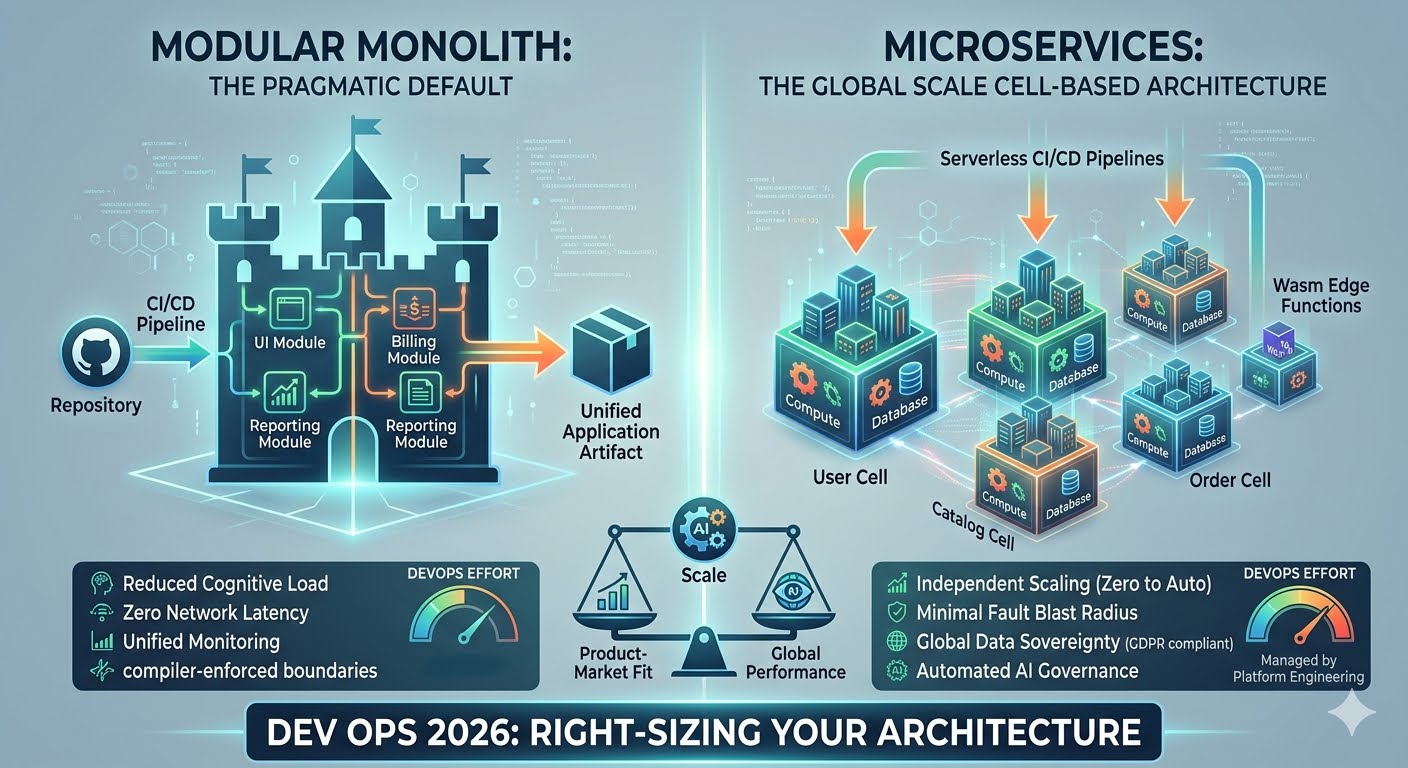
Microservice and Monoliths. In 2026, the long-standing debate between Microservices and Monolithic architectures has moved beyond hype and into a phase of "pragmatic maturity." The DevOps landscape has shifted; we are no longer in the era of "microservices for everything." Instead, 2026 is defined by Right-Sizing Architecture, where the choice is driven by team cognitive load, infrastructure cost, and the specific needs of the business rather than industry trends.The Modern Monolith: Not Your Father's Legacy CodeThe biggest surprise of 2026 is the resurgence of the Modular Monolith. For years, "monolith" was a dirty word in DevOps, associated with "spaghetti code" and slow deployment cycles. However, modern tooling has transformed the monolith into a sleek, highly maintainable option.In 2026, developers use advanced static analysis and compiler-enforced boundaries to ensure that a monolithic codebase remains modular. This allows a single deployment unit to behave like separate services internally. The benefits are clear:Reduced Complexity: No need for complex service meshes (like Istio) or distributed tracing for every minor feature.Performance: Zero network latency between modules. In-process communication is always faster than an API call over a network.Simplified DevOps: A single CI/CD pipeline, one monitoring stack, and no "dependency hell" between micro-repos.For startups and mid-sized teams in 2026, the Modular Monolith is the "default" choice, allowing them to ship faster without the "infrastructure tax" of microservices.Microservices in 2026: The Specialized PowerhouseWhile the monolith has reclaimed territory, Microservices remain the gold standard for global-scale applications. In 2026, microservices have evolved into "Cell-Based Architectures."Large enterprises like Amazon, Netflix, and Uber no longer just build "services"; they build independent "cells" that contain their own data stores and compute power. This minimizes the "blast radius" of any single failure. The 2026 microservices ecosystem is characterized by:Serverless Dominance: Most microservices are now "nanoservices" running on advanced serverless platforms that scale to zero instantly, eliminating the cost of idle containers.WebAssembly (Wasm) at the Edge: Many microservices have moved out of the central cloud and onto the "Edge." By using Wasm, these services run inches away from the user with near-instant cold starts.Automated Governance: AI-driven DevOps tools now manage the complexity that used to kill microservice projects. AI can automatically detect if a service change will break a downstream dependency before the code is even merged.The Convergence: Distributed Monoliths and Macro-servicesIn 2026, we’ve identified a dangerous middle ground: the Distributed Monolith. This happens when a team builds microservices but keeps them so tightly coupled that they must all be deployed together. DevOps engineers now spend significant effort "refactoring back" these failed microservice attempts into "Macro-services"—larger, more logical chunks of code that provide the scalability of services without the fragmentation.Key Factors for Choosing in 2026When deciding between the two in the current DevOps environment, teams look at three critical metrics:Cognitive Load: Can a single developer understand the entire system? If yes, stay monolithic. If the system is too large for one brain, it’s time to break it apart.Deployment Frequency: If different parts of your app need to be updated at vastly different speeds (e.g., a fast-changing UI vs. a slow-changing billing engine), microservices are essential.Data Sovereignty: In 2026, global privacy laws are stricter than ever. Microservices make it easier to keep "German user data" on "German servers" while the rest of the app runs globally.The Role of DevOps and Platform EngineeringThe rise of Internal Developer Platforms (IDPs) has leveled the playing field. Whether you choose a monolith or microservices, 2026 DevOps is about "Platform Engineering." Developers don't worry about the underlying architecture as much because the platform provides "Golden Paths"—pre-configured templates for both styles that include security, logging, and scaling out of the box.Conclusion: The End of the "One Size Fits All" EraIn 2026, the winner of the Microservices vs. Monolith battle is Architecture Agnosticism. The best DevOps teams are those that can evolve their architecture as they grow. They might start with a Modular Monolith to find "product-market fit" and then surgically extract high-load components into microservices as needed.The "Castles" (Monoliths) and the "Cities" (Microservices) both have their place. The secret to success in 2026 isn't choosing the most "modern" one, but choosing the one that lets your team write code, not manage infrastructure.
The Ethics of Ransomware Payments
May 10, 2026
5 min read

The Ethics of Ransomware Payments

The Ethics of Ransomware Payments. The decision to pay a ransomware demand is one of the most agonizing dilemmas in modern cybersecurity. It is no longer a purely financial calculation; it is a profound ethical crisis that pits an organization’s immediate survival against the long-term safety of the global digital ecosystem. As ransomware attacks grow in scale and severity, the debate over the morality of "buying back" data has become a central pillar of cybersecurity strategy.The Pragmatic Defense: The Case for PayingFrom a strictly utilitarian perspective, many organizations argue that paying a ransom is the "lesser of two evils." When critical infrastructure—such as a hospital, a power grid, or a municipal water system—is held hostage, the cost of inaction is measured in human lives, not just dollars.Immediate Restoration of Services: For a hospital with encrypted patient records, every hour of downtime could mean a delayed surgery or a missed diagnosis. In such high-stakes environments, the ethical obligation to protect human life often overrides the abstract goal of de-funding cybercrime.Fiduciary Responsibility: Corporate leaders have a legal and ethical duty to their shareholders and employees to minimize loss. If the cost of rebuilding a network from scratch is $10 million, but the ransom is $500,000, many boards see payment as the only responsible way to preserve the company’s solvency and protect thousands of jobs.Data Sensitivity: In cases of "double extortion," where hackers threaten to leak sensitive private data (like mental health records or trade secrets), organizations may pay not just for a decryption key, but for a promise (however hollow) that the data will be deleted.The Moral Hazard: The Case Against PayingThe counter-argument is built on the principle that "negotiating with terrorists" only fuels the fire. Law enforcement agencies, including the FBI and Interpol, strongly discourage payments because they create a self-sustaining cycle of victimization.Funding Future Attacks: Ransomware is a business. Every dollar paid is reinvested by criminal syndicates into research and development. This allows them to buy more powerful "zero-day" exploits, recruit better talent, and target even more vulnerable sectors. By paying, a victim is essentially subsidizing the next victim’s downfall.The "Marked" Status: Paying a ransom does not guarantee safety; it often guarantees a follow-up attack. Statistics show that organizations that pay are frequently targeted again, either by the same group or by others who see them as a "soft target" willing to open their wallet.No Guarantee of Recovery: Attackers are under no obligation to provide a working decryption key. In many instances, the decryption tools provided are buggy and result in further data corruption, or the attackers simply vanish after receiving the cryptocurrency.The Geopolitical and Legal DimensionThe ethics of ransomware payment are increasingly complicated by international law and sanctions. Many ransomware groups operate out of jurisdictions that are hostile to the West, and some are suspected of having direct ties to state intelligence agencies.If an organization pays a ransom to a group that is on an official sanctions list (such as groups linked to the Russian or North Korean governments), they may be inadvertently funding state-sponsored espionage or warfare. In the United States, the Office of Foreign Assets Control (OFAC) has warned that companies facilitating such payments could face severe legal penalties, regardless of the "urgency" of their situation. This shifts the ethical burden from a private choice to a matter of national security.The Rise of Mandatory Reporting and BansAs the crisis deepens, some governments are moving toward a total ban on ransomware payments. The logic is that if the "revenue stream" is completely cut off, the business model of ransomware will collapse. However, critics argue that a ban would only lead to "under-the-table" payments and cause businesses to shut down permanently rather than report the crime.A more moderate approach being adopted is mandatory reporting. By requiring companies to disclose attacks and payments, governments can gather the intelligence needed to dismantle the infrastructure (servers and crypto-exchanges) that these groups rely on.A New Ethical Framework: "Defensive Resilience"To move beyond the binary "to pay or not to pay" debate, the cybersecurity community is advocating for a framework of Defensive Resilience. The most ethical action an organization can take is to invest so heavily in backups and "offline" data storage that a ransom demand becomes irrelevant.Ethical leadership in this space requires:Transparency: Being honest with customers and regulators about the breach.Collaboration: Sharing threat intelligence with competitors to prevent the spread of a specific strain of ransomware.Proactive Investment: Prioritizing security budgets over "reactive" insurance policies.ConclusionThe ethics of ransomware payments remain a "grey hat" area where there are rarely perfect answers. While the individual organization may save itself by paying, it does so at the expense of the collective security of the internet. The only true solution to this ethical impasse is to remove the leverage that attackers hold. Until organizations can recover from an attack without the need for a criminal's key, the dilemma will continue to haunt boardrooms across the globe.
AI Driven Phishing
May 10, 2026
5 min read

AI Driven Phishing

AI Driven Phishing in Cybersecurity. The era of "clunky" phishing—characterized by obvious spelling errors and generic greetings—is rapidly coming to an end. AI-Driven Phishing represents the weaponization of Large Language Models (LLMs) and Generative AI to create highly sophisticated, personalized, and scalable social engineering attacks that bypass traditional security filters and human intuition.The Evolution: From "Spray and Pray" to "Spear and Scale"Traditional phishing relied on a "spray and pray" methodology: sending millions of low-quality emails in the hope that a tiny percentage of recipients would be gullible enough to click. AI has flipped this script.With tools like ChatGPT (and its illicit counterparts like WormGPT or FraudGPT), attackers can now conduct "Spear Phishing" at the scale of a mass campaign. AI can analyze vast amounts of publicly available data from LinkedIn, social media, and corporate websites to craft messages that are contextually relevant to the victim. It can mimic the specific writing style of a CEO, use industry-specific jargon, and reference recent company events, making the deception nearly indistinguishable from a legitimate internal communication.The Mechanics of AI-Driven AttacksAI has enhanced every stage of the phishing lifecycle:1. Perfected Language and LocalizationOne of the easiest ways to spot a phish used to be poor grammar or awkward phrasing, often a result of non-native speakers using translation tools. AI removes this "red flag." It can generate perfect, professional prose in dozens of languages, allowing cybercriminals to expand their reach into foreign markets with the same level of persuasiveness as a native speaker.2. Deepfakes: Beyond the InboxAI-driven phishing is no longer limited to text. Business Email Compromise (BEC) has evolved into Business Communication Compromise.Voice Deepfakes (Vishing): Using just a few seconds of a person's voice recorded from a YouTube video or a podcast, AI can clone a voice to make a phone call to an employee, posing as a frantic executive requesting an urgent wire transfer.Video Deepfakes: During virtual meetings (like Zoom or Teams), attackers can now use real-time deepfake filters to impersonate high-level officials. In a notable 2024 case, a finance worker in Hong Kong was tricked into paying out $25 million after attending a video call with what he thought were his "colleagues," all of whom were AI-generated deepfakes.3. Dynamic Credential HarvestingAI can build adaptive phishing sites. Instead of a static fake login page, an AI-driven site can change its appearance in real-time based on the user's browser, location, or the specific email they clicked. This bypasses static "URL reputation" databases that security software uses to block known malicious sites.The Threat to Modern Defense SystemsAI phishing is specifically designed to defeat the two pillars of modern defense: Technical Filters and Employee Training.Bypassing SEGs: Secure Email Gateways (SEGs) look for "signatures" of known attacks. Because AI can generate a unique, one-of-a-kind message for every single recipient, there is no "signature" to detect. The message is technically "clean"—it contains no malware, just a persuasive call to action.Eroding Human Intuition: Most Security Awareness Training (SAT) teaches employees to look for urgency and errors. When an AI creates a calm, professional, and error-free request that perfectly matches a real business process, the "human firewall" often fails.Defending Against the AI WaveAs attackers use AI to sharpen their spears, defenders must use AI to thicken their shields.1. AI-Powered Email SecurityOrganizations are moving toward Integrated Cloud Email Security (ICES). These systems use machine learning to build a "baseline" of normal communication patterns. If an email arrives that is technically valid but uses a tone or request type that is statistically "unlikely" for that specific sender, the system flags it as an anomaly.2. Moving Toward Phishing-Resistant MFATraditional Multi-Factor Authentication (MFA) that uses SMS codes or push notifications is still vulnerable to "MFA Fatigue" or proxy-based phishing. The gold standard is now FIDO2/WebAuthn (Passkeys), which uses hardware-backed cryptography to ensure that a user can only log in to a legitimate site, making it physically impossible for a phishing site to "intercept" the credentials.3. Redefining "Trust" in CommunicationCompanies must implement strict out-of-band verification policies. If an "executive" makes an unusual request via voice or video call, employees must be trained to verify the request through a secondary, pre-approved channel (like a specific internal chat app) before taking action.Conclusion: The Arms RaceAI-driven phishing has turned cybersecurity into an AI vs. AI arms race. The advantage currently sits with the attackers, who can experiment with new models without the constraints of ethics or regulations. However, by adopting "Zero Trust" principles and shifting toward cryptographic authentication methods, organizations can mitigate the impact of even the most sophisticated AI deceptions.The goal is no longer to teach employees to "spot the phish"—it is to build systems where even if a human is tricked, the technology prevents the breach.
Post-Quantum Cryptography (PQC)
May 10, 2026
3 min read

Post-Quantum Cryptography (PQC)

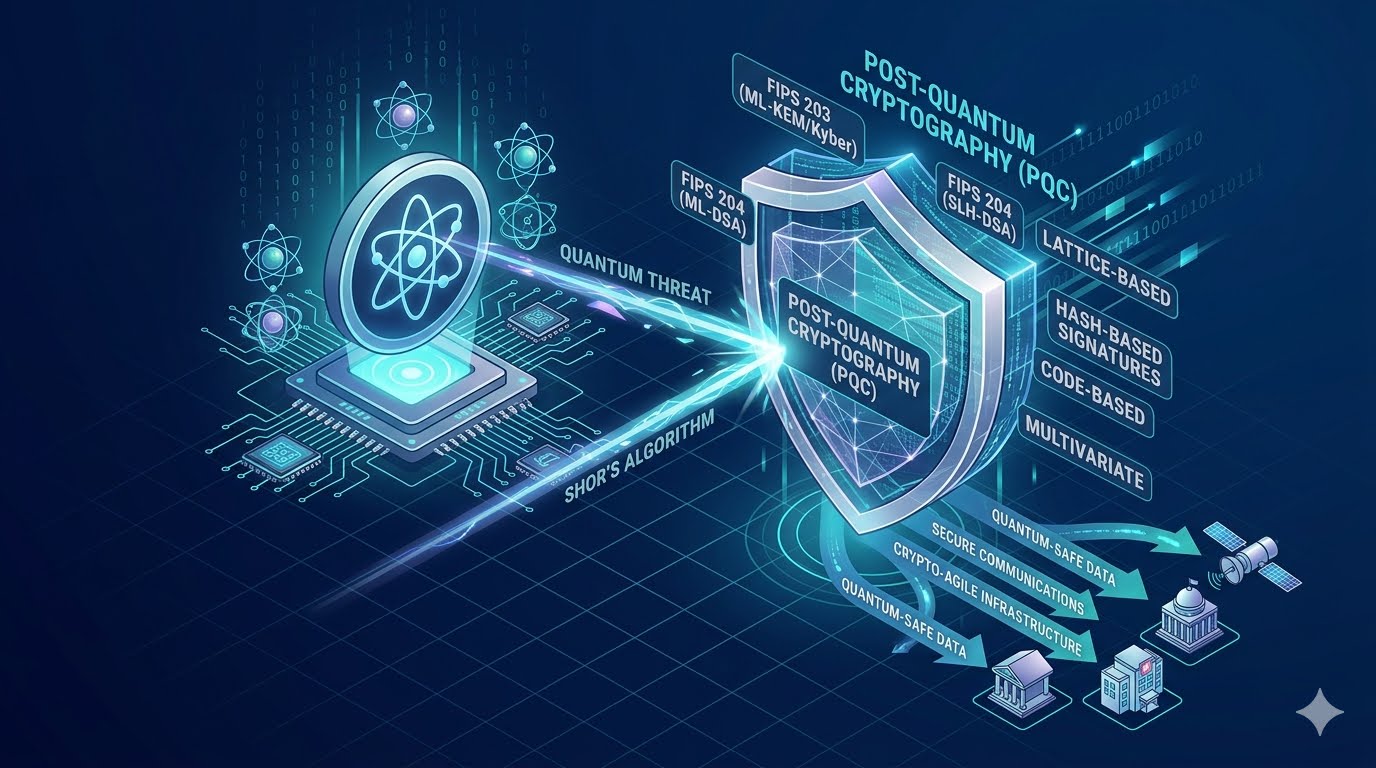
Post-Quantum Cryptography. Post-Quantum Cryptography (PQC) is the next critical frontier in cybersecurity, specifically designed to protect digital infrastructure from the theoretical but imminent threat of quantum computers. While traditional encryption relies on the difficulty of factoring large numbers—a task current computers find nearly impossible—quantum computers using Shor's algorithm could potentially solve these problems in minutes.The Quantum Threat: A Paradigm ShiftModern cybersecurity relies heavily on public-key infrastructure (PKI) like RSA and Elliptic Curve Cryptography (ECC) to secure everything from bank transfers to private messages. These methods are "pre-quantum" and vulnerable to a Cryptographically Relevant Quantum Computer (CRQC).A major concern for security experts is the "Harvest Now, Decrypt Later" strategy. Adversaries are currently intercepting and storing high-value encrypted data today, with the intent to decrypt it years from now when sufficiently powerful quantum computers become available. This makes transitioning to quantum-safe protocols an urgent priority, even before quantum computers are fully realized.Key Approaches to Post-Quantum CryptographyPQC does not require quantum hardware; it runs on classical computers but uses mathematical problems that are thought to be resistant to both classical and quantum attacks. Research is focused on several distinct mathematical foundations:Lattice-based Cryptography: These systems use high-dimensional geometric structures called lattices. Even for quantum computers, finding specific paths through these complex multidimensional grids is computationally exhausting. This approach, including algorithms like ML-KEM (formerly Kyber), is favored for its efficiency and scalability.Hash-based Signatures: These rely on cryptographic hash functions that are naturally resistant to quantum reversal. They offer high security but may have limitations in signature generation speed.Code-based Cryptography: Relying on error-correcting codes, these systems present quantum computers with difficult decoding problems. One of the oldest and most trusted is the Classic McEliece algorithm.Multivariate Cryptography: This approach uses systems of complex polynomial equations that are believed to be too difficult for any computer to solve efficiently.Standardization and ImplementationThe National Institute of Standards and Technology (NIST) has spearheaded a global effort to standardize these new algorithms. In August 2024, NIST released its first three official standards:FIPS 203 (ML-KEM): Based on the CRYSTALS-Kyber algorithm for general encryption.FIPS 204 (ML-DSA): Based on CRYSTALS-Dilithium for digital signatures.FIPS 205 (SLH-DSA): Based on SPHINCS+ as an alternative signature scheme.Organizations are encouraged to adopt "Crypto-Agility"—the ability to rapidly switch cryptographic algorithms without redesigning entire systems. Many are currently using hybrid schemes, which combine traditional classical encryption with post-quantum layers to ensure security remains intact even if one method is eventually compromised.Challenges and Future OutlookTransitioning to PQC is not without its hurdles. These new algorithms often require:Larger Key Sizes: Some PQC algorithms use much larger keys and certificates than RSA, requiring more storage and memory.Higher Latency: Encryption and decryption can be more computationally intensive, potentially slowing down real-time applications or high-frequency API requests.Infrastructure Updates: Legacy hardware, particularly in IoT or industrial environments, may lack the processing power needed for these advanced mathematical operations.Despite these challenges, tech giants like Google, Apple, and Microsoft have already begun integrating post-quantum protections into their platforms. As quantum computing continues to accelerate, the shift to PQC remains the only viable way to ensure long-term data resilience in a post-quantum world.
The Zero Trust Architecture (ZTA)
May 10, 2026
5 min read

The Zero Trust Architecture (ZTA)

Zero Trust Architecture in cybersecurity. The Zero Trust Architecture (ZTA) is no longer just a buzzword in cybersecurity circles; it is the fundamental framework required to secure the modern, decentralized digital landscape. As organizations move away from traditional office-based environments toward cloud-integrated, remote-first structures, the old "castle-and-moat" security model has become obsolete. Zero Trust represents a paradigm shift from "trust but verify" to "never trust, always verify."The Death of the PerimeterFor decades, cybersecurity was built on the concept of a hardened perimeter. If a user was inside the network (the castle), they were trusted. If they were outside, they were untrusted. This worked when all data lived in on-premise servers and all employees sat at desks in a single building.However, the rise of Cloud Computing, Software-as-a-Service (SaaS), and Bring Your Own Device (BYOD) policies shattered this perimeter. Today, an employee might access sensitive financial data from a coffee shop using a personal tablet. In this environment, the "internal" network is no longer a safe zone. If an attacker breaches the perimeter—through a stolen password or a phishing link—they gain "lateral movement" capabilities, allowing them to roam freely through the network. Zero Trust was designed to solve this exact vulnerability.The Core Principles of Zero TrustZero Trust is not a single software or product; it is a strategic framework based on three unwavering pillars:Assume Breach: Operates under the constant assumption that the network has already been compromised. This mindset forces security teams to design defenses that limit the "blast radius" of an attack.Verify Explicitly: Every request for access—whether from a CEO inside the office or an automated bot—must be authenticated and authorized based on multiple data points. This includes user identity, location, device health, service or workload, and data classification.Least Privilege Access: Users are granted only the minimum level of access required to perform their specific task, and only for the duration needed. This prevents a compromised account from accessing the entire database.How Zero Trust Works: The ComponentsTo implement Zero Trust, organizations rely on several key technological components working in harmony:Identity and Access Management (IAM)Identity is the new perimeter. Strong IAM involves Multi-Factor Authentication (MFA), which goes beyond simple passwords to include biometrics or hardware tokens. In a Zero Trust environment, identity is continuously re-validated throughout a session, not just at login.Micro-segmentationTraditional networks are "flat," meaning once you’re in, you can see everything. Micro-segmentation breaks the network into small, isolated zones. A person in the Marketing department has no technical path to reach the Accounting servers. If a Marketing laptop is infected with ransomware, the walls of the micro-segment stay up, preventing the virus from spreading to the rest of the company.Device Health VerificationBefore granting access, the system checks the "health" of the device. Does it have the latest security patches? Is the antivirus running? Is it a recognized corporate device? If a device is deemed "unhealthy," access is denied regardless of how valid the user's password is.Zero Trust Network Access (ZTNA)ZTNA replaces the traditional VPN. While a VPN gives a user a "tunnel" into the whole network, ZTNA creates a 1-to-1 connection between the user and a specific application. The rest of the network remains invisible to the user.The Benefits of a Zero Trust ApproachThe primary advantage of ZTNA is a massive reduction in risk. By eliminating implicit trust, companies can stop data breaches that rely on stolen credentials or lateral movement.Furthermore, it provides unprecedented visibility. Because every request is verified, security teams have a detailed log of who is doing what, when, and from where. This data is invaluable for compliance (like GDPR or HIPAA) and for spotting "Shadow IT"—unauthorized apps being used by employees.Finally, it supports workforce agility. Zero Trust allows employees to work securely from anywhere in the world without the performance bottlenecks often caused by traditional VPNs.Challenges in ImplementationTransitioning to Zero Trust is a marathon, not a sprint. The biggest hurdle is often legacy infrastructure. Older systems may not support modern authentication protocols like SAML or OIDC, making them difficult to "wrap" in a Zero Trust layer.There is also the risk of User Friction. If security checks are too frequent or cumbersome, employee productivity drops. Organizations must balance security with "Seamless Authentication"—using signals like location and behavior to verify identity in the background without constantly prompting the user for a code.The Future: AI and Continuous MonitoringAs we look forward, Zero Trust will be increasingly powered by Artificial Intelligence (AI) and Machine Learning (ML). Static rules (e.g., "Allow access if the user is in London") are being replaced by dynamic, risk-based scoring.If an AI detects that a user is logging in from London at 9:00 AM, but then attempts to download 50GB of data from a server in Tokyo at 9:05 AM, the system can instantly flag this as "impossible travel" and revoke access automatically. This level of real-time, automated response is the ultimate goal of the Zero Trust journey.ConclusionIn a world where cyberattacks are no longer a matter of "if" but "when," Zero Trust Architecture is the only logical response. By removing the concept of "trust" from the technical infrastructure, organizations can build a resilient environment that protects data even when the perimeter is breached. It requires a fundamental change in culture and technology, but for any business operating in the 21st century, it is a non-negotiable requirement for survival.
Intrusion Detection System (IDS)
May 08, 2026
7 min read

Intrusion Detection System (IDS)

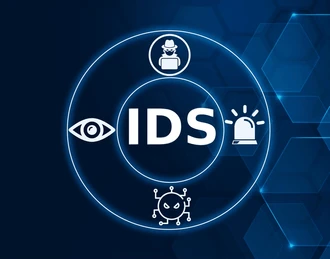
Intrusion Detection System (IDS) in Cybersecurity. A network security tool that can monitor network traffic and devices for specified malicious and, suspicious activities or security policy violations is considered an intrusion detection system (IDS).An IDS can help accelerate and automate network threat detection by alerting security administrators to known or potential threats, or by sending alerts to a centralized security tool. A centralized security tool such as a security information and event management (SIEM) system can combine data from other sources to help security teams identify and respond to cyberthreats that might slip by other security measures.IDSs can also support compliance efforts. Certain regulations, such as the Payment Card Industry Data Security Standard (PCI-DSS), require organizations to implement intrusion detection measures.An IDS cannot stop security threats on its own. Today IDS capabilities are typically integrated with, or incorporated into, intrusion prevention systems (IPSs), which can detect security threats and automatically act to prevent them.How intrusion detection systems workIDSs can be software applications that are installed on endpoints or dedicated hardware devices that are connected to the network. Some IDS solutions are available as cloud services. Whatever form it takes, an IDS uses one or both of two primary threat detection methods: signature-based or anomaly-based detection.Signature-based detectionSignature-based detection analyzes network packets for attack signatures, unique characteristics or behaviors that are associated with a specific threat. A sequence of code that appears in a particular malware variant is an example of an attack signature.A signature-based IDS maintains a database of attack signatures against which it compares network packets. If a packet triggers a match to one of the signatures, the IDS flags it. To be effective, signature databases must be regularly updated with new threat intelligence as new cyberattacks emerge and existing attacks evolve. Brand new attacks that are not yet analyzed for signatures can evade signature-based IDS.Anomaly-based detectionAnomaly-based detection methods use machine learning to create, and continually refine, a baseline model of normal network activity. Then it compares network activity to the model and flags deviations, such as a process that uses more bandwidth than normal, or a device opening a port.Because it reports any abnormal behavior, anomaly-based IDS can often catch new cyberattacks that might evade signature-based detection. For example, anomaly-based IDSs can catch zero-day exploits, attacks that take advantage of software vulnerabilities before the software developer knows about them or has time to patch them.But anomaly-based IDSs may also be more prone to false positives. Even benign activity, such as an authorized user accessing a sensitive network resource for the first time, can trigger an anomaly-based IDS.Less common detection methodsReputation-based detection blocks traffic from IP addresses and domains associated with malicious or suspicious activity. Stateful protocol analysis focuses on protocol behavior, for example, it might identify a denial-of-service (DoS) attack by detecting a single IP address making many simultaneous TCP connection requests in a short period.Whatever method(s) it uses, when an IDS detects a potential threat or policy violation, it alerts the incident response team to investigate. IDSs also keep records of security incidents, either in their own logs or by logging them with a security information and event management (SIEM) tool (see 'IDS and other security solutions' below). These incident logs can be used to refine the IDS’s criteria, such as by adding new attack signatures or updating the network behavior model.Types of intrusion prevention systemsIDSs are categorized based on where they’re placed in a system and what kind of activity they monitor.Network intrusion detection systems (NIDSs): monitor inbound and outbound traffic to devices across the network. NIDS are placed at strategic points in the network, often immediately behind firewalls at the network perimeter so that they can flag any malicious traffic breaking through.NIDS may also be placed inside the network to catch insider threats or hackers who hijacked user accounts. For example, NIDS might be placed behind each internal firewall in a segmented network to monitor traffic flowing between subnets.To avoid impeding the flow of legitimate traffic, a NIDS is often placed “out-of-band,” meaning that traffic doesn’t pass directly through it. A NIDS analyzes copies of network packets rather than the packets themselves. That way, legitimate traffic doesn’t have to wait for analysis, but the NIDS can still catch and flag malicious traffic.Host intrusion detection systems (HIDSs): are installed on a specific endpoint, like a laptop, router, or server. The HIDS only monitors activity on that device, including traffic to and from it. A HIDS typically works by taking periodic snapshots of critical operating system files and comparing these snapshots over time. If the HIDS notices a change, such as log files being edited or configurations being altered, it alerts the security team.Security teams often combine network-based intrusion detection systems and host-based intrusion detection systems. The NIDS looks at traffic overall, while the HIDS can add extra protection around high-value assets. A HIDS can also help catch malicious activity from a compromised network node, like ransomware spreading from an infected device.While NIDS and HIDS are the most common, security teams can use other IDSs for specialized purposes. A protocol-based IDS (PIDS) monitors connection protocols between servers and devices. PIDS are often placed on web servers to monitor HTTP or HTTPS connections.An application protocol-based IDS (APIDS): works at the application layer, monitoring application-specific protocols. An APIDS is often deployed between a web server and an SQL database to detect SQL injections.IDS evasion tacticsWhile IDS solutions can detect many threats, hackers can get around them. IDS vendors respond by updating their solutions to account for these tactics. However, these solution updates create something of an arm’s race, with hackers and IDSs trying to stay one step ahead of one another.Some common IDS evasion tactics include:Distributed denial-of-service (DDoS) attacks: taking IDSs offline by flooding them with obviously malicious traffic from multiple sources. When the IDS’s resources are overwhelmed by the decoy threats, the hackers sneak in.Spoofing: faking IP addresses and DNS records to make it look like their traffic is coming from a trustworthy source.Fragmentation: splitting malware or other malicious payloads into small packets, obscuring the signature and avoiding detection. By strategically delaying packets or sending them out of order, hackers can prevent the IDS from reassembling them and noticing the attack.Encryption: using encrypted protocols to bypass an IDS if the IDS doesn’t have the corresponding decryption key.Operator fatigue: generating large numbers of IDS alerts on purpose to distract the incident response team from their real activity.IDS and other security solutionsIDSs aren’t standalone tools. They’re designed to be part of a holistic cybersecurity system, and are often tightly integrated with one or more of the following security solutions.IDS and SIEM (security information and event management)IDSs alerts are often funneled to an organization’s SIEM, where they can be combined with alerts and information from other security tools into a single, centralized dashboard. Integrating IDS with SIEMs enables security teams to enrich IDS alerts with threat intelligence and data from other tools, filter out false alarms‌, and prioritize incidents for remediation.IDS and IPS (intrusion prevention systems)As noted above, an IPS monitors network traffic for suspicious activity, like an IDS, and intercepts threats in real time by automatically terminating connections or triggering other security tools. Because IPSs are meant to stop cyberattacks, they’re usually placed inline, meaning that all traffic has to pass through the IPS before it can reach the rest of the network.Some organizations implement an IDS and an IPS as separate solutions. More often, IDS and IPS are combined in a single intrusion detection and prevention system (IDPS) which detects intrusions, logs them, alerts security teams and automatically responds.IDS and firewallsIDSs and firewalls are complementary. Firewalls face outside the network and act as barriers by using predefined rulesets to allow or disallow traffic. IDSs often sit near firewalls and help catch anything that slips past them. Some firewalls, especially next-generation firewalls, have built-in IDS and IPS functions.
DevOps Life Cycle in Software Projects
May 07, 2026
6 min read

DevOps Life Cycle in Software Projects

DevOps Lifecycle in Software Projects. DevOps is a process whereby a single team is capable of handling the whole software application lifecycle, including development, testing, release, deployment, operation, display and planning. It integrates the terms “Dev” (for development) and “Ops” (for operations). With the help of DevOps the delivery of applications and services by a business can be faster. Amazon, Netflix, and other businesses have all effectively embraced DevOps to improve their customer experience.DevOps Lifecycle is the set of phases that includes DevOps for taking part in Development and Operation group duties for quicker software program delivery. DevOps follows positive techniques that consist of code, building, testing, releasing, deploying, operating, displaying, and planning. DevOps lifecycle follows a range of phases such as non-stop development, non-stop integration, non-stop testing, non-stop monitoring, and non-stop feedback. Each segment of the DevOps lifecycle is related to some equipment and applied sciences to obtain the process. Some of the frequently used tools are open source and are carried out primarily based on commercial enterprise requirements. DevOps lifecycle is effortless to manipulate and it helps satisfactory delivery.7 Cs of DevOps Continuous DevelopmentContinuous IntegrationContinuous TestingContinuous Deployment/Continuous DeliveryContinuous MonitoringContinuous FeedbackContinuous Operations1. Continuous DevelopmentIn Continuous Development code is written in small, continuous bits rather than all at once, Continuous Development is important in DevOps because this improves efficiency every time a piece of code is created, it is tested, built, and deployed into production. Continuous Development raises the standard of the code and streamlines the process of repairing flaws, vulnerabilities, and defects. It facilitates developers’ ability to concentrate on creating high-quality code.2. Continuous Integration Continuous Integration can be explained mainly in 4 stages in DevOps. They are as follows:Getting the SourceCode from SCMBuilding the codeCode quality reviewStoring the build artifactsThe stages mentioned above are the flow of Continuous Integration and we can use any of the tools that suit our requirement in each stage and of the most popular tools are GitHub for source code management(SCM) when the developer develops the code on his local machine he pushes it to the remote repository which is GitHub from here who is having the access can Pull, clone and can make required changes to the code. From there by using Maven we can build them into the required package (war, jar, ear) and can test the Junit cases.SonarQube performs code quality reviews where it will measure the quality of source code and generates a report in the form of HTML or PDF format. Nexus for storing the build artifacts will help us to store the artifacts that are build by using Maven and this whole process is achieved by using a Continuous Integration tool Jenkins.3. Continuous TestingAny firm can deploy continuous testing with the use of the agile and DevOps methodologies. Depending on our needs, we can perform continuous testing using automation testing tools such as Testsigma, Selenium, LambdaTest, etc. With these tools, we can test our code and prevent problems and code smells, as well as test more quickly and intelligently. With the aid of a continuous integration platform like Jenkins, the entire process can be automated, which is another added benefit.4. Continuous Deployment/ Continuous DeliveryContinuous Deployment: Continuous Deployment is the process of automatically deploying an application into the production environment when it has completed testing and the build stages. Here, we’ll automate everything from obtaining the application’s source code to deploying it.Continuous Delivery: Continuous Delivery is the process of deploying an application into production servers manually when it has completed testing and the build stages. Here, we’ll automate the continuous integration processes, however, manual involvement is still required for deploying it to the production environment.5. Continuous MonitoringDevOps lifecycle is incomplete if there was no Continuous Monitoring. Continuous Monitoring can be achieved with the help of Prometheus and Grafana we can continuously monitor and can get notified before anything goes wrong with the help of Prometheus we can gather many performance measures, including CPU and memory utilization, network traffic, application response times, error rates, and others. Grafana makes it possible to visually represent and keep track of data from time series, such as CPU and memory utilization.6. Continuous FeedbackOnce the application is released into the market the end users will use the application and they will give us feedback about the performance of the application and any glitches affecting the user experience after getting multiple feedback from the end users’ the DevOps team will analyze the feedbacks given by end users and they will reach out to the developer team tries to rectify the mistakes they are performed in that piece of code by this we can reduce the errors or bugs that which we are currently developing and can produce much more effective results for the end users also we reduce any unnecessary steps to deploy the application. Continuous Feedback can increase the performance of the application and reduce bugs in the code making it smooth for end users to use the application.7. Continuous Operations We will sustain the higher application uptime by implementing continuous operation, which will assist us to cut down on the maintenance downtime that will negatively impact end users’ experiences. More output, lower manufacturing costs, and better quality control are benefits of continuous operations.Different Phases of the DevOps LifecyclePlan: Professionals determine the commercial need and gather end-user opinions throughout this level. In this step, they design a project plan to optimize business impact and produce the intended result.Code – During this point, the code is being developed. To simplify the design process, the developer team employs lifecycle DevOps tools and extensions like Git that assist them in preventing safety problems and bad coding standards.Build – After programmers have completed their tasks, they use tools such as Maven and Gradle to submit the code to the common code source.Test – To assure software integrity, the product is first delivered to the test platform to execute various sorts of screening such as user acceptability testing, safety testing, integration checking, speed testing, and so on, utilizing tools such as JUnit, Selenium, etc.Release – At this point, the build is prepared to be deployed in the operational environment. The DevOps department prepares updates or sends several versions to production when the build satisfies all checks based on the organizational demands.Deploy – At this point, Infrastructure-as-Code assists in creating the operational infrastructure and subsequently publishes the build using various DevOps lifecycle tools.Operate – This version is now convenient for users to utilize. With tools including Chef, the management department take care of server configuration and deployment at this point.Monitor – The DevOps workflow is observed at this level depending on data gathered from consumer behavior, application efficiency, and other sources. The ability to observe the complete surroundings aids teams in identifying bottlenecks affecting the production and operations teams’ performance.
Introduction to Website Development
May 07, 2026
12 min read

Introduction to Website Development

Website development processes. Website development emphatically refers to the tasks and processes involved in designing, creating and maintaining a website. This includes everything from markup and coding to scripting, network configuration,and CMS development.If you want to get started with web development, a big part of that will be learning various programming languages. Depending on your focus, these could be front-end languages like HTML, CSS, and JavaScript or back-end languages like Python, PHP, Java, Ruby, and so on.However, I don't think learning programming languages is the only part of website development. You'll also need to learn how the web works at a basic level, especially if you want to go into back-end website development.I'll talk about some of these areas when I take you through roadmaps for both front-end and back-end development.Why is web development important?Can you believe that we're part of a world where over 5.52 billion people are connected through the internet? That's more than half of our global population actively engaging in research, connection, education, and entertainment through this incredible digital universe.Given the rapidly increasing number of internet users, it’s no surprise that web development is a rapidly expanding industry.Between now and 2033, the employment of web developers is expected to grow by 8%, which is faster than most other technology careers. It‘s an exciting time to be in this field, and I’m thrilled to be part of this dynamic industry.Web Development vs. Web ProgrammingWeb development and web programming sound very similar — and they are. But, there’s one very important distinction.Web development refers to the overall process of creating websites or web applications, including the project’s design, layout, coding, content creation, and functionality. It involves using a combination of programming languages, tools, and frameworks to bring a website or web application to life. Web development may also encompass project management activities, such as fielding development requests from stakeholders or freelance clients.Web programming, on the other hand, specifically refers to the coding and scripting of a website, whether the front-end or back-end. It primarily involves writing code to handle data, process user inputs, and generate dynamic content. A web programmer will rarely, if ever, handle a large web development project from end to end. They may build a certain section of a site or troubleshoot bugs.Understanding this difference has been crucial in my career, allowing me to appreciate the depth and breadth of skills required in the world of web creation. It's a reminder of the diverse talents and expertise that come together to make the digital world what it is today.1. What is a website?Websites are files stored on servers, which are computers that host (fancy term for “store files for”) websites. These servers are connected to a giant network called the internet.Now, how do we access these websites? This is where browsers come into play. Browsers are computer programs that load websites via your Internet connection, such as Google Chrome or Safari, while the computers used to access these websites are known as “clients.”2. What is an IP address?I was always fascinated by how the Internet knows where to send data. The answer lies in understanding IP addresses. To access a website, you need to know its Internet Protocol (IP) address. An IP address is a unique string of numbers. Each device has an IP address to distinguish itself from the billions of websites and devices connected via the Internet.If this sounds new to you, that‘s because you’ve been using domain names to reach websites. While you can access a website using its IP address, most internet users prefer to use domain names or by going through search engines.Domain names are connected to website server IPs using something called the Domain Name System (DNS). If you want to be a web developer, I think it's essential to understand how DNS works.Pro tip: To find your device’s IP address, you can also type “what’s my IP address” into your search browser.3. What does HTTP mean?HyperText Transfer Protocol (HTTP) is what connects our website request to the remote server that houses all website data. It’s a set of rules (a protocol) that defines how messages should be sent over the internet. It allows us to jump between site pages and websites.If I type a website into my web browser or search for something through a search engine, HTTP provides a framework so that the client (computer) and server can speak the same language when they make requests and responses to each other over the internet.It’s essentially the translator between you and the internet. HTTP reads our website request, reads the code sent back from the server, and translates it for us as a website.Understanding HTTP is important for all aspects of web development, but I think it's especially essential if you want to get into back-end development.4. What is coding?Coding refers to writing code for servers and applications using programming languages. They’re called “languages” because they include vocabulary and grammatical rules for communicating with computers. They also include special commands, abbreviations, and punctuation that can only be read by devices and programs.All software is written in at least one coding language, but languages vary based on platform, operating system, and style. All languages fall into one of two categories: front-end and back-end.Pro tip: Sometimes, you'll see that businesses are seeking a full stack developer. This means that you have expertise in both the front and back end.5. What does front-end mean?Front-end (or client-side) is the side of a website or software that you see and interact with as an Internet user. When website information is transferred from a server to a browser, front-end coding languages allow the website to function without having to continually “communicate” with the internet.Front-end code allows users to interact with a website and play videos, expand or minimize images, highlight text, and more. Web developers who work on front-end coding work on client-side development.6. What does back-end mean?On the contrary, the back-end (or server-side) is the side that you don’t see when you use the internet. It’s digital infrastructure. To non-developers, it looks like a bunch of numbers, letters, and symbols.There are more back-end coding languages than front-end languages. That’s because browsers — at the front end — only understand HTML, CSS, and JavaScript. Meanwhile, a server — at the back end — can be configured to understand pretty much any language.7. What is a CMS?A content management system (CMS) is a web application or a series of programs used to create and manage web content. (Note: A CMS isn't necessarily the same thing as a site builder, such as Squarespace or Wix.)While not required to build a website, using a CMS makes things easier. It provides the building blocks (like plugins and add-ons) and lets you create the structure with your code.Pro tip: Your CMS is often used for ecommerce and blogging, but it's useful for all types of websites. I think it can be especially helpful if you need to display and organize large amounts of data.8. What is cybersecurity?There are always malicious actors looking to find vulnerabilities in websites to expose private information, steal data, and crash servers. Cybersecurity is the practice of securing data, networks, and computers from these threats.The methods used by hackers are constantly evolving, as are the security measures taken to defend against them. Failing to understand how your site could be targeted could result in disaster.As a result, a basic understanding of cybersecurity best practices is critical for effective web development. You should also carry out security audits on a consistent basis. This will ensure that your website doesn't fall victim to bad actors attempting to steal your information.1. Front-End DevelopmentFront-end developers work on the client- or user-facing side of websites, programs, and software — in other words, what users see. They design and develop the visual aspects, including the layout, navigation, graphics, and other aesthetics.The main job of these developers is to build interfaces that help users reach their goals. They also often work on the user experience aspect of their projects.2. Back-End DevelopmentIf the front end is what users see, the back end is what they don’t. Back-end web developers work on the servers of websites, programs, and software to make sure everything works properly behind the scenes.These developers work with systems like servers, operating systems, APIs, and databases and manage the code for security, content, and site architecture. They collaborate with front-end developers to bring their products to users.3. Full Stack DevelopmentFull stack developers work in both the front-end and back-end sides of a website. They can create a website, application, or software program from start to finish. “Stack” refers to the different technologies that handle different functionalities on the same website, like the server, interface, etc.Because full stack developers require years in the field to build the necessary experience, this role is often sought after by companies looking to build or update their websites. This developer's all-around knowledge helps them optimize performance, catch issues before they occur, and help team members understand different parts of a web service.4. Website DevelopmentWebsite developers can be front-end, back-end, or full stack developers. However, these professionals specialize in building websites, as opposed to mobile applications, desktop software, or video games.5. Desktop DevelopmentDesktop developers specialize in building software applications that run locally on your device, rather than over the Internet in the web browser. Sometimes, the skill set of these developers overlaps with web developers if an application can run both online and off.6. Mobile DevelopmentMobile developers build applications for mobile devices such as smartphones or tablets. Mobile apps operate much differently than other websites and software programs, thus requiring a separate set of development skills and knowledge of specialized programming languages. (Psst: Even if you are not building a mobile application, you should aim to make your website mobile-friendly!)7. Game DevelopmentGame developers specialize in writing code for video games, including console games (Xbox, PlayStation, etc.), PC games, and mobile games — which means this specialty overlaps somewhat with mobile development.8. Embedded DevelopmentEmbedded developers work with all hardware that isn't a computer (or, at least, what most of us imagine as “computers” with a keyboard and screen). This includes electronic interfaces, consumer devices, IoT devices, real-time systems, and more.With a recent rise in interconnected devices — as seen with smart appliances, Bluetooth technologies, and virtual assistants — embedded development is becoming an in-demand practice.9. Security DevelopmentSecurity developers establish methods and procedures for securing software programs or websites. They typically work as ethical hackers, trying to “break” websites to expose vulnerabilities without intending harm. They also build systems that discover and eradicate security risks.Front-End Web Development LanguagesAs I've already discussed, front-end web development focuses on creating the visual and interactive elements of a site. It involves designing and building the user-facing side — what you see, essentially, when you pull up a site in a web browser.In my perspective, front-end development is likely the “easiest” way to begin a career in web development. That said, as with any other aspect of this field, it will have a learning curve. I'll discuss this in the next section when I share a general roadmap for getting started with front-end web development.Here are some of the most popular front-end web development languages. Having an understanding of these will be paramount as a front-end developer.HTML (Hypertext Markup Language)HTML is likely the language you first thought of when it comes to web development, and with good reason: HTML is the backbone of any web page. It provides both semantic structure and defines the elements of a website, such as headings, paragraphs, images, and links. Web developers use HTML to give content a proper layout before customizing it.CSS (Cascading Style Sheets)If HTML is the backbone of a site, then CSS is the muscle. CSS is responsible for styling the visual appearance of a website. It allows developers to customize colors, fonts, layouts, and other design elements. With CSS, you can also create responsive web pages that adapt to different screen sizes.While you can always write your own CSS from scratch, there are also lots of CSS frameworks that can help you more quickly and easily style your website.JavaScriptJavaScript is a dynamic programming language that adds interactive elements to web pages, such as dropdown menus, sliders, forms, and animations.JavaScript is widely used for client-side scripting (that is, the script runs on the client’s browser and not on the server that hosts the website). JavaScript generally enhances the user experience by making websites more dynamic and engaging.There are also a number of popular JavaScript frameworks and libraries that can help you, including jQuery and React.These languages play a crucial role in creating visually appealing, intuitive, and interactive websites. Don’t underestimate them: A website may have the best back-end structure, but unless the UI is modern, interactive, and user-friendly, it won’t be as appealing to a visitor.
Artificial Intelligence in Modern Medicine
May 07, 2026
5 min read

Artificial Intelligence in Modern Medicine

Artificial intelligence in modern medicine. Artificial intelligence in medicine is referred to as the use of machine learning models in processing of medical data in order to give medical professionals important insights, improving health outcomes and patient experiences.How is artificial intelligence used in medicine?Thanks to recent advances in computer science and informatics, artificial intelligence (AI) is quickly becoming an integral part of modern healthcare. AI algorithms and other applications powered by AI are being used to support medical professionals in clinical settings and in ongoing research.Currently, the most common roles for AI in medical settings are clinical decision support and imaging analysis. Clinical decision support tools help providers make decisions about treatments, medications, mental health and other patient needs by providing them with quick access to information or research that's relevant to their patient. In medical imaging, AI tools are being used to analyze CT scans, x-rays, MRIs and other images for lesions or other findings that a human radiologist might miss.The challenges that the COVID-19 pandemic created for many health systems also led many healthcare organizations around the world to start field-testing new AI-supported technologies, such as algorithms designed to help monitor patients and AI-powered tools to screen COVID-19 patients.The research and results of these tests are still being gathered, and the overall standards for the use AI in medicine are still being defined. Yet opportunities for AI to benefit clinicians, researchers and the patients they serve are steadily increasing. At this point, there is little doubt that AI will become a core part of the digital health systems that shape and support modern medicine.AI applications in medicineThere are numerous ways AI can positively impact the practice of medicine, whether it's through speeding up the pace of research or helping clinicians make better decisions.AI in disease detection and diagnosisUnlike humans, AI never needs to sleep. Machine learning models could be used to observe the vital signs of patients receiving critical care and alert clinicians if certain risk factors increase. While medical devices like heart monitors can track vital signs, AI can collect the data from those devices and look for more complex conditions, such as sepsis. One IBM client has developed a predictive AI model for premature babies that is 75% accurate in detecting severe sepsis.Personalized disease treatmentPrecision medicine could become easier to support with virtual AI assistance. Because AI models can learn and retain preferences, AI has the potential to provide customized real-time recommendations to patients around the clock. Rather than having to repeat information with a new person each time, a healthcare system could offer patients around-the-clock access to an AI-powered virtual assistant that could answer questions based on the patient's medical history, preferences and personal needs.AI in medical imagingAI is already playing a prominent role in medical imaging. Research has indicated that AI powered by artificial neural networks can be just as effective as human radiologists at detecting signs of breast cancer as well as other conditions. In addition to helping clinicians spot early signs of disease, AI can also help make the staggering number of medical images that clinicians have to keep track of more manageable by detecting vital pieces of a patient's history and presenting the relevant images to them.Clinical trial efficiencyA lot of time is spent during clinical trials assigning medical codes to patient outcomes and updating the relevant datasets. AI can help speed this process up by providing a quicker and more intelligent search for medical codes. Two IBM Watson Health clients recently found that with AI, they could reduce their number of medical code searches by more than 70%.Accelerated drug developmentDrug discovery is often one of the longest and most costly parts of drug development. AI could help reduce the costs of developing new medicines in primarily two ways: creating better drug designs and finding promising new drug combinations. With AI, many of the big data challenges facing the life sciences industry could be overcome.Benefits of AI in medicineInformed patient careIntegrating medical AI into clinician workflows can give providers valuable context while they're making care decisions. A trained machine learning algorithm can help cut down on research time by giving clinicians valuable search results with evidence-based insights about treatments and procedures while the patient is still in the room with them.Error reductionThere is some evidence that AI can help improve patient safety. A recent systemic review of 53 peer-reviewed studies examining the impact of AI on patient safety found that AI-powered decision support tools can help improve error detection and drug management.Reducing the costs of careThere are a lot of potential ways AI could reduce costs across the healthcare industry. Some of the most promising opportunities include reducing medication errors, customized virtual health assistance, fraud prevention, and supporting more efficient administrative and clinical workflows.Increasing doctor-patient engagementMany patients think of questions outside of typical business hours. AI can help provide around-the-clock support through chatbots that can answer basic questions and give patients resources when their provider’s office isn’t open. AI could also potentially be used to triage questions and flag information for further review, which could help alert providers to health changes that need additional attention.Providing contextual relevanceOne major advantage of deep learning is that AI algorithms can use context to distinguish between different types of information. For example, if a clinical note includes a list of a patient's current medications along with a new medication their provider recommends, a well-trained AI algorithm can use natural language processing to identify which medications belong in the patient's medical history.

Stay Ahead in Tech

Get the latest ICT tutorials, DevOps guides, and AI news delivered directly to your inbox.