The Latest in

ICT Articles & Tutorials

World ICT News is a professional platform dedicated to Artificial Intelligence, Cloud Computing, DevOps, and Cybersecurity. Empowering the next generation of ICT specialists. Our exclusive tutorials and articles are designed to serve as a stepping stone for you into the world of ICT industry...

Mastering Complex Loops and Array in Javascript
May 22, 2026
7 min read

Mastering Complex Loops and Array in Javascript

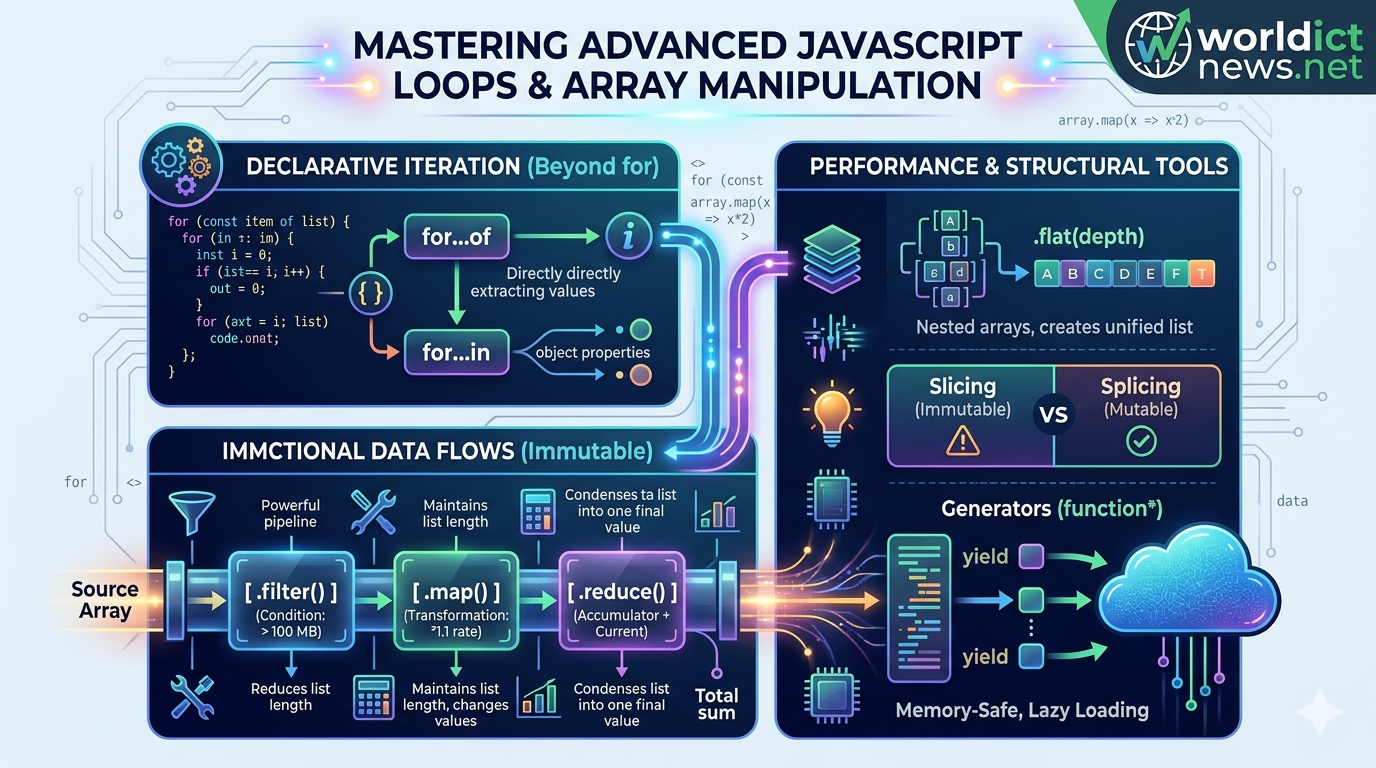
Advanced JavaScript: Mastering Complex Loops and Array Manipulation. In modern software engineering, data is rarely processed in simple, predictable formats. Enterprise applications routinely handle deeply nested JSON payloads, real-time API streams, and large arrays of complex data objects. To build high-performance, maintainable software architectures, developers must move beyond basic for loops and standard array operations.Modern ECMAScript (ES6+) provides a robust toolkit of advanced iteration protocols and functional array methods. Mastering these tools allows you to write declarative, highly optimized code that eliminates common logical bugs, minimizes computational overhead, and improves readability. This guide explores complex control flows, functional transformation matrices, memory-efficient generators, and optimal data mutation strategies with real-world examples.1. Declarative Iteration Protocols: Beyond the Standard LoopTraditional indexing loops (for (let i = 0; i < arr.length; i++)) introduce manual tracking states, making them prone to off-by-one errors and scope leaks. Modern JavaScript introduces declarative iteration protocols that abstract the underlying pointer mechanics away from the developer.The for...of StatementThe for...of loop executes a custom iteration loop over values produced by an iterable object—including arrays, strings, maps, sets, and function arguments.javascriptconst hardwareNodes = ['Server-A', 'Server-B', 'Gateway-01'];// Direct value extraction without manual index trackingfor (const node of hardwareNodes) { console.log(`Node Address: ${node}`);}Use code with caution.The for...in Statement (Object Reflection)Unlike for...of, the for...in loop iterates over the enumerable string properties of an object. It should never be used to traverse standard arrays because it inspects structural keys rather than array index values.javascriptconst systemConfig = { port: 443, ssl: true, environment: 'production' };for (const key in systemConfig) { if (Object.prototype.hasOwnProperty.call (systemConfig, key)) { console.log(`Setting: ${key} -> Value: ${systemConfig[key]}`); }}Use code with caution.2. Functional Functional Array Transformations: Immutable Data StreamsModern JavaScript embraces functional programming paradigms. The cornerstone of this approach is immutability: instead of modifying a raw source array directly, functional methods process data through an assembly pipeline, returning a brand-new array instance.Source Array ──► [ .filter() ] ──► [ .map() ] ──► [ .reduce() ] ──► Final Scalar/ArrayHigh-Order Methods Breakdown.map(): Transforms every individual element inside an array uniformly, producing a new array of identical length..filter(): Evaluates a boolean condition against each element, passing only items that return true into the new collection..reduce(): Executes a callback reducer function across all elements, condensing the entire array down into a single cumulative scalar output (like an integer, string, or object).Complex Pipeline Code ExampleConsider an array of telemetry logs collected from a cloud infrastructure environment. We need to filter out normal logs, extract the memory usage metrics from critical warnings, and calculate the total memory deficit.javascriptconst systemLogs = [ { id: 101, type: 'info', memoryUsage: 120 }, { id: 102, type: 'critical', memoryUsage: 512 }, { id: 103, type: 'warning', memoryUsage: 256 }, { id: 104, type: 'critical', memoryUsage: 1024 }];// Pipeline processing: Filter -> Map -> Reduceconst totalCriticalMemoryCost = systemLogs .filter(log => log.type === 'critical') .map(log => log.memoryUsage) .reduce((accumulator, currentMemory) => accumulator + currentMemory, 0);console.log(`Total Critical Memory Deficit: ${totalCriticalMemoryCost} MB`);// Output: Total Critical Memory Deficit: 1536 MBUse code with caution.3. High-Performance Searching and Matching OperationsWhen working with microservice arrays, locating specific objects quickly requires specialized evaluation tools that optimize computing resources.javascriptconst repositoryNodes = [ { tag: 'v1.0.0', compiled: true }, { tag: 'v1.1.0-beta', compiled: false }, { tag: 'v1.2.0', compiled: true }];// 1. .find() - Extracts the first exact matching object instanceconst activeNode = repositoryNodes.find(node => node.compiled === true);console.log('First Compiled Node:', activeNode.tag); // Output: v1.0.0// 2. .findIndex() - Locates the system index position of a matchconst uncompiledIndex = repositoryNodes.findIndex(node => !node.compiled);console.log('Uncompiled Pointer Index:', uncompiledIndex); // Output: 1// 3. .some() - Checks if at least ONE item meets the condition (Returns Boolean)const containsBeta = repositoryNodes.some(node => node.tag.includes('beta'));console.log('Contains Beta Software:', containsBeta); // Output: true// 4. .every() - Validates if 100% of items meet the conditionconst allCompiled = repositoryNodes.every(node => node.compiled);console.log('Deployment Validation Status:', allCompiled); // Output: falseUse code with caution.4. Advanced Array Mutation: Flattening and SlicingComplex data systems often produce multidimensional array models (arrays inside arrays). Modern JavaScript provides clean, built-in methods to structure these collections without resorting to recursive custom loop logic.Flattening Nested Collections with .flat() and .flatMap()The .flat(depth) method recursively flattens a nested array structure down to a specified depth metric. The .flatMap() method combines map-based transformations and flattening operations into a single performance loop.javascriptconst clusterMatrix = [ ['Node-01', 'Node-02'], ['Node-03', ['Node-04-Backup']]];// Flattening down 2 layers deepconst unifiedCluster = clusterMatrix.flat(2);console.log('Unified Node Matrix:', unifiedCluster);// Output: ['Node-01', 'Node-02', 'Node-03', 'Node-04-Backup']Use code with caution.Slicing vs. Splicing: Mutating vs. Non-MutatingUnderstanding the structural mechanics of .slice() and .splice() is essential for avoiding accidental data mutation bugs:.slice(start, end): Returns a shallow, isolated copy of a portion of an array. The source array remains completely unchanged..splice(start, deleteCount, items...): Destructively alters the source array by removing, replacing, or inserting items in place.javascriptconst inventory = ['Disk-A', 'Disk-B', 'Disk-C', 'Disk-D'];// Safe extraction using sliceconst subset = inventory.slice(1, 3);console.log('Extracted Subset:', subset); // Output: ['Disk-B', 'Disk-C']console.log('Source Inventory Integrity Check:', inventory); // Unchanged// Destructive replacement using spliceconst removedItems = inventory.splice(2, 1, 'SSD-Replacement');console.log('Altered Source Inventory:', inventory); // Output: ['Disk-A', 'Disk-B', 'SSD-Replacement', 'Disk-D']Use code with caution.5. Memory Optimization: Lazy Iteration with GeneratorsWhen processing exceptionally large data sets (e.g., streaming millions of string entries or database records), loading the entire collection into system memory all at once can easily cause browser tab crashes or severe out-of-memory errors on backend platforms.JavaScript resolves this constraint using Generator Functions. Denoted by an asterisk (function*), generators use the yield keyword to output values lazily, one at a time, pausing execution until the program explicitly requests the next element.javascript// Generator function creating an infinite, memory-safe data counterfunction* streamLogGenerator() { let internalCounter = 1; while (true) { yield `System-Log-Stream-ID: ${internalCounter++}`; }}const logStream = streamLogGenerator();// Requesting calculations on-demandconsole.log(logStream.next().value); // Output: System-Log-Stream-ID: 1console.log(logStream.next().value); // Output: System-Log-Stream-ID: 2console.log(logStream.next().value); // Output: System-Log-Stream-ID: 3Use code with caution.Because memory is only allocated for the active yielded item, generators allow your applications to navigate gargantuan data arrays or streams with near-zero initial memory overhead.ConclusionAdvanced loop control and structured array transformations represent a critical transition from basic scripting to scalable software development. By replacing manual loops with declarative functional workflows like .map(), .filter(), and .reduce(), you build predictable, immutable data systems. Combining these techniques with type safety, flattening architectures, and memory-safe generator streams enables you to build high-performance data operations optimized for complex enterprise applications.Frequently Asked Questions (FAQ)1. Why is mutability dangerous when manipulating JavaScript arrays?When you mutate an array directly (using methods like .push(), .reverse(), or .splice()), you change the data stored at that shared memory address. If other parts of your application rely on that original array state, it can lead to silent logical bugs, broken UI renders, and unpredictable component interactions.2. What is the execution performance difference between .map() and .forEach()?The .map() method transforms data functionally, creating and returning a new array instance based on your callback transformations. The .forEach() method is designed strictly to execute side-effects (e.g., updating external states or logging variables); it does not return a value and leaves your data collections unchanged.3. Can you terminate or break out of a .forEach() loop early?No. Unlike traditional for or modern for...of loops, a .forEach() iteration loop cannot be terminated using the standard break or continue statements. If your application logic requires an early exit based on a condition, you should use for...of, .some(), or .find() instead.4. How does the .reduce() initial value parameter impact code stability?If you omit the initial value parameter in a .reduce() loop, JavaScript automatically assigns the first element of your array as the initial accumulator state. If your array happens to be empty at runtime, omitting this initial value will cause the application to crash, throwing a severe TypeError. Always define an explicit initial accumulator parameter (e.g., 0, "", or {}).5. When should I choose a Generator function over a standard array return?Choose a Generator function whenever you are processing open-ended file streams, executing infinite mathematical cycles, or reading extremely large database sets. Generators produce values on-demand using minimal memory buffers, preventing your runtime environments from exhausting application memory capacities.
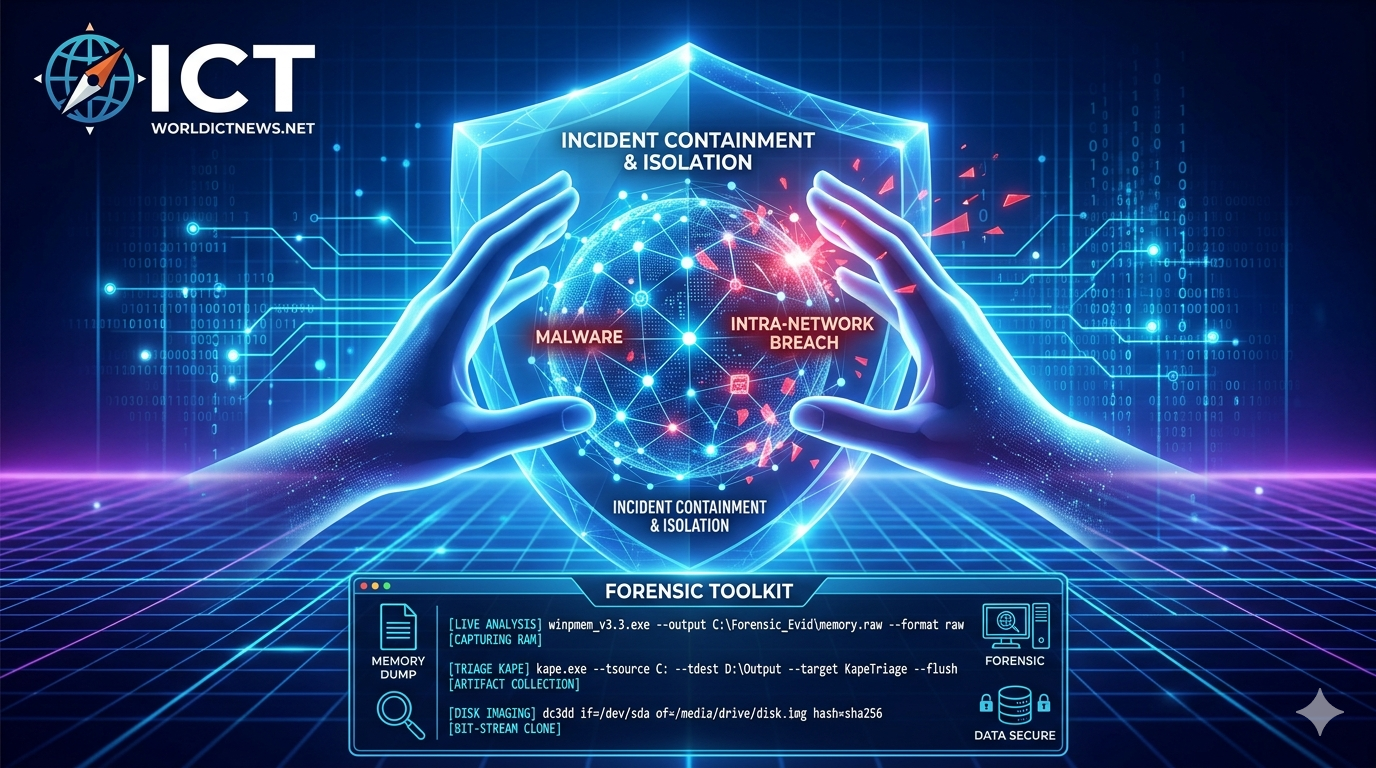
A Comprehensive Guide to Cyber Incident Response Execution
May 22, 2026
10 min read

A Comprehensive Guide to Cyber Incident Response Execution

Firefighting in the Digital Age: A Step-by-Step Guide to Incident Response Execution. When a cyberattack strikes an organization, chaos is the default setting. Servers go dark, databases leak, ransom notes appear on screens, and panic spreads through leadership teams. In these critical moments, an Incident Responder is the digital equivalent of a firefighter. They do not just understand security theory; they execute a highly coordinated, tactical protocol to find the fire, contain it, extinguish it, and ensure the building doesn’t burn down again.This article provides an operational, step-by-step blueprint of how an Incident Responder executes their duties during a cybersecurity crisis, structured around the industry-standard NIST SP 800-61 r2 framework.Phase 1: Preparation (Before the Fire Starts)Incident response does not begin when an alert fires; it begins months in advance. Execution in this phase focuses on establishing readiness, visibility, and tools.1. Tool Deployment and Health ChecksAn responder cannot defend what they cannot see. The first tactical step is ensuring the operational readiness of the Security Operations Center (SOC) stack:EDR/XDR (Endpoint Detection and Response): Verifying agents are healthy, updated, and actively checking in across all servers, workstations, and cloud instances.SIEM/SOAR Configuration: Ensuring logs from firewalls, active directories, DNS servers, and cloud providers (AWS, Azure) are normalizing and aggregating correctly.Out-of-Band Communication: Setting up secure, separate communication channels (like encrypted Signal groups or standalone Microsoft Teams tenants) in case the corporate network and email systems are compromised.2. Playbook and Kits StandardizationResponders build and update "Jump Bags"—digital toolkits containing pre-compiled, static forensic binaries (like Sysinternals, FTK Imager Lite, or KAPE) stored on secure, write-blocked media or isolated cloud repositories. They also continuously drill using tabletop exercises to ensure the chain of command is clear.Phase 2: Detection and Analysis (Spotting the Smoke)This phase marks the official start of an active incident. The responder transitions from standard monitoring to high-alert investigation.1. Alert Triage and ValidationA typical enterprise triggers thousands of security alerts daily. The responder must instantly separate noise from actual malicious behavior.Correlating Events: If an alert shows an unusual PowerShell script executing on a workstation, the responder immediately checks firewall logs to see if that same workstation initiated an outbound connection to an unknown IP address on port 443.Eliminating False Positives: Verifying if the "malicious activity" was simply an unannounced scheduled task built by the internal IT operations team.2. Initial Scoping and Indicators of Compromise (IoCs)Once an alert is validated as a true positive, the responder identifies the Indicators of Compromise (IoCs). This includes:Cryptographic hashes of malicious files (MD5/SHA256).Malicious domain names and Command and Control (C2) IP addresses.Specific registry keys modified by malware.The responder takes these IoCs and runs a global sweep across the SIEM to identify the "Blast Radius"—how many endpoints or accounts have touched these same indicators.3. Determining the Scope and SeverityThe incident is categorized based on impact:Low: A single workstation infected with adware.Medium: An employee's credentials compromised, but multi-factor authentication (MFA) blocked the login.High/Critical: Active hands-on-keyboard adversary moving laterally through the network, or data exfiltration detected.Phase 3: Containment (Putting Up the Firewalls)The primary objective of containment is to limit the damage and prevent the attacker or malware from moving further into the network. Responders usually divide this into two sub-steps.1. Short-Term ContainmentSpeed is critical. The responder executes immediate mitigation actions:Network Isolation: Using the EDR tool to logically isolate infected endpoints from the network while maintaining a secure management channel for forensics.Account Disablement: Instantly disabling compromised Active Directory or Microsoft Entra ID accounts to stop lateral movement.Firewall Blocks: Implementing temporary block rules on perimeter firewalls for the identified external C2 IP addresses.2. Long-Term Containment and Evidence PreservationBefore cleaning up the systems, the responder must preserve volatile data for legal and forensic investigation. Crucial Rule: Never reboot a machine before capturing memory. Rebooting destroys the RAM, which holds the active malware processes, encryption keys, and network connections.Live Memory Acquisition: Running tools like DumpIt or LiME to capture the system memory (RAM).Disk Imaging: Creating bit-stream copies of hard drives using hardware write-blockers to ensure no data is altered during the extraction process.Documenting Chain of Custody: Meticulously tracking who collected the evidence, at what exact time, and calculating cryptographic hashes of the forensic images to ensure tampering cannot happen.Technical Appendix: Forensic Command-Line ExecutionWhen executing live forensics on an infected machine, an incident responder must use precise commands to collect volatile data without contaminating the host operating system. Below are the standard tools and commands executed during Windows and Linux investigations.1. Volatile Memory Collection (RAM Capture)Capturing RAM must be done before any system shutdowns or reboots to preserve running processes, network connections, and unencrypted credentials.Windows: WinPmemWinPmem is an open-source tool used to dump physical memory into a single raw file. Run via an administrative Command Prompt or PowerShell:cmdwinpmem_v3.3.rc3.exe --output C:\Forensic_Evid\memory.raw --format rawUse code with caution.--output: Specifies the secure destination folder (ideally an external, write-blocked drive or network share).--format raw: Outputs a standard .raw or .dmp image compatible with memory analysis tools like Volatility.Linux: LiME (Linux Memory Extractor)On Linux systems, memory is grabbed using a kernel module approach. Responders compile or load the LiME module to dump memory over the network or to a local disk:bashsudo insmod lime-5.4.0-77-generic.ko "path=/tmp/linux_memory.lime format=raw"Use code with caution.insmod: Inserts the LiME kernel module.path=: The target file path for the memory dump.2. Triage and Artifact Collection (Live Response)Instead of waiting hours for full disk imaging, responders use triage tools to extract high-value artifacts (like event logs, registry hives, and MFT data) in minutes.Windows: KAPE (Kroll Artifact Parser and Extractor)KAPE automate the collection and parsing of Windows artifacts. It uses targets (gkape scripts) to pull specific forensic files:cmdkape.exe --tsource C: --tdest D:\TargetOutput --target KapeTriage --flushUse code with caution.--tsource C:: Identifies the target system drive.--tdest: The destination directory where the collected files will be compressed and saved.--target KapeTriage: Automatically grabs web browser history, event logs, prefetch files, and registry hives.Linux: UAC (Unix Artifact Collector)UAC is a script-based tool used to live-triage Linux and Unix-like operating systems:bashsudo ./uac -p ir_triage /tmp/uac-outputUse code with caution.-p ir_triage: Runs a pre-configured profile designed specifically for Incident Response triage, gathering information on active network connections, open files, and system configurations.3. Bit-Stream Disk Imaging (Dead Box Forensics)When a complete clone of the hard drive is required for deep analysis, responders use the standard utility dd or its forensics-focused cousin dc3dd to capture the block layer.Linux/Unix: dc3ddThis tool provides a safe command-line architecture to patch data straight to an external storage unit while hashing on the fly to protect the chain of custody.bashsudo dc3dd if=/dev/sda of=/media/forensic_drive/suspect_disk.img hash=sha256 log=/media/forensic_drive/imaging_log.txtUse code with caution.if=/dev/sda: The source file parameter representing the physical drive under investigation.of=: The path where the exact image file copy will be compiled.hash=sha256: Calculates the SHA-256 hash automatically during the imaging process to verify data integrity.4. Memory Analysis (Post-Collection)Once the memory file (.raw) is extracted and moved to an isolated investigation workstation, the responder parses it using analysis frameworks.Cross-Platform: Volatility 3Volatility allows the responder to dissect the captured memory dump to find hidden processes, rootkits, or malicious network connections that were active during the incident.bashpython3 vol.py -f /path/to/memory.raw windows.pslist.PsListUse code with caution.-f: Feeds the acquired memory image into the framework.windows.pslist.PsList: A plugin command that reconstructs and displays the process tree to identify if malicious processes were mimicking legitimate system actions (like svchost.exe).Phase 4: Eradication (Killing the Root Infection)Once the threat is safely contained and evidence is locked down, the responder switches to a search-and-destroy mindset. Eradication means completely removing all elements of the incident from the environment.1. Root Cause AnalysisThe responder looks backward to figure out exactly how the attacker got in (Weaponization and Delivery phase of the Cyber Kill Chain). Did they exploit an unpatched VPN vulnerability? Was it a phishing email?2. Threat RemovalMalware Deletion: Manually removing persistent registry keys, scheduled tasks, and malicious binaries that automated antivirus engines might have missed.Vulnerability Patching: Closing the door the attacker used. If a public-facing server was exploited via an old Apache vulnerability, that server must be patched immediately.Credential Revocation: Forcing an organization-wide password reset and revoking all active OAuth tokens across the cloud ecosystem to ensure the attacker cannot simply log back in using valid, hijacked sessions.Phase 5: Recovery (Restoring Business Operations)Recovery focuses on safely returning affected systems to production and verifying that they are operating cleanly.1. System RestorationResponders work alongside IT engineering teams to rebuild infrastructure:Clean Rebuilds: The gold standard is rebuilding affected servers from trusted Infrastructure-as-Code (IaC) templates or known-clean gold images, rather than trying to "clean" an heavily compromised operating system.Backup Verification: If restoring from backups, the responder scans the backup images before bringing them live to ensure the malware wasn't already sitting dormant inside the backup archives weeks prior to the attack.2. Enhanced Continuous MonitoringOnce a system is back online, it is placed in an "Intensive Care Unit" status. The responder deploys aggressive monitoring rules on those specific assets for the next 14 to 30 days, knowing that attackers often try to return immediately if they lose access.Phase 6: Lessons Learned (Post-Incident Optimization)Often neglected due to fatigue, this is the most critical phase for long-term organizational security. It occurs days or weeks after the threat has been resolved.1. Post-Mortem MeetingThe responder brings together leadership, legal, HR, and IT teams to review a strict timeline of events:What happened, and at what time?How well did the team respond? Were the playbooks followed?Where were the blind spots? (e.g., "We lacked logs for our cloud storage bucket, which delayed our analysis by 6 hours.")2. Updating Defenses and DocumentationThe final execution step is converting the scars of the attack into permanent armor:Modifying SIEM detection rules to catch the specific techniques used by this adversary in the future.Rewriting Incident Response playbooks to address the bottlenecks discovered during the crisis.Publishing a final, formal Incident Report detailing the root cause, financial impact, data scope, and remediation efforts for regulatory compliance and executive leadership.ConclusionIncident response is a highly structured discipline where methodology beats intuition every time. By systematically moving through Preparation, Detection, Containment, Eradication, Recovery, and Lessons Learned, a responder removes emotion from a crisis. This step-by-step execution ensures that an organization can withstand even the most aggressive cyberattacks, limiting downtime, protecting data integrity, and emerging more resilient against the threats of tomorrow.
Modern JavaScript: Frameworks and Ecosystem
May 22, 2026
8 min read

Modern JavaScript: Frameworks and Ecosystem

Modern JavaScript: Frameworks, Ecosystem, and Applications in Software Development. The evolution of JavaScript is one of the most remarkable stories in software engineering. What began in 1995 as a lightweight client-side scripting language designed to add basic animations to web browsers has transformed into an engineering powerhouse. Today, Modern JavaScript is an omnipresent runtime engine that powers complex enterprise web platforms, mobile applications, cloud services, and desktop software frameworks.This shift was accelerated by two major architectural milestones: the standardization of Modern ECMAScript (ES6+) specification rules and the creation of Node.js, which unlocked JavaScript execution outside the web browser environment. This comprehensive guide explores the core technical features of Modern JavaScript, analyzes the dominant development frameworks, and maps out its versatile applications across modern enterprise software development.1. Core Technical Architecture of Modern JavaScript (ES6+)Before diving into frontend libraries and server runtimes, it is essential to understand the modern language features that distinguish old JavaScript (ES5) from Modern JavaScript (ES6 and beyond). Modern development relies on clean, declarative syntax structures that improve code maintainability and minimize runtime logical bugs.Asynchronous Execution: Promises and Async/AwaitJavaScript is fundamentally a single-threaded language, meaning it executes one line of code at a time. However, web applications must handle slow operations—such as retrieving database records or querying third-party APIs—without freezing the user interface. Modern JavaScript handles this natively via asynchronous structures.javascript// Modern Asynchronous API Fetch Example using Async/Awaitasync function fetchSystemMetrics(endpoint) { try { const response = await fetch(endpoint); if (!response.ok) throw new Error("Network latency anomaly detected."); const data = await response.json(); return data; } catch (error) { console.error("System Log Error:", error.message); }}Use code with caution.Modules and Scoping ControlsModern frameworks use modular design principles, isolating software parts into separate script files. This prevents scope conflicts using built-in encapsulation keywords:javascript// Exporting a specialized utility class: mathUtils.jsexport const calculateDataDrift = (metricA, metricB) => Math.abs(metricA - metricB);// Importing the component into your application entrypoint: app.jsimport { calculateDataDrift } from './mathUtils.js';Use code with caution.2. The Big Three Frontend FrameworksBuilding large, scalable user interfaces using raw, native DOM manipulation code quickly leads to unmanageable code architectures. To solve this problem, software engineers rely on component-driven frontend frameworks. While many specialized libraries exist, three open-source ecosystems dominate enterprise software development. ┌── MODERN JS FRAMEWORKS ──┐ │ │ ▼ ▼ ▼┌──────┐ ┌──────┐ ┌──────┐│ REACT │ │ ANGULAR │ │ VUE.JS ││ Component │ │ Full-Battery │ │ Progressively││ Ecosystem │ │ Framework │ │ Adaptable │└──────┘ └──────┘ └──────┘React (Maintained by Meta)React is technically a UI library rather than a full-battery framework, but it commands the largest developer market share globally. React introduced the concept of the Virtual DOM, an in-memory representation of webpage elements that calculates minimal, optimized updates before rendering changes to the actual browser window.Core Architecture: Component-Based, using JSX syntax (a declarative blend of JavaScript logic and structural HTML markup).Best Use Case: Single-Page Applications (SPAs), complex dashboards, and rapidly scaling tech platforms.Angular (Maintained by Google)Angular is a robust, strictly structured, full-battery web application framework. Unlike React, Angular ships with built-in modules for routing, form validation, and server communication out of the box.Core Architecture: Model-View-Controller (MVC) built entirely on TypeScript (a statically typed superset of JavaScript that catches code errors during development rather than at runtime).Best Use Case: Enterprise banking software, corporate internal tooling, and large-scale applications managed by decentralized engineering teams.Vue.js (Community-Driven Project)Vue.js is a progressive frontend framework designed to combine the clean component architecture of React with the approachable, template-driven syntax of traditional HTML.Core Architecture: Single-File Components (SFCs), where HTML structure, CSS layout styling, and JavaScript programmatic logic exist inside a unified .vue file wrapper.Best Use Case: Rapid prototype creation, content-driven websites, and teams transitioning from traditional server-side rendering architectures.3. Full-Stack Architectures and Meta-FrameworksWhile frontend frameworks handle client-side rendering, modern enterprise development requires robust search engine optimization (SEO), fast initial load speeds, and secure backend routing. This need has catalyzed the rise of Meta-Frameworks that bridge client logic with server computing.Next.js (Built on React) and Nuxt.js (Built on Vue)These meta-frameworks abstract complex server pipelines away from developers, providing native access to advanced server architectures:Server-Side Rendering (SSR): The server pre-renders the full structural HTML page with complete data before transmitting it to the user's browser, providing optimized indexation for search engine crawlers.Static Site Generation (SSG): Pages are compiled into static files during the build pipeline, allowing them to be cached on global Content Delivery Networks (CDNs) for near-instantaneous load times.4. Cross-Platform Applications: Beyond the Web BrowserModern JavaScript is no longer limited to browser windows. A single engineering team can leverage JavaScript skills to deploy software applications across entirely distinct computing hardware targets. ┌─── MODERN JAVASCRIPT ───┐ │ │ ┌────┴───┐ ┌───┴──┐ ┌──┴──┐ ▼ ▼ ▼ ▼ ▼ ▼[ MOBILE APPS ] [ DESKTOP APPS ] [ CLOUD SERVERLESS ] [ BACKEND APIS ] React Native, NativeScript Electron, Tauri AWS Lambda, Cloudflare Node.js, Bun runtimesMobile Application Development: React NativeUsing React Native, developers can write application code in JavaScript and compile it directly into native iOS and Android user interface components. Unlike web-view wrapper apps, React Native applications communicate directly with the mobile operating system's native graphics engines, achieving high performance and fluid animations.Desktop App Deployments: Electron and TauriEnterprise desktop platforms like Slack, Visual Studio Code, and Discord are built using JavaScript ecosystems. Electron packs a Chromium browser window alongside a Node.js runtime process into a native app container. For more resource-constrained environments, modern alternatives like Tauri replace heavy internal browser dependencies with thin system web views to build highly optimized desktop apps.Cloud Serverless Computing: AWS Lambda and Cloudflare WorkersBecause modern JavaScript runtimes like V8 feature near-instant start times, the cloud computing architecture uses JavaScript heavily for Serverless Functions. When an event triggers an API endpoint, serverless nodes run short code loops instantly, enabling organizations to process backend events without paying for idle server space.5. Implementation Roadmap for Choosing Your Software StackWhen structuring a new enterprise digital platform, matching the correct JavaScript runtime environment and framework to your business goals is critical. Use this technical checklist to configure your project stack:Evaluate SEO Requirements: If your platform depends on organic web search discoverability, skip basic client-side React/Vue architectures. Choose a meta-framework like Next.js or Nuxt.js configured for Server-Side Rendering (SSR).Enforce Type Safety: For systems processing complex data contracts or financial records, require TypeScript over standard JavaScript to prevent object property runtime failures.Select Runtimes Judiciously: For standard corporate web APIs, utilize Node.js. For microservices prioritizing maximum request throughput and low cold-start latency, evaluate modern high-performance runtimes like Bun.Consolidate Codebases: If your roadmaps require both iOS and Android variants, utilize React Native to share business logic across both platforms, reducing total development resource overhead.ConclusionModern JavaScript has evolved into a highly versatile and robust software development ecosystem. Through structural language features like async/await, powerful frontend components from React, Angular, or Vue, and cross-platform runtimes like Node.js and React Native, JavaScript enables developers to build complex, full-stack applications with efficiency and scale. By understanding these modern paradigms and choosing the right framework combinations, engineering teams can build resilient digital architectures suited for the modern landscape.Frequently Asked Questions (FAQ)1. What is the fundamental difference between Node.js and browser-based JavaScript?Browser-based JavaScript executes inside a sandboxed environment controlled by the browser, giving it direct access to user interface elements (the DOM) while restricting direct file system operations. Node.js is a standalone runtime environment built on Chrome's V8 engine that runs directly on server hardware, giving it full access to filesystem operations, operating system networks, and databases.2. Why should a project switch from standard JavaScript to TypeScript?TypeScript adds static type definitions on top of standard JavaScript syntax. By declaring strict datatypes for variables and functions, errors are discovered during code compilation inside the development editor, rather than triggering unpredictable runtime crashes for active users.3. What is the primary benefit of utilizing a Virtual DOM over standard DOM manipulations?Directly updating webpage elements (the DOM) is computationally expensive and causes rendering lags when performed frequently. A Virtual DOM acts as a lightweight blueprint copy inside memory. When data changes, the framework calculates the most efficient structural changes first, batch-updating the visible webpage elements all at once to maintain performance.4. How does Server-Side Rendering (SSR) improve page performance over Client-Side Rendering (CSR)?In CSR, the server sends a blank HTML shell along with heavy JavaScript file streams; the user's browser must download and run those scripts before any text appears. In SSR, the server runs the initial scripts on the backend and transmits a complete, text-filled HTML page to the user, leading to faster initial load times and reliable indexing by search engine web crawlers.5. Can JavaScript be used for high-performance backend data processing?Yes, but with architectural constraints. Because JavaScript runs on a single event-driven loop, it handles high volumes of concurrent I/O connections (like receiving web traffic requests or fetching data) exceptionally well. However, for continuous CPU-heavy calculations (like advanced video processing or complex scientific model analysis), multi-threaded environments like Rust, C++, or Go are generally preferred.
Introduction to JavaScript
May 21, 2026
7 min read

Introduction to JavaScript

Introduction to JavaScript: A Comprehensive Guide for Beginners. In the modern ecosystem of software development, JavaScript stands as one of the most vital technologies. Alongside HTML and CSS, it forms the core triad of World Wide Web development. While HTML provides the structural framework of a webpage and CSS handles the visual styling, JavaScript injects interactivity, logic, and dynamic behavior.Every time a webpage updates content without reloading, displays an interactive map, animates complex graphics, or processes a form validation instantly, JavaScript is executing behind the scenes. This hands-on guide serves as a practical introduction to JavaScript, taking you from basic syntax rules to functional program logic with clear code examples.1. Setting Up Your JavaScript EnvironmentOne of the main advantages of learning JavaScript is that you do not need to install complex compilers or specialized development environments to run your code. Every modern web browser (such as Google Chrome, Mozilla Firefox, or Microsoft Edge) features an integrated JavaScript execution engine.Using the Browser ConsoleTo open your browser's developer tools and execute JavaScript immediately:Right-click anywhere on an open webpage and select Inspect.Click on the Console tab in the developer panel.Type the following code string and press Enter:javascriptconsole.log("Hello, World!");Use code with caution.The console.log() function is a built-in mechanism used to print text outputs directly to the developer console. It is an invaluable utility for debugging code.Linking JavaScript to an HTML DocumentFor actual project development, JavaScript code is written in dedicated files with a .js extension and linked to an HTML file using the <script> tag.File: index.htmlhtml<!DOCTYPE html><html lang="en"><head> <meta charset="UTF-8"> <title>JavaScript Introduction</title></head><body> <h1>Open your browser console to see the output.</h1> <!-- Linking external script file --> <script src="app.js"></script></body></html>Use code with caution.File: app.jsjavascriptconsole.log("The external JavaScript file has loaded successfully.");Use code with caution.2. Variables and Data TypesPrograms rely on variables to temporarily store, manage, and retrieve data during runtime execution. In JavaScript, variables are declared using three primary keywords: let, const, and var.let: Used to declare variables whose values are expected to change over time.const: Short for "constant." Used to declare variables that cannot be reassigned or altered after initialization.var: An older keyword from legacy JavaScript versions. It is generally avoided in modern programming due to its loose scoping rules.Variables Code Examplejavascript// Declaring a reassignable variablelet userScore = 10;userScore = 15; // Valid reassignment// Declaring an unchangeable constantconst systemPort = 8080;// systemPort = 9090; // Throws a TypeError errorconsole.log("Score:", userScore);console.log("Port:", systemPort);Use code with caution.Core Data TypesJavaScript variables automatically adapt to hold different data classifications. The most common primitive data types include:javascriptlet websiteName = "World ICT News"; // String (Text data)let articleCount = 25; // Number (Integers or decimals)let isApproved = true; // Boolean (True or False logic)let rawData = null; // Null (Intentionally empty value)let container; // Undefined (Variable with no value set yet)Use code with caution.3. Basic Operators and ArithmeticOperators are symbols used to perform calculations, evaluate comparisons, and manipulate data fields.Arithmetic OperatorsJavaScript supports standard mathematical symbols:+ (Addition)- (Subtraction)* (Multiplication)/ (Division)javascriptlet basePrice = 100;let taxRate = 0.05;let totalTax = basePrice * taxRate;let finalPrice = basePrice + totalTax;console.log("Total Tax Amount:", totalTax); // Output: 5console.log("Final Purchase Price:", finalPrice); // Output: 105Use code with caution.String ConcatenationThe addition operator + can also join text strings together.javascriptlet greeting = "Welcome to ";let channel = "World ICT News";let fullMessage = greeting + channel;console.log(fullMessage); // Output: Welcome to World ICT NewsUse code with caution.4. Conditional Logic: Control FlowPrograms need to make decisions based on specific conditions. This flow is managed using conditional statements: if, else if, and else.Comparison OperatorsTo evaluate conditions, JavaScript uses comparison symbols:=== (Strict equality: values and types must match exactly)!== (Strict inequality)> (Greater than)< (Less than)javascriptlet accountBalance = 250;let productCost = 300;if (accountBalance >= productCost) { console.log("Transaction Approved. Enjoy your purchase!");} else if (accountBalance > 0 && accountBalance < productCost) { console.log("Transaction Declined. Insufficient funds in account.");} else { console.log("Account frozen or unavailable.");}Use code with caution.5. Functions: Reusable Blocks of CodeA function is a self-contained block of code designed to perform a specific, repetitive task. Functions accept data inputs (called parameters), perform calculation operations inside their boundaries, and output a final result using the return statement.javascript// Defining a function to calculate server uptime percentagefunction calculateUptime(totalHours, downtimeHours) { let operationalHours = totalHours - downtimeHours; let uptimePercentage = (operationalHours / totalHours) * 100; return uptimePercentage;}// Invoking (calling) the function with argumentslet weeklyUptime = calculateUptime(168, 2);console.log("Weekly Server Uptime Profile:", weeklyUptime + "%");// Output: Weekly Server Uptime Profile: 98.80952380952381%Use code with caution.6. Working with Collections: ArraysAn Array is a structured list used to store multiple data items inside a single variable reference. Arrays use a zero-based index system, meaning the very first item in the collection sits at position 0.javascript// Creating an array of programming categorieslet techCategories = ["Cybersecurity", "Cloud Computing", "DevOps", "AI"];// Accessing individual items via index positionsconsole.log("First Category:", techCategories[0]); // Output: Cybersecurityconsole.log("Third Category:", techCategories[2]); // Output: DevOps// Checking total array length dynamicallyconsole.log("Total Menu Elements:", techCategories.length); // Output: 4// Adding a new element to the end of the arraytechCategories.push("Data Science");console.log("Updated Categories List:", techCategories);Use code with caution.7. Loops: Automating Repetitive TasksLoops allow you to run the same block of code multiple times without rewriting it. The for loop is commonly used to step through arrays sequentially.javascriptlet alerts = ["Critical Error", "Warning Log", "System Update Success"];// Looping through each alert item sequentiallyfor (let i = 0; i < alerts.length; i++) { console.log("Processing Alert Log #" + (i + 1) + ": " + alerts[i]);}/* Console Output:Processing Alert Log #1: Critical ErrorProcessing Alert Log #2: Warning LogProcessing Alert Log #3: System Update Success*/Use code with caution.ConclusionJavaScript is a versatile language that brings life to web applications. By mastering these foundational concepts—variables, data types, arithmetic operators, conditional statements, functions, arrays, and loops—you have established the basic programming skills required to build client-side web interactions. From here, you can progress to working with DOM manipulation (updating HTML elements live) and asynchronous data streams (fetching data from APIs).Frequently Asked Questions (FAQ)1. What is the difference between let and const in JavaScript?let allows you to reassign the value of a variable later in your code programmatically. const creates an immutable binding; once a value is assigned to a const variable, trying to overwrite it will trigger an error.2. Why does JavaScript use === instead of == for comparisons?The triple equals operator === performs a strict evaluation, meaning it checks both the value and the underlying data type. The double equals == operator uses a process called type coercion, attempting to convert data types automatically before comparing, which can introduce subtle logical bugs.3. Can JavaScript run outside of a web browser?Yes. While JavaScript was originally built exclusively for browsers, environments like Node.js allow developers to execute JavaScript directly on server systems, databases, and backend computing infrastructure.4. What does undefined mean in a console alert?An undefined status indicates that a variable name has been officially created or declared within the codebase, but no initial value has been assigned to it yet.5. What are array index positions zero-indexed?In computer programming arrays, numbering begins at 0 instead of 1. The index number represents the offset or distance from the start of the memory array. The first item has an offset distance of zero.
Intrusion Prevention System (IPS) Deployment Guide
May 21, 2026
9 min read

Intrusion Prevention System (IPS) Deployment Guide

Intrusion Prevention System (IPS) in Cybersecurity: An Enterprise Deployment Guide. In the rapidly evolving landscape of network security, discovering a threat after it has already penetrated your infrastructure is no longer sufficient. While an Intrusion Detection System (IDS) is highly valuable for monitoring and providing deep analytical visibility, its passive nature means that malicious payloads, data exfiltration scripts, and ransomware strings can execute successfully before a Security Operations Center (SOC) analyst has the chance to respond to an alert.To bridge this operational delay and implement real-time defensive mitigation, modern enterprise security relies on an Intrusion Prevention System (IPS). An IPS is an active network security appliance or software service designed to inspect data flows, identify vulnerabilities, and automatically intercept malicious activity before it reaches its intended destination. This comprehensive guide details the foundational architecture of an IPS, explores its proactive defensive actions, evaluates its core variants, and provides a step-by-step roadmap for deployment.1. What is an Intrusion Prevention System?An Intrusion Prevention System is a inline network security technology that continuously scans network traffic to identify and block malicious activities. It represents a direct evolution of the traditional IDS, moving from a passive alert generation tool to an active, real-time security countermeasure.The fundamental structural difference lies in network placement. While an IDS sits out-of-band and receives a mirrored copy of network traffic via a SPAN port or network TAP, an IPS sits directly inline with network traffic. This means that all network data packets must physically pass through the IPS processing engine before they can continue to their destination.[ Internet Traffic ] │ ▼┌─────┐│ Firewall │└──┬──┘ │ ▼┌─────┐│ IPS Engine │ ◄─── (Inline: Automatically inspects and └──┬──┘ drops malicious packets in real time) │ ▼┌─────┐│ Core Servers │└─────┘Because it sits inline, the IPS has the unique capability to halt a packet in mid-transit, drop the connection, or reconfigure firewall rules instantly when an active exploit is recognized.2. Core Proactive Actions of an IPSWhen an IPS detects an anomaly, a signature match, or a policy violation, it does not merely log the event; it initiates automated, real-time countermeasures. Depending on configuration rules, an IPS executes four primary mitigation strategies:Dropping Malicious PacketsThe most direct action an IPS takes is dropping packets. If an incoming packet contains a known vulnerability exploit payload (e.g., a buffer overflow attack string aimed at an unpatched enterprise application), the IPS discards that specific packet while allowing standard, safe web packets from the same stream to continue moving forward.Resetting ConnectionsIf an attacker initiates a sustained exploit sequence or a brute-force credential attack, the IPS can send a TCP Reset (RST) packet to both the source and destination addresses. This instantly tears down the active socket connection, forcing the attacker's automation scripts to completely restart the handshake process.Dynamic Firewall ReconfigurationAdvanced IPS engines can interact directly with surrounding perimeter firewalls. If an automated script from a specific external IP address initiates an extensive port scan or a distributed denial-of-service (DDoS) spike, the IPS can update the corporate firewall's blocklist to drop all subsequent incoming traffic from that offending IP address at the perimeter.Traffic Sanitization (Normalization)Attackers sometimes attempt to evade security filters by slightly altering network transport layer formats—such as fragmenting packets into unusual sizes or rearranging packet sequences. An IPS can sanitize incoming traffic by reassembling fragmented packets, cleaning up packet headers, and normalizing data sequences before passing them down to internal hosts.3. Core Architectures: NIPS, HIPS, and WIPSIntrusion Prevention Systems are deployed at different layers of an enterprise infrastructure depending on the specific assets they are protecting.Network Intrusion Prevention Systems (NIPS)A Network Intrusion Prevention System (NIPS) analyzes data packets across entire subnets or network segments. It protects groups of servers, employee workstations, and cloud instances.Placement: Deployed inline immediately behind perimeter firewalls or at the boundaries between distinct internal corporate zones (such as separating the open corporate Wi-Fi network from the core financial database segment).Tools: Cisco Firepower, Palo Alto Networks Threat Prevention, and open-source Suricata configured in inline mode.Host Intrusion Prevention Systems (HIPS)A Host Intrusion Prevention System (HIPS) is a software agent installed directly on an individual machine, such as a critical server, application host, or executive endpoint.Operation: HIPS monitors activity inside the operating system, inspecting local system calls, memory allocations, and registry changes. If an application attempts to write code illegally to protected system kernel space, the HIPS agent actively kills the application process.Tools: OSSEC, Trend Micro Deep Security, and modern Endpoint Detection and Response (EDR) agents.Wireless Intrusion Prevention Systems (WIPS)A Wireless Intrusion Prevention System (WIPS) is a specialized variant that monitors the radio frequency spectrum of an organization's physical facility.Operation: WIPS analyzes wireless protocols to detect and neutralize threats unique to Wi-Fi infrastructure. If an attacker spins up a "Rogue Access Point" mimicking the corporate network name or launches a deauthentication attack to kick employees off the network, the WIPS emits counter-signals to disrupt the rogue wireless connection.4. Detection Methodologies and the Fail-Safe DilemmaTo safely prevent attacks without interrupting legitimate enterprise commerce, an IPS combines multiple detection methodologies.Detection MechanismsSignature-Based Detection: Matches packet byte sequences against known vulnerability fingerprints. Highly effective at blocking established exploits with minimal false-positives.Anomaly-Based Detection: Flags deviations from an established baseline of normal network behavior. Vital for catching novel Zero-Day exploits, but prone to false alarms if network patterns shift unexpectedly.Stateful Protocol Analysis: Understands the protocol rules established by governing bodies (like the IETF). If an application packet violates basic protocol standards (such as sending an HTTP request with invalid header fields), the IPS drops it as malformed traffic.The Fail-Open vs. Fail-Closed ConfigurationBecause an IPS sits directly inline, it introduces a significant architectural decision point: What happens if the IPS appliance loses power, experiences a software crash, or encounters a processing bottleneck?Security architects must configure the appliance to fail in one of two modes:Fail-Open (Priority on Availability): If the IPS crashes, network traffic bypasses the inspection engine completely and continues flowing to internal hosts unhindered. This ensures business operations stay online, but leaves the network temporarily exposed to threats until the IPS is restored.Fail-Closed (Priority on Security): If the IPS crashes, all inbound and outbound network traffic is completely blocked at the interface. This maintains absolute security by guaranteeing no uninspected packet enters the perimeter, but results in a total network outage for the enterprise.5. Implementation Roadmap for Enterprise DeploymentDeploying an active prevention system requires an iterative, careful approach. Dropping valid business traffic by accident can cause severe financial and operational disruptions. Follow this 5-step roadmap for a successful deployment:Phase 1: Passive Baseline (Detection Mode Only)Deploy the IPS hardware inline, but configure its initial rule policies to Audit/Detect Only rather than prevent. Let the system run for 2 to 4 weeks to observe real-world traffic flows, log baseline behaviors, and identify safe internal systems.Phase 2: False-Positive Tuning and Rule ReviewAnalyze the generated audit logs to find frequent alerts triggered by safe, internal utilities (such as scheduled vulnerability scanners or internal code deployment loops). Create explicit policy exceptions to safelist these safe business events.Phase 3: Gradual Prevention EnforcementBegin switching high-confidence signatures (such as critical Remote Code Execution exploits and verified malware command-and-control drops) from "Log" to "Drop/Block." Avoid turning on automated anomaly-based blocking globally during this stage.Phase 4: Establish High-Availability (HA) ClustersDeploy IPS units in active-passive or active-active failover pairs. If one hardware component fails, traffic is instantly rerouted to the secondary unit within milliseconds, ensuring zero uptime interruption.Phase 5: Continuous Threat Intelligence IntegrationConfigure automated, daily updates for signature databases and IP reputation tracking feeds. This ensures your active prevention metrics stay updated against emerging vulnerabilities and malicious domains.ConclusionAn Intrusion Prevention System is a vital pillar of a modern, proactive defense-in-depth security model. By moving beyond simple detection and into automated inline mitigation, an IPS intercepts threats at the perimeter before they can establish an internal foothold. When deployed methodically—using structured tuning windows to eliminate false positives and setting up highly available configurations—an IPS provides reliable, real-time protection that safeguards sensitive data assets, reduces pressure on SOC incident response teams, and maintains enterprise business continuity.Frequently Asked Questions (FAQ)1. What is the key difference between an IDS and an IPS?The primary difference is that an IDS is a passive monitoring system that sits out-of-band to analyze network copies and generate alerts, whereas an IPS sits inline with live network traffic to actively block, drop, or reset connections when an exploit is identified.2. Can an IPS replace a standard network firewall?No, an IPS does not replace a firewall. A firewall acts as a boundary barrier that screens large blocks of traffic based on ports, IP rules, and protocols. An IPS is deployed behind the firewall to perform deep, resource-intensive packet inspection to identify hidden exploits allowed through those open firewall ports.3. What does a "False Positive" mean in an IPS context?A false positive occurs when an IPS misidentifies safe, legitimate business traffic as a malicious cyberattack. Because an IPS operates inline, a false positive can cause operational harm by automatically dropping valid database transactions or blocking legitimate corporate users.4. How does an IPS handle fully encrypted network traffic?An IPS cannot look for signatures inside encrypted payloads (like HTTPS/TLS streams). To inspect this traffic, an enterprise must combine the IPS with a SSL/TLS decryption tool or Next-Generation Firewall (NGFW) that decrypts traffic at the boundary, passes cleartext to the IPS engine, and re-encrypts it before sending it forward.5. What is the benefit of a Wireless Intrusion Prevention System (WIPS)?A WIPS secures the physical airspace of an enterprise by continuously scanning for wireless protocol threats. It actively blocks unauthorized or malicious wireless activities, such as employee devices connecting to dangerous rogue access points or hackers attempting packet-sniffing attacks over Wi-Fi networks.
Intrusion Detection System (IDS) Deployment Guide
May 21, 2026
9 min read

Intrusion Detection System (IDS) Deployment Guide

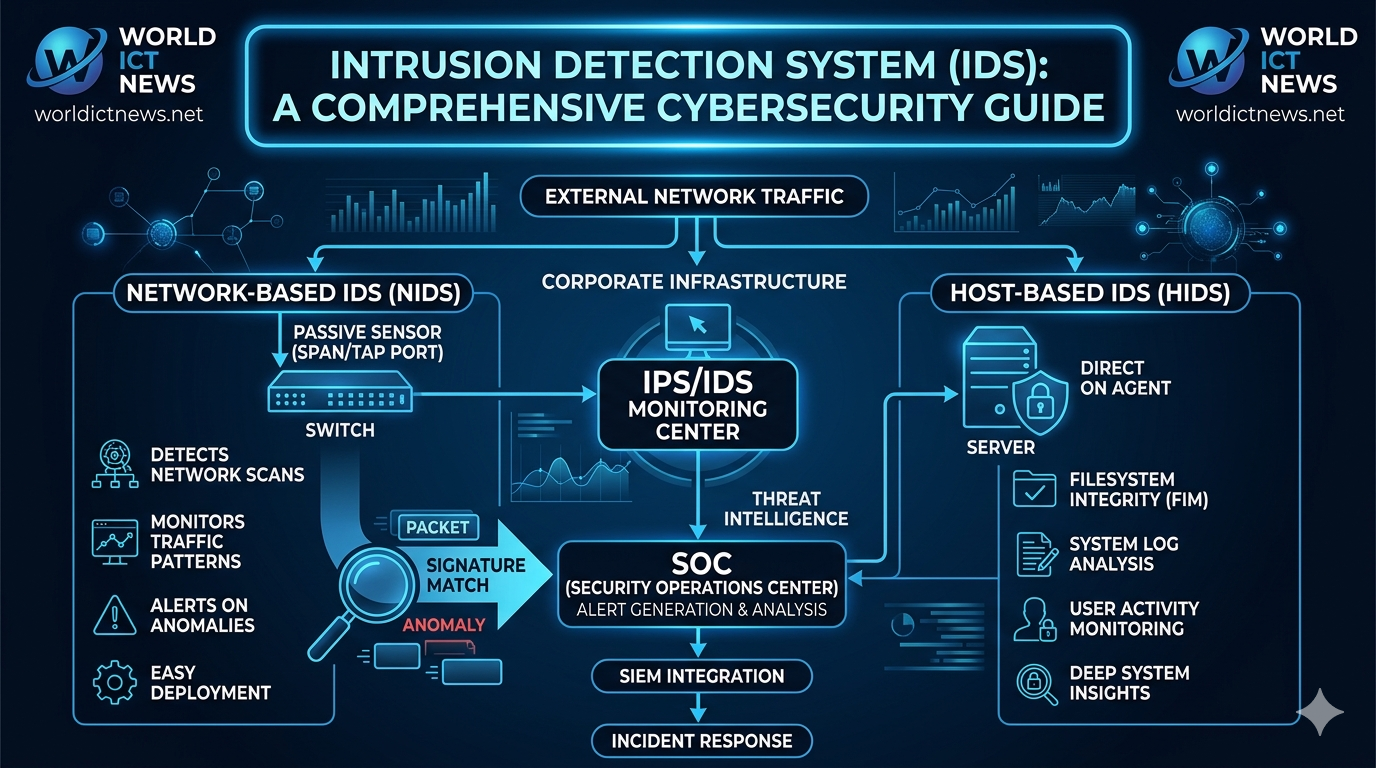
Intrusion Detection System (IDS) in Cybersecurity: A Comprehensive Deployment Guide. In the modern digital landscape, corporate networks face an unceasing barrage of cyber threats. From automated vulnerability scanners to highly coordinated Advanced Persistent Threats (APTs), malicious actors are constantly looking for weaknesses in digital infrastructure. Traditional perimeter security tools—such as standard firewalls—operate by blocking unauthorized external access based on pre-defined ports and IP rules. However, once an attacker bypasses the perimeter or compromises an internal credential, standard firewalls offer little to no visibility into internal threat progression.To bridge this critical visibility gap, security architecture relies on an Intrusion Detection System (IDS). An IDS serves as an automated security sensor that continuously monitors network traffic and system activity for signs of unauthorized access, policy violations, or malicious payloads. This comprehensive guide details the foundational architecture of an IDS, explores its core operational variations, analyzes signature vs. anomaly detection, and provides an implementation checklist for enterprise deployment.1. What is an Intrusion Detection System?An Intrusion Detection System is a specialized software application or hardware appliance configured to monitor system logs or network packets. Its primary purpose is to identify suspicious activity and generate real-time alerts for Security Operations Center (SOC) analysts to investigate.Unlike an Intrusion Prevention System (IPS), which sits directly in line with network traffic and actively drops malicious packets to stop an attack, a standard IDS operates out-of-band as a passive monitoring tool. Think of an IPS as an active security guard physically blocking a door, while an IDS is a closed-circuit television (CCTV) security camera system that triggers an alarm when an unauthorized entry occurs.[ Incoming Network Traffic ] │ ┌───▼───┐ │ Firewall │ └───┬───┘ │ ├───────┐ ▼ ▼ [ Internal Network ] [ IDS Sensor (Passive Mirror) ] │ │ ▼ ▼ [ Core Servers ] [ SOC Alert Generated ]By functioning passively, an IDS provides deep visibility into traffic patterns without introducing processing latency or risking accidental downtime for critical applications due to false-positive blocks.2. Core Architectures: NIDS vs. HIDSIntrusion Detection Systems are classified into two main deployment models depending on where they collect data: Network-based and Host-based systems.Network Intrusion Detection Systems (NIDS)A Network Intrusion Detection System (NIDS) monitors traffic flowing across an entire subnet or network segment. It analyzes packets moving between internal systems, as well as traffic passing through the main gateway.Deployment: NIDS sensors are typically placed at strategic choke points, such as immediately behind a perimeter firewall, inside a Demilitarized Zone (DMZ), or adjacent to core internal switches. They rely on Network TAPs or Switch Port Analyzer (SPAN) ports to mirror network traffic into the sensor.Use Case: NIDS is used to spot network-wide anomalies, including distributed port scans, man-in-the-middle (MitM) attacks, and unauthorized lateral movement between subnets.Popular Tool: Snort, Suricata, and Zeek (formerly Bro).Host Intrusion Detection Systems (HIDS)A Host Intrusion Detection System (HIDS) is installed locally on a specific endpoint or server instance. It only monitors the inbound and outbound traffic, system logs, registry changes, and file integrity of that specific machine.Deployment: HIDS is deployed as a software agent directly on critical enterprise infrastructure, such as database servers, payment gateways, or domain controllers.Use Case: HIDS excels at detecting internal threats that network sensors cannot see. For example, if a user plugs a malicious USB drive into a server, modifies system files, or escalates local user privileges, HIDS will flag the unauthorized alteration.Popular Tool: OSSEC, Wazuh, and Tripwire.3. Detection Methodologies: Signature vs. AnomalyTo differentiate safe, regular system traffic from an active exploit, an IDS relies on two primary data analysis methodologies:Signature-Based DetectionSignature-based detection operates similarly to traditional antivirus software. It scans network packets and system logs for specific, pre-defined patterns—known as "signatures"—that match known malware samples or exploit behaviors.The Advantage: It is highly accurate and efficient at catching known threats. If a packet contains a specific code string associated with a known Ransomware strain, the IDS triggers an immediate, low-false-positive alert.The Limitation: It is blind to novel threats. If an attacker deploys a customized "Zero-Day" exploit or modifies a malware file's hash code, signature-based systems will fail to trigger an alert because a matching signature does not yet exist in their database.Anomaly-Based DetectionAnomaly-based detection relies on behavioral tracking rather than file fingerprints. During its initial configuration phase, the system goes through a learning window to map out a "baseline" of typical, everyday network behavior.The Baseline Profile: It records metrics such as typical bandwidth consumption, standard user login hours, common protocols used, and average system resource loads.The Trigger: If network behavior deviates significantly from this established baseline (e.g., a standard employee account suddenly downloads 50GB of encrypted data from a core database server at 3:00 AM), the system flags the anomaly as a potential breach.The Advantage: It can catch zero-day attacks and insider threats that leave no distinct signature footprint.The Limitation: It is notorious for generating high rates of false-positive alerts. If an IT team runs a legitimate, unscheduled system backup or utility update, the sudden spike in network traffic can easily trigger a false alarm.4. Setting Up an Open-Source NIDS: The Snort LogicTo illustrate how an intrusion detection system evaluates traffic, let us examine the logical syntax used by Snort, the industry standard for open-source signature-based NIDS.Snort relies on simple, human-readable rules to analyze network headers and payloads. A standard Snort rule is divided into a rule header and rule options.Example Rules Analysis:Rule 1: Detecting Cleartext FTP Root Loginsalert tcp any any -> 192.168.1.0/24 21 (msg:"FTP Root Login Attempt Detected"; content:"USER root"; sid:1000001;)Action (alert): Generate an alert log entry for the analyst.Protocol (tcp): Look exclusively at TCP network traffic.Source (any any): Look for traffic originating from any external IP and any source port.Direction (->): Moving toward the internal network destination.Destination (192.168.1.0/24 21): Targeted at your internal subnet on Port 21 (the standard port for FTP).Message (msg): The explicit text shown in the SOC dashboard.Content (content:"USER root"): The specific text pattern inside the packet payload that triggers the rule.Rule 2: Tracking Basic Network ICMP Ping Scansalert icmp any any -> $HOME_NET any (msg:"ICMP Ping Scan Detected"; itype:8; sid:1000002;)Protocol (icmp): Tracks ping requests.Option (itype:8): Specifically flags Echo Request packets, which are commonly used by attackers mapping out your internal network topology during a reconnaissance phase.5. Enterprise Deployment Challenges and TuningWhile an IDS is critical for network visibility, simply deploying a sensor and walking away will cause problems for a security team. Effective security architecture requires ongoing system maintenance and tuning.The Problem of Alert FatigueA standard out-of-the-box IDS deployment can generate thousands of alerts per day. If a SOC team is flooded with meaningless or low-priority notifications (such as false-positive anomaly logs or informational pings), they can develop alert fatigue. When alert fatigue sets in, analysts may ignore critical alerts, allowing actual compromises to pass through unnoticed.Overcoming Encryption BlindspotsModern web traffic is largely encrypted via HTTPS/TLS protocols. While encryption protects data privacy, it also blinds traditional network IDS sensors. If an attacker delivers a malicious payload inside a fully encrypted TLS stream, a standard NIDS cannot read the internal packet content to trigger a signature match.To mitigate this limitation, modern enterprise networks deploy TLS Decryption Proxies or Next-Generation Firewalls (NGFW) to decrypt inbound traffic, pass the cleartext stream through the NIDS sensor for deep inspection, and re-encrypt the data before forwarding it to its internal destination.6. Implementation Checklist for Enterprise DeploymentTo maximize the value of your Intrusion Detection System, ensure your engineering team executes these five deployment steps:Map Assets & Choke Points: Identify your highest-value data repositories (databases, web servers) and position NIDS sensors at the specific network boundaries protecting them.Deploy Layered HIDS: Install host-based logging agents (like Wazuh) on all public-facing production servers to track file adjustments and privilege changes locally.Implement TLS Decryption: Establish a decryption strategy at your network boundary so your NIDS sensors can analyze inbound application-layer payloads.Establish an Automated Rule Update Pipeline: Configure your signature database to automatically update its threat definitions every 24 hours to protect against emerging vulnerabilities.Integrate with a SIEM Platform: Stream your IDS alerts into a centralized Security Information and Event Management (SIEM) dashboard like Splunk or Elastic Security. This allows you to cross-reference network alerts with local system logs for complete situational awareness.ConclusionAn Intrusion Detection System is an essential foundation of a modern defense-in-depth cybersecurity strategy. By providing granular visibility into both network traffic and local host alterations, an IDS ensures that security teams can spot reconnaissance attempts, malicious files, and insider threats early in the attack lifecycle. When configured properly and tuned to prevent alert fatigue, an IDS gives organizations the real-time visibility needed to discover, investigate, and mitigate infrastructure compromises before they escalate into catastrophic data breaches.Frequently Asked Questions (FAQ)1. What is the difference between an IDS and a Firewall?A firewall acts as a digital barrier that allows or blocks network traffic based on rigid criteria like IP addresses, ports, or protocols. An Intrusion Detection System (IDS) sits behind that barrier to passively inspect the data inside those permitted packets, alerting security teams if the content contains malicious exploits or unauthorized behaviors.2. Can an IDS stop a cyberattack from happening?No, a standard IDS cannot stop an attack because it is a passive monitoring tool designed to generate alerts after an event is detected. To actively block or mitigate a live attack in real time, you must upgrade your architecture or transition the sensor into an Intrusion Prevention System (IPS).3. Why do anomaly-based intrusion detection systems have high false-positive rates?Anomaly-based systems flag any behavior that diverges from a previously recorded normal baseline. If a network administrator runs a valid but unscheduled high-bandwidth database migration or software update, the system treats this unexpected activity as an anomaly, triggering a false-positive alert.4. What does "File Integrity Monitoring" mean in a Host IDS?File Integrity Monitoring (FIM) is a HIDS function that tracks cryptographic hashes of core operating system files. If a hacker alters an official system file to hide malware or establish a back door, the file's hash value changes, prompting the HIDS to issue a critical warning to administrators.5. Where should a Network IDS sensor be placed?A Network IDS (NIDS) sensor should be placed at internal network choke points where critical data flows. Common deployment locations include inside the Demilitarized Zone (DMZ) behind the main firewall, directly in front of database clusters, or on internal switches routing core traffic.
Probability Distribution Manual Calculation Procedures
May 16, 2026
6 min read

Probability Distribution Manual Calculation Procedures

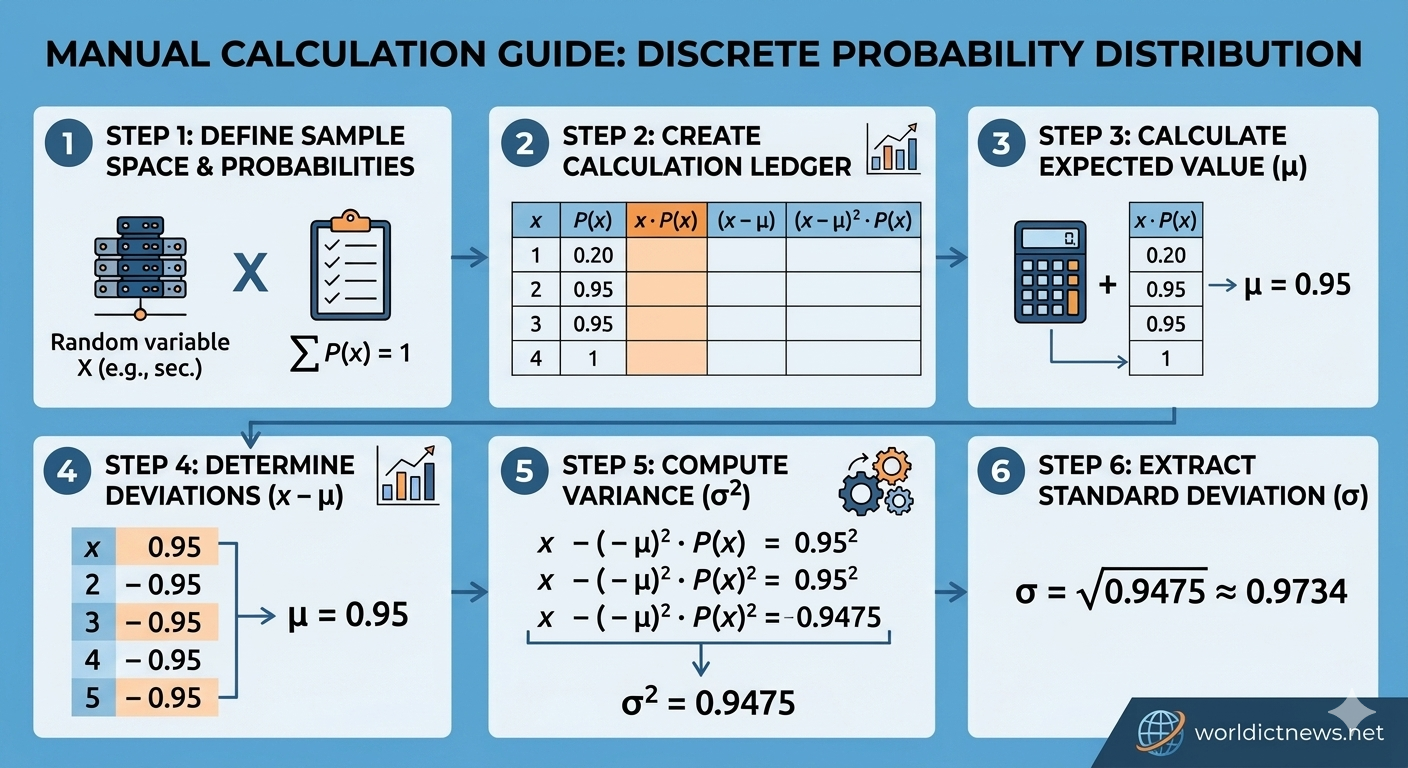
Step-by-Step Probability Distribution Manual Calculation. In the fields of data science, machine learning, and statistical analysis, understanding how data points are distributed is foundational. While modern software pipelines and online calculators instantly compute statistical values, understanding the underlying mathematics is crucial for diagnosing modeling anomalies like data drift or skewed datasets.A Probability Distribution is a mathematical function that describes the likelihood of obtaining the possible values that a random variable can take. This comprehensive, hands-on guide walks you through the step-by-step manual calculation of a discrete probability distribution. You will learn how to build a manual probability distribution table, calculate the expected value (mean), compute the variance, and determine the standard deviation without relying on external software tools.1. Core Definitions: Random Variables and DistributionsTo build a probability distribution calculator manually, you must first understand the type of data you are processing. Random variables are divided into two primary categories:Discrete Random Variables: Variables that take on a countable number of distinct values (e.g., the number of servers failing in a data center, or the number of support tickets received per hour).Continuous Random Variables: Variables that take on an infinite number of possible values within a continuous range (e.g., the execution time of a cloud function, or network latency in milliseconds).This manual calculation guide focuses on Discrete Probability Distributions, which are governed by two mandatory mathematical axioms:The probability of each individual outcome x must sit between 0 and 1 inclusive:0 <= P(X = x) <= 1The sum of all individual probabilities across the entire sample space must equal exactly 1:Sum of P(x) = 12. Setting Up the Scenario Sample SpaceLet us establish a practical IT infrastructure scenario to serve as our calculation baseline.Suppose a DevOps engineering team tracks a cluster of 3 load balancers. Over a historical monitoring period, they record how many load balancers experience a localized configuration sync error during an automated deployment cycle.The sample space for the number of affected load balancers (x) ranges from 0 to 3. Based on log frequency data, the underlying probability values are recorded as follows:Probability of 0 errors: 0.40Probability of 1 error: 0.35Probability of 2 errors: 0.15Probability of 3 errors: 0.10Step 1: Verify the Distribution AxiomBefore executing advanced calculations, calculate the sum of your probabilities to verify the dataset is statistically valid:Sum of P(x) = 0.40 + 0.35 + 0.15 + 0.10 = 1.00The sum equals exactly 1.00, confirming the dataset is a valid probability distribution.3. Constructing the Calculation TableThe most effective tool for manual distribution calculation is a multi-column matrix table. This structural layout breaks down complex formulas into simple arithmetic steps, reducing calculation errors.Create a blank ledger containing five core columns:x: The individual random variable outcomes.P(x): The corresponding probability of each outcome.x * P(x): The product used to calculate the Expected Value.(x - Mean): The deviation of each outcome from the calculated mean.(x - Mean)^2 * P(x): The weighted squared deviation used to calculate Variance.Let's populate the primary inputs:Outcome (x)Probability (P(x))x * P(x)(x - Mean)(x - Mean)^2 * P(x)00.40nill nillnill10.35nillnillnill20.15nillnillnill30.10nillnillnill4. Step-by-Step Calculation of Expected Value (Mean)The Expected Value, mathematically denoted as E(X) or the symbol Mean, represents the long-term average outcome if the random event were repeated an infinite number of times.The formula for the expected value of a discrete distribution is:Mean = Sum of [x * P(x)]Step 2: Calculate the product for each rowRow 1 (x=0): 0 * 0.40 = 0.00Row 3 (x=1): 1 * 0.35 = 0.35Row 3 (x=2): 2 * 0.15 = 0.30Row 4 (x=3): 3 * 0.10 = 0.30Step 3: Sum the productsAdd the values together to find the expected value (Mean):Mean = 0.00 + 0.35 + 0.30 + 0.30 = 0.95Statistical Interpretation: If the engineering team runs thousands of deployments, they can expect an average of 0.95 errors per deployment cycle.5. Step-by-Step Calculation of VarianceThe Variance, denoted as Variance or Var(X), measures the dispersion of the distribution. It quantifies how far the individual outcomes spread out from the expected value (Mean = 0.95) we just calculated.The formula for calculating variance manually is:Variance = Sum of [(x - Mean)^2 * P(x)]Step 4: Calculate the deviation column (x - Mean)Subtract the mean (0.95) from each individual outcome (x):Row 1 (x=0): 0 - 0.95 = -0.95Row 2 (x=1): 1 - 0.95 = 0.05Row 3 (x=2): 2 - 0.95 = 1.05Row 4 (x=3): 3 - 0.95 = 2.05Step 5: Square the deviations and multiply by P(x)Square each deviation result to eliminate negative signs, then multiply that result by the row's corresponding probability:Row 1 (x=0): (-0.95)^2 0.40 = 0.9025 0.40 = 0.3610Row 2 (x=1): (0.05)^2 0.35 = 0.0025 0.35 = 0.000875Row 3 (x=2): (1.05)^2 0.15 = 1.1025 0.15 = 0.165375Row 4 (x=3): (2.05)^2 0.10 = 4.2025 0.10 = 0.42025Step 6: Sum the weighted squared deviationsAdd the values from the final column to find the total variance:Variance = 0.3610 + 0.000875 + 0.165375 + 0.42025 = 0.94756. Step-by-Step Calculation of Standard DeviationWhile variance is mathematically valuable, its units are squared (e.g., "0.9475 errors squared"), making it difficult to interpret alongside raw data. To return to our baseline unit of measurement, we calculate the Standard Deviation.The standard deviation is simply the positive square root of the variance:Standard Deviation = Square Root of (Variance)Step 7: Extract the square rootUsing a standard manual calculations block for the Square Root of 0.9475:Standard Deviation = Square Root of (0.9475) = 0.9734Final Analysis Profile: Our calculated system profile shows an expected error rate of 0.95 errors with a standard deviation of 0.9734 errors. This indicates a high level of variability relative to the mean, signaling that error rates fluctuate significantly between different deployment cycles.7. The Completed Reference Ledger TableBelow is the fully calculated distribution table. This serves as the reference blueprint for verifying manual arithmetic:Outcome (x)Probability (P(x))x * P(x)(x - Mean)(x - Mean)^2 * P(x)00.400.00-0.950.36100010.350.35+0.050.00087520.150.30+1.050.16537530.100.30+2.050.420250Sum1.00Mean = 0.95—Variance = 0.9475ConclusionBuilding a probability distribution calculator manually requires a methodical, step-by-step approach to processing outcomes, probabilities, and statistical averages. By validating the baseline axioms, constructing a ledger table, and processing expected values, variance, and standard deviation sequentially, you can calculate discrete distributions accurately without software dependencies. This core mathematical workflow forms the foundation for data modeling, risk profiling, and complex algorithmic processing across tech and data sectors.Frequently Asked Questions (FAQ)1. What happens if the sum of my P(x) column does not equal 1?If the sum of your probabilities does not equal exactly 1.0, your dataset is structurally invalid or incomplete. Double-check your initial log figures for math errors, or ensure that you have accounted for every possible outcome in your sample space.2. Can an individual deviation value (x - Mean) be negative?Yes, individual deviation values will be negative whenever an outcome (x) is smaller than the calculated distribution mean. However, these negative values disappear in the next step when you square the deviations.3. What is the alternative formula for calculating variance manually?An alternative formula for variance is the computational formula: Variance = Sum of [x^2 * P(x)] - Mean^2. This method skips the individual deviation column by summing the products of the squared outcomes and probabilities, then subtracting the squared mean at the very end.4. What does a standard deviation close to 0 indicate?A standard deviation close to 0 indicates that the random variable outcomes are tightly clustered around the expected value, signaling high predictability and low variance across cycles.5. Is this manual calculation method applicable to continuous variables?No, this specific tabular summation method applies only to discrete random variables. Continuous random variables require integral calculus over a specific probability density function (PDF) boundary to find mean and variance.
Data Science Lifecycle: From Collection to Deployment
May 16, 2026
10 min read

Data Science Lifecycle: From Collection to Deployment

Understanding the Data Science Lifecycle: From Collection to Deployment. In the modern digital economy, data is frequently described as the new oil. However, raw data, much like unrefined petroleum, holds little inherent value. The true power of data lies in an organization's ability to extract actionable insights, build predictive systems, and automate decision-making processes. To transform chaotic datasets into strategic business assets, data professionals rely on a structured, iterative framework known as the Data Science Lifecycle.The Data Science Lifecycle serves as a roadmap for executing complex data projects. It ensures that data initiatives align with commercial objectives, maintain statistical integrity, and culminate in stable production deployments. Whether you are building an AI-powered product recommendation engine or analyzing customer churn trends, following this end-to-end lifecycle is critical to avoiding project failure. This comprehensive guide details the foundational phases of the lifecycle—from initial data acquisition to final model deployment.1. Business Understanding and Problem DefinitionEvery successful data science project begins not with code or algorithms, but with clear business objectives. Jumping directly into data collection without defining a specific problem is one of the leading causes of enterprise data project cancellation.During this initial phase, data scientists collaborate closely with domain experts, product managers, and executive stakeholders to answer fundamental questions:What specific business problem are we trying to solve? (e.g., Reducing fraudulent financial transactions).What are the project constraints, timelines, and budget limitations?How will the success of the project be measured?+-------------------------------------------------------------------+| PROJECT METRIC ALIGNMENT || || Business Goal: Reduce Customer Churn || │ || ▼ || Data Science Metric: Optimize ROC-AUC / F1-Score for Fraud Class|+-------------------------------------------------------------------+This phase bridges the gap between commercial terminology and statistical metrics. For instance, if the business goal is to "improve customer retention," the data science team must translate this into a measurable modeling target, such as "building a binary classification model to predict which users have a high probability of canceling their subscription within the next 30 days."2. Data Acquisition and CollectionOnce the objective is established, the next step is gathering the raw material: data. Depending on the project scope, data can originate from a variety of sources, both internal and external to the enterprise.Data collection strategies generally fall into three categories:Internal Relational DatabasesMost corporate data resides within structured transactional databases. Data engineers and data scientists use Structured Query Language (SQL) to extract historical customer records, sales transactions, and product inventories from systems like PostgreSQL, MySQL, or enterprise data warehouses like Snowflake and Google BigQuery.Application Log Files and Streaming DataFor real-time applications, data is continuously ingested via event streams. For example, tracking user clicks on an e-commerce website or gathering sensor metrics from IoT devices requires streaming pipelines managed by tools like Apache Kafka or AWS Kinesis.External APIs and Web ScrapingWhen internal data is insufficient, external datasets must be acquired. This involves programmatically pulling data via third-party Application Programming Interfaces (APIs), utilizing public datasets (such as those found on Kaggle or government repositories), or leveraging web scraping frameworks like Beautiful Soup and Scrapy to extract unstructured web text.3. Data Cleansing and PreprocessingRaw data is rarely clean. It is often riddled with missing values, duplicate entries, formatting inconsistencies, and statistical anomalies. Data cleansing—frequently called data wrangling—is the most time-consuming phase of the lifecycle, often consuming up to 70% to 80% of a data scientist's total workflow.Raw Data ──► [ Deduplication ] ──► [ Imputation ] ──► [ Type Casting ] ──► Clean DataKey preprocessing operations include:Handling Missing ValuesData records frequently contain blank entries. Data scientists must decide whether to remove rows with missing attributes entirely or fill them using statistical estimation techniques known as imputation (e.g., replacing a missing age value with the column's mean or median).Eliminating Duplicates and Corrupted RowsSystem glitches can cause duplicate records or corrupt entries. Identifying and purging these anomalies ensures that machine learning models are not trained on skewed or incorrect inputs.Data Type StandardizationsData must be correctly formatted before mathematical processing. This involves converting string characters into numerical values, standardizing datetime fields across uniform time zones, and ensuring categorical elements (like "True/False" or "Yes/No") are parsed systematically.4. Exploratory Data Analysis (EDA)With clean data in hand, data scientists perform Exploratory Data Analysis (EDA). The objective of EDA is to explore the dataset's underlying structure, identify patterns, detect anomalies, and test hypotheses using visual and statistical summaries. [ Histogram ] [ Scatter Plot ] [ Heatmap ] Distribution Check Correlation Detection Multicollinearity CheckEDA typically leverages three core visualization techniques:Histograms and Box Plots: Used to examine the distribution of individual variables and isolate extreme values (outliers) that could distort future predictions.Scatter Plots: Utilized to map two distinct variables against one another, revealing hidden linear or non-linear correlations.Correlation Heatmaps: Used to analyze the linear relationships across all numerical columns simultaneously. This helps identify multicollinearity, a condition where two input features are highly correlated, potentially degrading the stability of certain machine learning models.5. Feature Engineering and SelectionFeature engineering is the process of using domain knowledge to transform raw variables into more informative inputs (features) that enhance the predictive accuracy of machine learning models.Feature Transformation ExamplesTemporal Extractions: Extracting specific data components from a single timestamp field, such as converting "2026-05-16 18:35:00" into categorical components like "Day of Week: Saturday" or "Hour: 18".One-Hot Encoding: Converting text-based categorical variables (such as a "Country" column containing values like "USA", "UK", or "Nigeria") into separate binary columns containing 0s and 1s, which algorithms can process mathematically.Feature Scaling: Normalizing numerical variables to sit within a uniform scale (e.g., between 0 and 1) using techniques like Min-Max Scaling or Standardization. This prevents features with large numeric scales (like annual income) from over-indexing against smaller scales (like age).Feature SelectionIncluding too many variables can cause models to overfit, slow down training times, and increase computational costs. Feature selection algorithms help isolate the most important predictors while discarding redundant or irrelevant data columns.6. Model Training and ValidationThis phase is where predictive modeling takes place. Data scientists select appropriate machine learning algorithms based on the problem definition established in phase one.Entire Dataset ├── Train Set (80%) ──► Train Model Adjusting Weights └── Test Set (20%) ──► Evaluate Unseen GeneralizationAlgorithm CategoriesRegression Models: Used for predicting continuous numerical outputs (e.g., Linear Regression or Random Forest Regressors to predict housing prices).Classification Models: Used for predicting discrete categorical outputs (e.g., Logistic Regression, Support Vector Machines, or Gradient Boosting Classifiers to determine if an email is "Spam" or "Not Spam").Clustering Models: Unsupervised techniques used to group unlabelled data points based on geometric proximity (e.g., K-Means clustering for market segmentation).Training and Testing SplitTo ensure a model can generalize effectively to new data, the dataset is split into two parts: a Training Set (typically 80%) used to build the model, and a Testing Set (typically 20%) kept isolated. Evaluating the model against the testing set provides an unbiased assessment of its real-world performance.7. Model EvaluationBefore a model is allowed to influence business operations, its performance must be validated against standardized metrics. Relying solely on basic "Accuracy" can be highly misleading, especially when dealing with unbalanced datasets.Consider a fraud detection system where only 1% of transactions are actually fraudulent. A broken model that simply guesses "Not Fraud" for every transaction will technically achieve 99% accuracy, while failing completely at its actual objective. Data scientists rely on more robust evaluation metrics to measure true performance: ACTUAL VALUES True False PREDICTED +--------+-----------+ VALUES | TP | FP | --> Precision = TP / (TP + FP) +--------+-----------+ | FN | TN | --> Recall = TP / (TP + FN) +--------+-----------+Precision: Measures the proportion of predicted positive instances that were actually correct. This is critical when false positives are expensive.Recall (Sensitivity): Measures the proportion of actual positive instances that the model successfully caught. This is vital in scenarios like medical diagnostics or fraud detection, where missing a true positive has severe consequences.F1-Score: The harmonic mean of Precision and Recall, providing a balanced metric for uneven datasets.ROC-AUC Score: Evaluates how well a classification model separates different classes across various decision thresholds.8. Deployment and MLOpsThe final phase of the Data Science Lifecycle moves the trained model out of the local development environment (like Jupyter Notebooks) and into a production ecosystem where apps and end-users can access it in real time. This transition falls under the domain of MLOps (Machine Learning Operations).[ Local Notebook ] ──► [ Docker Container ] ──► [ REST API Endpoint ] ──► [ Web App ]A standard deployment workflow follows these operational steps:Containerization with DockerThe model files, code libraries, dependencies, and configuration settings are packaged together into a isolated Docker Container. This guarantees that the model runs identically regardless of whether it is hosted on a local testing laptop or an enterprise cloud cluster.Exposing as a REST APIThe containerized model is wrapped in a lightweight web framework like FastAPI or Flask and deployed as an active API endpoint. External applications can send data to this endpoint via JSON requests and receive live model predictions within milliseconds.Production InfrastructureAPI endpoints are scaled across cloud infrastructure using orchestration tools like Kubernetes, or serverless deployment pipelines like AWS SageMaker, Azure ML, or Google Vertex AI.Continuous Monitoring and Drift DetectionDeploying a model is not a one-time event. Over time, real-world data distributions change, causing a drop in predictive accuracy—a phenomenon known as Model Drift or Data Drift. Production monitoring pipelines track incoming data and trigger automated retraining loops when performance dips below acceptable thresholds.ConclusionThe Data Science Lifecycle is a structured, end-to-end framework that converts raw data into reliable, production-ready systems. Navigating from initial business alignment through cleansing, feature engineering, modeling, and MLOps deployment requires careful execution at every step. By adhering to this lifecycle, organizations can build robust analytics frameworks that add measurable, scalable value to their digital infrastructure.Frequently Asked Questions (FAQ)1. Why is Exploratory Data Analysis (EDA) important before machine learning?EDA helps data scientists understand the underlying patterns, structure, and quality of a dataset before training models. Skipping EDA can lead to training algorithms on skewed data, missing critical feature correlations, or failing to identify outliers that distort predictive accuracy.2. What is the difference between Precision and Recall?Precision measures the accuracy of positive predictions (out of all examples predicted as positive, how many were true). Recall measures the model's ability to find all positive instances (out of all actual positive examples, how many were correctly caught).3. What causes Model Drift in production environments?Model Drift occurs when the real-world data an active model encounters shifts away from the historical data it was originally trained on. Changes in consumer behavior, macroeconomic trends, or system updates can alter data patterns, making older predictions less accurate over time.4. What role does Docker play in the Data Science Lifecycle?Docker standardizes model deployment by packaging code, runtime environments, and dependencies into an isolated container. This eliminates the "it works on my machine" problem, ensuring the model functions consistently across local machines, staging areas, and live cloud environments.5. Why does data cleaning take up the majority of a project's timeline?Real-world data is routinely collected from uncoordinated logs, user inputs, and legacy databases. Resolving missing values, fixing corrupted formats, and standardizing datatypes requires meticulous programmatic checks to avoid feeding low-quality data into machine learning models.
Cloud Security Best Practices for Digital Infrastructure
May 16, 2026
10 min read

Cloud Security Best Practices for Digital Infrastructure

Cloud Security Best Practices: Securing Your Digital Infrastructure. As organizations rapidly migrate their operations to platforms like Amazon Web Services (AWS), Microsoft Azure, and Google Cloud Platform (GCP), the traditional perimeter-based security model has become obsolete. Cloud computing offers unparalleled scalability, agility, and cost-efficiency, but it also introduces unique vulnerabilities. From misconfigured cloud storage buckets to compromised identity credentials, the modern threat landscape is vast and sophisticated.Securing your digital infrastructure requires a proactive strategy that moves away from the old mindset of "building a higher firewall." Instead, modern cloud security focuses on data-centric security, zero-trust architectures, and automated governance. This comprehensive guide breaks down the foundational cloud security best practices that IT administrators, DevOps teams, and enterprise organizations must implement to safeguard sensitive assets, maintain compliance, and prevent catastrophic data breaches.1. The Shared Responsibility Model: Who Protects What?Before deploying a single workload, every cloud professional must understand the foundational rule of cloud computing: The Shared Responsibility Model. A common misconception among new cloud adopters is that shifting infrastructure to a provider like AWS or Microsoft means shifting 100% of the security burden. This misunderstanding is a primary cause of enterprise cloud data leaks.Cloud security is a strict partnership between the vendor and the customer:Security OF the Cloud (Provider Responsibility): The cloud service provider (CSP) is responsible for safeguarding the global infrastructure that runs all the services offered. This includes the physical security of data centers (concrete walls, biometric access, security guards), the underlying hardware (servers, storage arrays), and the virtualization software layer.Security IN the Cloud (Customer Responsibility): The customer is entirely responsible for what they place inside the cloud. This includes configuring operating systems, managing network traffic controls (firewalls, security groups), setting up Identity and Access Management (IAM), protecting customer data, and ensuring applications are securely coded.+-------------------------------------------------------------+| CUSTOMER RESPONSIBILITY (Security IN the Cloud) || [ Data ] [ IAM ] [ OS Patching ] [ Network Firewalls ] |+-------------------------------------------------------------+| PROVIDER RESPONSIBILITY (Security OF the Cloud) || [ Virtualization ] [ Hardware ] [ Physical Data Centers ]|+-------------------------------------------------------------+If a hacker accesses an open, unencrypted Amazon S3 bucket, it is not an AWS security failure; it is a customer configuration failure. Understanding where the provider's responsibility ends and yours begins is the first step toward building a bulletproof cloud architecture.2. Implement Strict Identity and Access Management (IAM)In a cloud-native ecosystem, identity is the new network perimeter. In traditional on-premises networks, security relied on physical access or corporate VPNs. In the cloud, anyone with the right credentials can access critical backend resources from anywhere in the world. Consequently, robust Identity and Access Management (IAM) is your primary line of defense.The Principle of Least Privilege (PoLP)The most critical IAM rule is the Principle of Least Privilege (PoLP). This rule dictates that every user, service account, and software application should only have the minimum necessary permissions required to perform its specific task—and absolutely nothing more.For example, a junior developer should not have global "Administrator" access to your entire cloud suite if their only task is deploying code to a specific testing environment. Instead, restrict their access using granular, role-based access control (RBAC).Enforcing Multi-Factor Authentication (MFA)Password leaks happen daily through phishing attacks, credential stuffing, and social engineering. Relying on a single password to protect a root cloud account is an invitation to disaster.Enforcing Multi-Factor Authentication (MFA) across 100% of your user accounts is mandatory. MFA requires users to provide two or more verification factors to gain access, such as a password combined with a time-based token from an authenticator app (like Google Authenticator) or a hardware key (like a YubiKey). Enabling MFA instantly stops the vast majority of automated credential attacks.Managing and Rotating API Keys and CredentialsHumans are not the only entities accessing your cloud infrastructure; automated scripts, CI/CD pipelines, and application microservices do too. These services rely on programmatic access keys or API tokens.Never Hardcode Keys: Never embed secret API keys, database passwords, or private tokens directly into your software application code. If that code is pushed to a public repository like GitHub, malicious bots will scrape it within seconds.Use Secrets Managers: Utilize native tools like AWS Secrets Manager, Azure Key Vault, or HashiCorp Vault to securely store and inject secrets at runtime.Enforce Automated Rotation: Implement policies that automatically rotate programmatic keys every 90 days or less. This ensures that even if a key is leaked, its window of usability is extremely narrow.3. Data Encryption: Protecting Assets at Rest and in TransitData is an organization's most valuable asset, making it the primary target for malicious actors. To protect data from unauthorized access or interception, it must be encrypted at every stage of its lifecycle.Encryption at RestData at rest refers to information stored statically on physical media, such as block storage volumes, relational databases, object storage buckets, or archived backups.Server-Side Encryption (SSE): Enable server-side encryption across all cloud storage repositories by default. Major CSPs allow you to toggle this on with a single click, using advanced encryption standards like AES-256.Key Management Services (KMS): Manage your cryptographic keys using services like AWS KMS or Azure Key Vault. These platforms provide full visibility into who accessed a key and when, and allow you to control access policies independently of the underlying data.Encryption in TransitData in transit refers to information moving across a network—whether traveling between the user's browser and your cloud server, or moving internally between microservices within your private cloud network.Enforce HTTPS/TLS: Ensure that all web-facing endpoints enforce modern Transport Layer Security (TLS 1.3 or at minimum TLS 1.2) via HTTPS. Block all unencrypted HTTP traffic (Port 80) at the load balancer or firewall level.Internal Network Protection: Do not assume your internal cloud network is completely safe. Use Virtual Private Clouds (VPCs) and configure secure internal routing protocols to encrypt traffic passing between backend web servers and database instances.4. Network Security and Perimeter DefenseWhile identity management is vital, traditional network security principles still play a critical role in preventing unauthorized entry and mitigating Distributed Denial of Service (DDoS) attacks.Segregating Networks with VPCs and SubnetsA basic architectural error is putting all your virtual servers into one open, unmanaged network pool. Instead, structure your environment using a Virtual Private Cloud (VPC) divided into public and private subnets.[ Internet ] │ ▼┌──────────────┐│ PUBLIC SUBNET (Accessible to Internet) ││ [ Internet Gateway ] ──► [ Application Load Balancer ] │└──────────────┘ │ ▼┌───────────────┐│ PRIVATE SUBNET (Isolated from Internet) ││ [ Internal Web Servers ] ──► [ Secure Database ] │└───────────────┘Public Subnets: Reserve these exclusively for resources that must interact directly with the open internet, such as load balancers, public content delivery networks (CDNs), or public-facing API gateways.Private Subnets: Place all core application logic, backend processing engines, and databases here. These assets should have internal private IP addresses only, completely cut off from direct internet access.Configuring Firewalls and Security GroupsCloud firewalls operate at two distinct levels: the network interface level and the subnet level.Security Groups (Stateful): Think of these as a firewall for your individual virtual servers (instances). Configure them to block all incoming traffic by default, only opening specific necessary ports (such as opening Port 443 for web traffic, while restricting database Port 5432 strictly to internal application servers).Network Access Control Lists (NACLs - Stateless): Operating at the subnet boundary, NACLs serve as a secondary defense layer to block or allow large blocks of IP addresses before they ever hit your virtual machine instances.Deploying Web Application Firewalls (WAF)Standard firewalls block traffic based on IP addresses and ports, but they cannot read the intent of HTTP web traffic. A Web Application Firewall (WAF) analyzes application-layer traffic to detect and block common exploits, such as SQL Injection (SQLi), Cross-Site Scripting (XSS), and malicious bot scraping, before the requests reach your servers.5. Continuous Monitoring, Auditing, and Automated LoggingCloud environments are dynamic. Systems launch, scale up, change configurations, and shut down automatically. In such an elastic ecosystem, manual inspections are impossible. You must establish a continuous monitoring and logging architecture.Implement Centralized LoggingIf a security breach occurs, your security team needs a reliable, tamper-proof paper trail to figure out exactly what happened, when it happened, and what data was exposed. Turn on native cloud auditing tools immediately:AWS CloudTrail / Azure Activity Log: These services record every single API call made within your cloud account. Whether an administrator logs in, a developer modifies a firewall rule, or an automated script deletes a database, the action is stamped with a timestamp, IP address, and identity signature.Store Logs Securely: Route these logs to an isolated, highly secure storage bucket with write-once-read-many (WORM) policies enabled to prevent an intruder from wiping their tracks.Automated Threat Detection and Vulnerability ScanningDo not wait for a periodic audit to discover a configuration mistake. Use cloud-native security posture management tools to continuously analyze your infrastructure against known compliance frameworks (like ISO 27001 or CIS Benchmarks). Tools like AWS GuardDuty, Microsoft Defender for Cloud, or open-source equivalents use machine learning to flag anomalies, such as an unknown administrative login from an unusual country or an unexpected spike in outbound data transfers.Conclusion & Actionable Cloud Security ChecklistSecuring a cloud environment is not a one-time project; it is an ongoing operational commitment. By treating security as a core architectural requirement rather than an afterthought, you protect your business, secure your user data, and build an infrastructure that inspires trust.To implement this guide effectively, review your cloud dashboard against this immediate 5-step checklist:Turn on Multi-Factor Authentication (MFA) for every single user account, starting with the root/master account. Audit your firewalls and security groups to ensure no database or internal web port is accidentally exposed to the public internet (0.0.0.0/0).Enable default Server-Side Encryption (SSE) across all storage repositories and object storage buckets.Activate comprehensive API logging (e.g., AWS CloudTrail or Azure Activity Log) and store the results securely.Adopt the principle of least privilege, ensuring your application software accounts hold zero administrative permissions.Frequently Asked Questions (FAQ)1. What is the most common cause of cloud security breaches?The vast majority of cloud security breaches are caused by human misconfiguration rather than direct vendor vulnerability. Examples include leaving cloud storage buckets open to the public internet, using weak administrative passwords without multi-factor authentication (MFA), or hardcoding programmatic API keys into public software repositories.2. How does the Principle of Least Privilege (PoLP) protect cloud data?The Principle of Least Privilege protects data by limiting the potential blast radius of a security breach. By giving users and automated service accounts only the exact permissions needed to execute their roles, a compromised credential cannot be weaponized to wipe out entire databases or modify global cloud network firewall configurations.3. What is the difference between stateful security groups and stateless NACLs?Stateful security groups operate at the individual server or virtual machine instance level, meaning any approved inbound traffic is automatically allowed to exit back out. Stateless Network Access Control Lists (NACLs) operate at the wider subnet boundary, meaning you must explicitly write separate inbound and outbound firewall rules to allow traffic to flow through.4. Why is a standard firewall insufficient for modern web applications in the cloud?A standard network firewall only filters traffic based on source IP addresses and network ports. It cannot inspect the payload of an incoming HTTP request. A Web Application Firewall (WAF) operates at the application layer, allowing it to inspect traffic patterns and block advanced cyberattacks like SQL Injection (SQLi) and Cross-Site Scripting (XSS).5. Do cloud providers encrypt my data by default?While major providers like AWS, Google Cloud, and Azure offer native encryption capabilities, default settings vary by specific service. Best practice mandates explicitly enabling Server-Side Encryption (SSE) on all storage volumes, object storage buckets, and relational database snapshots during creation, and managing the keys through a dedicated Key Management Service (KMS).

Stay Ahead in Tech

Get the latest ICT tutorials, DevOps guides, and AI news delivered directly to your inbox.